Question:easy
Sum of all prime numbers less than 50 is
Sum of all prime numbers less than 50 is
Show Hint
List the 15 primes below 50 and add them; check the total against each statement rather than guessing.
Updated On: Jul 13, 2026
- more than 500
- less than 200
- a prime number
- an even number
Show Solution
The Correct Option is D
Solution and Explanation
There is a shortcut here that avoids adding all 15 primes right away: think about odd and even counts instead.
- more than 500: the primes below 50 are all fairly small, the biggest is 47, and there are only 15 of them, so their total cannot realistically cross 500. This option is ruled out once we see how few and how small the numbers are.
- less than 200: even just the top five primes, 31, 37, 41, 43 and 47, already add up to close to 200 by themselves, and there are ten more primes to add on top of that, so the full sum has to be well past 200. This option fails too.
- a prime number: among the 15 primes below 50, exactly one of them, 2, is even; the other 14 are odd. Adding an even count of odd numbers always gives an even result, and adding the even number 2 on top keeps the total even. Since the sum is even and clearly bigger than 2, it cannot be a prime number, because the only even prime is 2 itself.
- an even number: by the same parity reasoning, the sum of 14 odd primes is even, and adding 2 keeps it even. So the total must be even.
The parity argument alone tells us the answer has to be an even number, without even finishing the addition. Adding the primes out directly, 2+3+5+7+11+13+17+19+23+29+31+37+41+43+47, gives 328, which confirms this: 328 is indeed even, well below 500, and well above 200.
Let's summarize:
- Only one prime below 50 is even, 2; the rest are odd, and there are 14 of them, an even count.
- An even count of odd numbers sums to an even number, and adding one more even number keeps it even.
The sum of all primes less than 50 is an even number.
Was this answer helpful?
0
Top Questions on Number System
- Find the number of integers \(n\) such that \(1 \leq n \leq 100\) and \(n^2 + 3n + 2\) is divisible by 5.
- BITSAT - 2025
- Mathematics
- Number System
- Find the smallest number between 2000 and 3000 that is exactly divisible by 21, 24 and 28.
- SNAP - 2024
- Quantitative Aptitude
- Number System
- Based on the given pattern find the next term of the given series: 5, 6, 16, 57, 244, 1245, ?
- SNAP - 2024
- Quantitative Aptitude
- Number System
- There are 3 different types of rice weighing \(435,\ 493,\) and \(551\) kg respectively. The rice is packed in bags so that no two types are mixed and all bags are of equal size. Find the least number of bags.
- SNAP - 2024
- Quantitative Aptitude
- Number System
- Want to practice more? Try solving extra ecology questions todayView All Questions
Questions Asked in XAT exam
Applicants have been shortlisted for interviews for some data analyst positions. Some of the applicants have advanced expertise in one or more fields among the following: data analysis, database handling and coding. The numbers of applicants with different advanced expertise are given in the 2 × 8 table below.
The number of applicants with advanced expertise in all three fields is given as x in the table, where x is a non-negative integer.
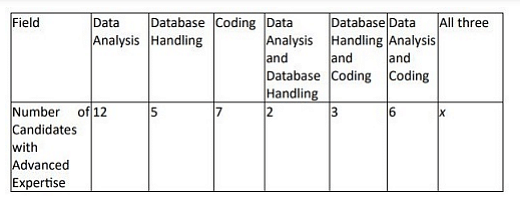
The number of applicants with advanced expertise in all three fields is given as x in the table, where x is a non-negative integer.
- XAT - 2024
- Data Interpretation