Read the following situation and choose the best possible alternative.
Seema was a finance manager at an MNC and felt that gender discrimination at her workplace was slowing down her career. Frustrated, she quit her job and started her own company. When she started the company, Seema decided to keep an equal number of male and female employees. Over the last six years, Seema has become a very successful entrepreneur and has grown her business to eight locations across the country. Recently, however, Seema has run into an ethical problem: many of her female employees are not willing to travel between cities or work late hours, even though the job needs this, while her male employees do this without hesitation. Seema is now under pressure to reduce the number of female employees, but she also knows that hiring equal numbers of men and women was one of the strongest reasons she started the company in the first place. What should she do as a responsible woman entrepreneur?
Seema was a finance manager at an MNC and felt that gender discrimination at her workplace was slowing down her career. Frustrated, she quit her job and started her own company. When she started the company, Seema decided to keep an equal number of male and female employees. Over the last six years, Seema has become a very successful entrepreneur and has grown her business to eight locations across the country. Recently, however, Seema has run into an ethical problem: many of her female employees are not willing to travel between cities or work late hours, even though the job needs this, while her male employees do this without hesitation. Seema is now under pressure to reduce the number of female employees, but she also knows that hiring equal numbers of men and women was one of the strongest reasons she started the company in the first place. What should she do as a responsible woman entrepreneur?
Show Hint
- Check whether the unwilling female employees can be given roles that do not need travel and involve less overtime.
- Reduce the number of female employees since it has become a business need, without letting this concern affect her decision.
- Let the current situation continue exactly as it is.
- Hire only male employees from now on.
The Correct Option is A
Solution and Explanation
Think of this less as a men-versus-women staffing question and more as a role-fit problem: certain employees, who happen to currently be some of the female staff, cannot take on travel-heavy, late-hour assignments, while the company still needs those assignments covered.
- Reduce the number of female employees: this treats gender as the cause of the problem, when the real cause is that specific roles need travel and overtime that specific employees cannot manage. It also throws away Seema's founding goal of equal representation.
- Let the status quo continue: doing nothing keeps forcing employees into roles they cannot fulfil, which will keep creating friction and does not actually solve anything.
- Hire only male employees going forward: this permanently shuts out an entire gender from future hiring because of a scheduling mismatch affecting only some current staff, which is a far bigger and more unfair step than the problem calls for.
Instead, the sensible fix is to separate the who from the what: keep the equal male-female hiring policy exactly as it is, but rearrange which employees do which job. Employees, of any gender, who cannot travel or work late can be shifted into roles or locations that do not need this, while roles that do need travel and overtime can be filled by whoever, male or female, is able and willing to do them.
Let's summarize:
- The real problem is a mismatch between certain roles and certain employees' availability, not a flaw in hiring equal numbers of men and women.
- Reducing female headcount or hiring only men solves nothing and undoes Seema's founding principle.
- Reassigning unwilling employees to roles without heavy travel or overtime keeps the policy intact and fixes the actual problem.
So Seema should see if the unwilling female employees can be given assignments that do not need travel and involve less overtime, which is option 1.
Top Questions on Analytical Decision Making
- Tech predictions often fail not because of wrong models or a lack of imagination, but due to lack of humility in admitting our uncertainty about the future.( Maximum 250 words )
- XAT - 2024
- Decision Making
- Analytical Decision Making
- There’s a community 30 km outside of the main city. Mr. S started a grocery business in the community after winning the bid by offering way above the rent initially drafted by the community council. The community council, led by Mr. D, agreed to the offer with a performance review every three years. Mr. S also agreed to provide an additional 15% of his grocery sales to the council, banking on the prospect of selling in higher volumes. After setting up his business, Mr. S noticed that SUV owners in the community usually bought goods in bulk from the city once a week and used his store primarily for daily necessities and occasional big purchases like mixer grinders.
- XAT - 2025
- Decision Making
- Analytical Decision Making
- Arya, a graduate from a reputable institute, got a job in an IT company but became bored after a year. Her best friend S, who worked at the same company, joined a top-tier B-school for an MBA, which tempted Arya to pursue the same path. Her friend assured her that an MBA would boost her career prospects and salary. Arya started preparing for an MBA while continuing her job, but the challenge of balancing preparation with work made her consider leaving the job.
- XAT - 2025
- Decision Making
- Analytical Decision Making
- A person suffering from Aichmophobia is most likely to be afraid of which of the following object?
- MAH MBA CET - 2025
- General Awareness
- Analytical Decision Making
- Want to practice more? Try solving extra ecology questions todayView All Questions
Questions Asked in XAT exam
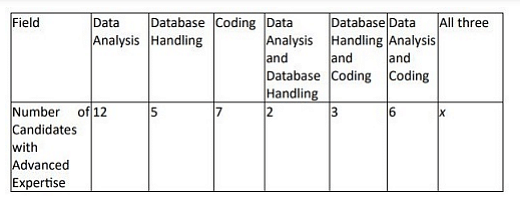
The number of applicants with advanced expertise in all three fields is given as x in the table, where x is a non-negative integer.
- XAT - 2024
- Data Interpretation