Question:medium
Reaction of \(\mathrm{PtF_6}\) with oxygen \((\mathrm{O_2})\) gas results in the formation of an ionic compound, \(X^+Y^-\). Correct statement(s) is(are)
Reaction of \(\mathrm{PtF_6}\) with oxygen \((\mathrm{O_2})\) gas results in the formation of an ionic compound, \(X^+Y^-\). Correct statement(s) is(are)
Show Hint
The product is O2+ PtF6-. O2+ has bond order 2.5, platinum is Pt(V) with 5 d electrons, and PtF6 oxidises oxygen.
Updated On: Nov 19, 2026
- The bond order of \(X^+\) is \(1.5\).
- Valence \(d\)-orbitals of the metal ion in \(X^+Y^-\) has \(5\) electrons.
- \(\mathrm{PtF_6}\) acts as an oxidant in this reaction.
- \(\mathrm{PtF_6}\) acts as a fluorinating agent in this reaction.
Show Solution
The Correct Option is B, C
Solution and Explanation
Step 1: Electron transfer view:
The electron affinity of $\mathrm{PtF_6}$ is large, and the ionisation energy of $\mathrm{O_2}$ is about $12.07\ \mathrm{eV}$.
The lattice energy of the ionic solid makes up the difference, so one electron moves from $\mathrm{O_2}$ to $\mathrm{PtF_6}$.
This gives the salt $\mathrm{O_2^+PtF_6^-}$.
Step 2: Count d electrons first:
The anion $\mathrm{PtF_6^-}$ has Pt in the $+5$ state. Platinum has $10$ valence electrons in $5d^9\,6s^1$.
Pt(V) has lost five of them, leaving $10 - 5 = 5$ electrons, all in d orbitals. So (B) is TRUE.
Step 3: Roles of PtF6:
Gaining an electron is reduction, so $\mathrm{PtF_6}$ is the oxidising agent. (C) is TRUE.
A fluorinating agent would hand over F to the other substance. Here no $\mathrm{O-F}$ bond forms. (D) is FALSE.
Step 4: Bond order of the cation:
Taking an electron out of $\mathrm{O_2}$ comes from an antibonding $\pi^*$ orbital.
$\mathrm{O_2}$ has bond order $2$. Losing one $\pi^*$ electron raises it by $\tfrac{1}{2}$, giving $2.5$.
So (A), which says $1.5$, is FALSE.
Final Answer:
The correct options are (B) and (C). \[ \boxed{\text{B, C}} \]
Was this answer helpful?
0
Top Questions on Group 15 Elements
- The maximum covalency of a non-metallic group 15 element 'E' with the weakest E-E bond is:
- JEE Main - 2025
- Chemistry
- Group 15 Elements
- (a) Baryte,
(b) Galena,
(c) Zinc blende and
(d) Copper pyrites.
How many of these minerals are sulphide based?- JEE Main - 2022
- Chemistry
- Group 15 Elements
- The correct order of the oxidation states of nitrogen in $NO, N_2O, NO_2$ and $N_2 O_3$ is :
- JEE Main - 2019
- Chemistry
- Group 15 Elements
- An organic compound $'A'$ is oxidized with ${Na2O2}$ followed by boiling with ${HNO3}$. The resultant solution is then treated with ammonium molybdate to yield a yellow precipitate. Based on above observation, the element present in the given compound is :
- JEE Main - 2019
- Chemistry
- Group 15 Elements
- Want to practice more? Try solving extra ecology questions todayView All Questions
Questions Asked in JEE Advanced exam
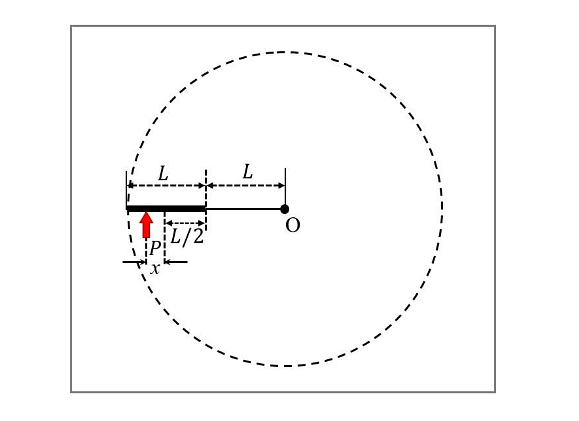
A thin uniform rod of length L and certain mass is kept on a frictionless horizontal table with a massless string of length L fixed to one end (top view is shown in the figure). The other end of the string is pivoted to a point O. If a horizontal impulse P is imparted to the rod at a distance x = L/n from the mid-point of the rod (see figure), then the rod and string revolve together around the point O, with the rod remaining aligned with the string. In such a case, the value of n is _____.
- JEE Advanced - 2024
- Friction