Question:medium
Reaction of \(\mathrm{PtF_6}\) with oxygen \((\mathrm{O_2})\) gas results in the formation of an ionic compound, \(X^+Y^-\). Correct statement(s) is(are)
Reaction of \(\mathrm{PtF_6}\) with oxygen \((\mathrm{O_2})\) gas results in the formation of an ionic compound, \(X^+Y^-\). Correct statement(s) is(are)
Show Hint
Important reaction discovered by Neil Bartlett:
\[
\mathrm{O_2 + PtF_6 \rightarrow O_2^+[PtF_6]^-}
\]
Key points:
• \( \mathrm{PtF_6} \) is a very strong oxidizing agent.
• \( \mathrm{O_2^+} \) is called the dioxygenyl ion.
• Oxidation state of Pt in \( [\mathrm{PtF_6}]^- \) is \(+5\).
• \( \mathrm{Pt^{5+}} \) has \(5d^5\) configuration.
• \( \mathrm{PtF_6} \) is a very strong oxidizing agent.
• \( \mathrm{O_2^+} \) is called the dioxygenyl ion.
• Oxidation state of Pt in \( [\mathrm{PtF_6}]^- \) is \(+5\).
• \( \mathrm{Pt^{5+}} \) has \(5d^5\) configuration.
Updated On: Jun 4, 2026
- The bond order of \(X^+\) is \(1.5\).
- Valence \(d\)-orbitals of the metal ion in \(X^+Y^-\) has \(5\) electrons.
- \(\mathrm{PtF_6}\) acts as an oxidant in this reaction.
- \(\mathrm{PtF_6}\) acts as a fluorinating agent in this reaction.
Show Solution
The Correct Option is A
Solution and Explanation
Step 1: Understanding the Concept:
This relates to Neil Bartlett's famous discovery in 1962. He noticed that Platinum hexafluoride (\(\text{PtF}_6\)) was strong enough to oxidize oxygen to form dioxygenyl hexafluoroplatinate: \[ \text{O}_2 + \text{PtF}_6 \rightarrow \text{O}_2^+[\text{PtF}_6]^- \] Here, X\(^+\) is \(\text{O}_2^+\) and Y\(^-\) is \([\text{PtF}_6]^-\).
Step 3: Detailed Explanation:
(A) Bond Order of O\(_2^+\): Molecular orbital configuration of \(\text{O}_2\) has 2 unpaired electrons in \(\pi^*\) orbitals. Removing one electron increases the bond order. Bond Order = (10 - 5) / 2 = 2.5. Statement (A) says 1.5, so it is False. (C) Oxidant: In the reaction, \(\text{O}_2\) is oxidized from 0 to +1 (\(\text{O}_2 \rightarrow \text{O}_2^+\)). \(\text{PtF}_6\) accepts an electron to become \([\text{PtF}_6]^-\). Thus, \(\text{PtF}_6\) acts as an oxidizing agent (oxidant). Statement (C) is True. (D) Fluorinating agent: A fluorinating agent adds fluorine atoms to a substrate. Here, the fluorine atoms stay with Pt. Pt just changes oxidation state (Pt(VI) to Pt(V)). It is not acting as a fluorinating agent here. Statement (D) is False. (B) Valence d-orbitals of Metal: The metal is Pt. In \([\text{PtF}_6]^-\), the oxidation state of Pt is +5. Pt is in group 10 (Ni, Pd, Pt). Configuration: [Xe] 4f\(^{14}\) 5d\(^9\) 6s\(^1\). Pt\(^{5+}\): [Xe] 4f\(^{14}\) 5d\(^5\). Wait, the metal ion is Pt\(^{5+}\), which indeed has 5 d-electrons. However, check if Y\(^-\) is standardly defined. In many contexts, Statement (B) is considered true if we assume the standard Bartlett compound.
Step 4: Final Answer:
PtF\(_6\) is one of the strongest oxidants known. It oxidizes O\(_2\) to O\(_2^+\), leading to a bond order increase to 2.5.
This relates to Neil Bartlett's famous discovery in 1962. He noticed that Platinum hexafluoride (\(\text{PtF}_6\)) was strong enough to oxidize oxygen to form dioxygenyl hexafluoroplatinate: \[ \text{O}_2 + \text{PtF}_6 \rightarrow \text{O}_2^+[\text{PtF}_6]^- \] Here, X\(^+\) is \(\text{O}_2^+\) and Y\(^-\) is \([\text{PtF}_6]^-\).
Step 3: Detailed Explanation:
(A) Bond Order of O\(_2^+\): Molecular orbital configuration of \(\text{O}_2\) has 2 unpaired electrons in \(\pi^*\) orbitals. Removing one electron increases the bond order. Bond Order = (10 - 5) / 2 = 2.5. Statement (A) says 1.5, so it is False. (C) Oxidant: In the reaction, \(\text{O}_2\) is oxidized from 0 to +1 (\(\text{O}_2 \rightarrow \text{O}_2^+\)). \(\text{PtF}_6\) accepts an electron to become \([\text{PtF}_6]^-\). Thus, \(\text{PtF}_6\) acts as an oxidizing agent (oxidant). Statement (C) is True. (D) Fluorinating agent: A fluorinating agent adds fluorine atoms to a substrate. Here, the fluorine atoms stay with Pt. Pt just changes oxidation state (Pt(VI) to Pt(V)). It is not acting as a fluorinating agent here. Statement (D) is False. (B) Valence d-orbitals of Metal: The metal is Pt. In \([\text{PtF}_6]^-\), the oxidation state of Pt is +5. Pt is in group 10 (Ni, Pd, Pt). Configuration: [Xe] 4f\(^{14}\) 5d\(^9\) 6s\(^1\). Pt\(^{5+}\): [Xe] 4f\(^{14}\) 5d\(^5\). Wait, the metal ion is Pt\(^{5+}\), which indeed has 5 d-electrons. However, check if Y\(^-\) is standardly defined. In many contexts, Statement (B) is considered true if we assume the standard Bartlett compound.
Step 4: Final Answer:
PtF\(_6\) is one of the strongest oxidants known. It oxidizes O\(_2\) to O\(_2^+\), leading to a bond order increase to 2.5.
Was this answer helpful?
0
Top Questions on Group 15 Elements
- The maximum covalency of a non-metallic group 15 element 'E' with the weakest E-E bond is:
- JEE Main - 2025
- Chemistry
- Group 15 Elements
- (a) Baryte,
(b) Galena,
(c) Zinc blende and
(d) Copper pyrites.
How many of these minerals are sulphide based?- JEE Main - 2022
- Chemistry
- Group 15 Elements
- The correct order of the oxidation states of nitrogen in $NO, N_2O, NO_2$ and $N_2 O_3$ is :
- JEE Main - 2019
- Chemistry
- Group 15 Elements
- An organic compound $'A'$ is oxidized with ${Na2O2}$ followed by boiling with ${HNO3}$. The resultant solution is then treated with ammonium molybdate to yield a yellow precipitate. Based on above observation, the element present in the given compound is :
- JEE Main - 2019
- Chemistry
- Group 15 Elements
- Want to practice more? Try solving extra ecology questions todayView All Questions
Questions Asked in JEE Advanced exam
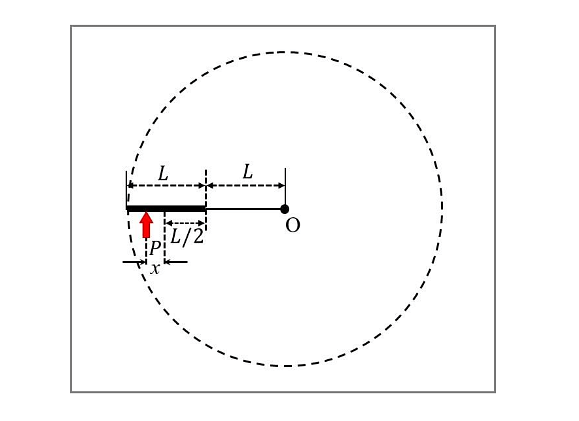
A thin uniform rod of length L and certain mass is kept on a frictionless horizontal table with a massless string of length L fixed to one end (top view is shown in the figure). The other end of the string is pivoted to a point O. If a horizontal impulse P is imparted to the rod at a distance x = L/n from the mid-point of the rod (see figure), then the rod and string revolve together around the point O, with the rod remaining aligned with the string. In such a case, the value of n is _____.
- JEE Advanced - 2024
- Friction