Question:hard
(Questions 115 to 117): The year 2004 was a great year for Top-Cloth cotton mill. Manufacturing towels for the export market and employing more than 2000 workers, the company had an impressive growth in sales and profits. The Chairman felt that employees were entitled to a share in the profits, and it was proposed that the employee mess be air-conditioned. The proposal was discussed in a meeting attended by, among other senior officials, the marketing director, the personnel director and the finance director. The proposal was based on the fact that the shop floor of the mill often had temperatures in excess of 40 degrees C with a relative humidity of 99%. The air-conditioned mess would represent management's appreciation of the employees' hard work.
At the end of 2005, management reviewed the mill's performance. Profits were higher, and employee attrition was negligible. The Chairman decided that employees deserved additional recognition for their fine work. Since the mess had already been air-conditioned, the Chairman wanted to know if the employees appreciated this sort of action. In the course of discussion, the Chairman asked the personnel director to send a questionnaire to a sample of fifty employees and obtain their reaction to the air-conditioned mess. The management agreed to decide only after obtaining the feedback from the employees.
The personnel director mailed a simple form to fifty employees, asking them for the following information: "Please state your reaction to the air-conditioned mess." Of the fifty forms mailed, forty-six were returned. The answers received were as follows:
Reaction Frequency "I did not know it was air-conditioned." 16 "I never eat there" 8 "If management can spend money like that, they should pay us more" 6 "I wish the entire mill was air-conditioned." 8 "The mess is for management employees." 4 "It is OK." 2 Miscellaneous comments 2
116. Management of Top-Cloth cotton mill considers itself to be socially conscious, and its decisions are often re-examined for their social relevance and their impact on society. In view of this consideration, what could have been considered before deciding on profit sharing?
A. communicating management's intentions via employee newsletters
B. taking employees' inputs in designing the cafeteria's interiors and installation of air-conditioning
C. considering employees' views on different ways of sharing excess profits
D. investing in capacity expansion to take care of the booming export market
E. dividing the profits equally among the workers and shareholders
The options in decreasing order of their impact on society:
(Questions 115 to 117): The year 2004 was a great year for Top-Cloth cotton mill. Manufacturing towels for the export market and employing more than 2000 workers, the company had an impressive growth in sales and profits. The Chairman felt that employees were entitled to a share in the profits, and it was proposed that the employee mess be air-conditioned. The proposal was discussed in a meeting attended by, among other senior officials, the marketing director, the personnel director and the finance director. The proposal was based on the fact that the shop floor of the mill often had temperatures in excess of 40 degrees C with a relative humidity of 99%. The air-conditioned mess would represent management's appreciation of the employees' hard work.
At the end of 2005, management reviewed the mill's performance. Profits were higher, and employee attrition was negligible. The Chairman decided that employees deserved additional recognition for their fine work. Since the mess had already been air-conditioned, the Chairman wanted to know if the employees appreciated this sort of action. In the course of discussion, the Chairman asked the personnel director to send a questionnaire to a sample of fifty employees and obtain their reaction to the air-conditioned mess. The management agreed to decide only after obtaining the feedback from the employees.
The personnel director mailed a simple form to fifty employees, asking them for the following information: "Please state your reaction to the air-conditioned mess." Of the fifty forms mailed, forty-six were returned. The answers received were as follows:
116. Management of Top-Cloth cotton mill considers itself to be socially conscious, and its decisions are often re-examined for their social relevance and their impact on society. In view of this consideration, what could have been considered before deciding on profit sharing?
A. communicating management's intentions via employee newsletters
B. taking employees' inputs in designing the cafeteria's interiors and installation of air-conditioning
C. considering employees' views on different ways of sharing excess profits
D. investing in capacity expansion to take care of the booming export market
E. dividing the profits equally among the workers and shareholders
The options in decreasing order of their impact on society:
At the end of 2005, management reviewed the mill's performance. Profits were higher, and employee attrition was negligible. The Chairman decided that employees deserved additional recognition for their fine work. Since the mess had already been air-conditioned, the Chairman wanted to know if the employees appreciated this sort of action. In the course of discussion, the Chairman asked the personnel director to send a questionnaire to a sample of fifty employees and obtain their reaction to the air-conditioned mess. The management agreed to decide only after obtaining the feedback from the employees.
The personnel director mailed a simple form to fifty employees, asking them for the following information: "Please state your reaction to the air-conditioned mess." Of the fifty forms mailed, forty-six were returned. The answers received were as follows:
| Reaction | Frequency |
|---|---|
| "I did not know it was air-conditioned." | 16 |
| "I never eat there" | 8 |
| "If management can spend money like that, they should pay us more" | 6 |
| "I wish the entire mill was air-conditioned." | 8 |
| "The mess is for management employees." | 4 |
| "It is OK." | 2 |
| Miscellaneous comments | 2 |
116. Management of Top-Cloth cotton mill considers itself to be socially conscious, and its decisions are often re-examined for their social relevance and their impact on society. In view of this consideration, what could have been considered before deciding on profit sharing?
A. communicating management's intentions via employee newsletters
B. taking employees' inputs in designing the cafeteria's interiors and installation of air-conditioning
C. considering employees' views on different ways of sharing excess profits
D. investing in capacity expansion to take care of the booming export market
E. dividing the profits equally among the workers and shareholders
The options in decreasing order of their impact on society:
Show Hint
Rank each action by how many people it reaches and how directly it changes real economic outcomes, such as money or jobs, versus just comfort or one-way communication.
Updated On: Jul 13, 2026
- B, C, E, D, A
- D, E, C, B, A
- C, B, A, D, E
- E, D, C, B, A
Show Solution
The Correct Option is D
Solution and Explanation
This is a judgement-ranking question, so instead of chasing a single provable fact, we weigh each action on two yardsticks: how many people it reaches, and how directly it changes real economic outcomes rather than just comfort or communication.
- E, dividing profits equally among workers and shareholders: puts real money directly into the hands of a large group of stakeholders. This is the biggest, most direct social effect.
- D, investing in capacity expansion for the export market: grows jobs, supplier business and the local economy at scale, a strong but slightly less direct effect than handing out money.
- C, asking employees' views on sharing the profits: gives employees real say over their own economic benefit, but it only reaches the mill's own staff, a narrower group than D's ripple effect on the wider economy.
- B, employee input on cafeteria interiors and air-conditioning: is consultation too, but about comfort and interior design, a much smaller stake than a share of profit.
- A, communicating intentions via newsletters: is one-way information with no real change to anyone's circumstances, so it carries the least social weight.
Lining these up from the biggest effect to the smallest gives E first, then D, then C, then B, and finally A.
Let's summarize:
- Direct money to a broad group, E, outweighs indirect economic growth, D.
- Consultation on profit-sharing, C, outweighs consultation on cafeteria comfort, B.
- One-way communication, A, carries the least social weight of all five.
So the decreasing order of social impact is E, D, C, B, A.
Was this answer helpful?
0
Top Questions on Analytical Decision Making
- Tech predictions often fail not because of wrong models or a lack of imagination, but due to lack of humility in admitting our uncertainty about the future.( Maximum 250 words )
- XAT - 2024
- Decision Making
- Analytical Decision Making
- There’s a community 30 km outside of the main city. Mr. S started a grocery business in the community after winning the bid by offering way above the rent initially drafted by the community council. The community council, led by Mr. D, agreed to the offer with a performance review every three years. Mr. S also agreed to provide an additional 15% of his grocery sales to the council, banking on the prospect of selling in higher volumes. After setting up his business, Mr. S noticed that SUV owners in the community usually bought goods in bulk from the city once a week and used his store primarily for daily necessities and occasional big purchases like mixer grinders.
- XAT - 2025
- Decision Making
- Analytical Decision Making
- Arya, a graduate from a reputable institute, got a job in an IT company but became bored after a year. Her best friend S, who worked at the same company, joined a top-tier B-school for an MBA, which tempted Arya to pursue the same path. Her friend assured her that an MBA would boost her career prospects and salary. Arya started preparing for an MBA while continuing her job, but the challenge of balancing preparation with work made her consider leaving the job.
- XAT - 2025
- Decision Making
- Analytical Decision Making
- A person suffering from Aichmophobia is most likely to be afraid of which of the following object?
- MAH MBA CET - 2025
- General Awareness
- Analytical Decision Making
- Want to practice more? Try solving extra ecology questions todayView All Questions
Questions Asked in XAT exam
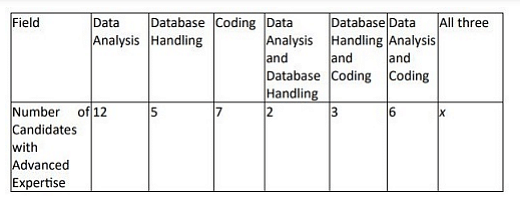
Applicants have been shortlisted for interviews for some data analyst positions. Some of the applicants have advanced expertise in one or more fields among the following: data analysis, database handling and coding. The numbers of applicants with different advanced expertise are given in the 2 × 8 table below.
The number of applicants with advanced expertise in all three fields is given as x in the table, where x is a non-negative integer.
The number of applicants with advanced expertise in all three fields is given as x in the table, where x is a non-negative integer.
- XAT - 2024
- Data Interpretation