(Questions 115 to 117): The year 2004 was a great year for Top-Cloth cotton mill. Manufacturing towels for the export market and employing more than 2000 workers, the company had an impressive growth in sales and profits. The Chairman felt that employees were entitled to a share in the profits, and it was proposed that the employee mess be air-conditioned. The proposal was discussed in a meeting attended by, among other senior officials, the marketing director, the personnel director and the finance director. The proposal was based on the fact that the shop floor of the mill often had temperatures in excess of 40 degrees C with a relative humidity of 99%. The air-conditioned mess would represent management's appreciation of the employees' hard work.
At the end of 2005, management reviewed the mill's performance. Profits were higher, and employee attrition was negligible. The Chairman decided that employees deserved additional recognition for their fine work. Since the mess had already been air-conditioned, the Chairman wanted to know if the employees appreciated this sort of action. In the course of discussion, the Chairman asked the personnel director to send a questionnaire to a sample of fifty employees and obtain their reaction to the air-conditioned mess. The management agreed to decide only after obtaining the feedback from the employees.
The personnel director mailed a simple form to fifty employees, asking them for the following information: "Please state your reaction to the air-conditioned mess." Of the fifty forms mailed, forty-six were returned. The answers received were as follows:
Reaction Frequency "I did not know it was air-conditioned." 16 "I never eat there" 8 "If management can spend money like that, they should pay us more" 6 "I wish the entire mill was air-conditioned." 8 "The mess is for management employees." 4 "It is OK." 2 Miscellaneous comments 2
115. The main conclusion(s) about the personnel director that emerge(s) from this situation is(are):
A. The personnel director did not have the competence to manage an employee feedback survey, and should have been given the task to a professional consultant.
B. The personnel director was responsible for employees' reactions.
C. The personnel director had failed in his duty of maintaining constant touch with employees.
D. The cost of air-conditioning is a waste, since its beneficiaries did not feel any benefit.
At the end of 2005, management reviewed the mill's performance. Profits were higher, and employee attrition was negligible. The Chairman decided that employees deserved additional recognition for their fine work. Since the mess had already been air-conditioned, the Chairman wanted to know if the employees appreciated this sort of action. In the course of discussion, the Chairman asked the personnel director to send a questionnaire to a sample of fifty employees and obtain their reaction to the air-conditioned mess. The management agreed to decide only after obtaining the feedback from the employees.
The personnel director mailed a simple form to fifty employees, asking them for the following information: "Please state your reaction to the air-conditioned mess." Of the fifty forms mailed, forty-six were returned. The answers received were as follows:
| Reaction | Frequency |
|---|---|
| "I did not know it was air-conditioned." | 16 |
| "I never eat there" | 8 |
| "If management can spend money like that, they should pay us more" | 6 |
| "I wish the entire mill was air-conditioned." | 8 |
| "The mess is for management employees." | 4 |
| "It is OK." | 2 |
| Miscellaneous comments | 2 |
115. The main conclusion(s) about the personnel director that emerge(s) from this situation is(are):
A. The personnel director did not have the competence to manage an employee feedback survey, and should have been given the task to a professional consultant.
B. The personnel director was responsible for employees' reactions.
C. The personnel director had failed in his duty of maintaining constant touch with employees.
D. The cost of air-conditioning is a waste, since its beneficiaries did not feel any benefit.
Show Hint
- B only
- C only
- D only
- A, C and D
The Correct Option is D
Solution and Explanation
The question is testing whether we can separate a conclusion that is genuinely backed by the case facts from one that merely sounds reasonable. Let's check each of the four statements against the actual numbers and events in the passage.
- A (lacked competence, should have used a consultant): the whole survey was one vague open line mailed to fifty people. The scattered results, ranging from "didn't know" to "never eat there" to "pay us more instead", show the question was not designed to get a clear, usable answer. That points to a real competence gap, so A holds up.
- B (responsible for employees' reactions): the reactions belong to the employees; they are reporting their own views and habits, not reacting to something the director personally did to them. Blaming the director for the content of employees' opinions is not supported by the passage, so B does not hold.
- C (failed to stay in touch with employees): sixteen of the forty-six respondents, over a third, said they did not even know the mess was air-conditioned. A director who was genuinely in regular contact with staff would not have such a large information gap. This is direct evidence for C.
- D (the air-conditioning cost was a waste): almost nobody in the responses reported real appreciation; only two said "it is OK", while most either were unaware, did not use the mess, or thought the money should have gone into pay instead. So the spending did not land as a felt benefit, supporting D.
Three of the four statements, A, C and D, are backed by the facts in the passage; B is not, because it misattributes ownership of the employees' own opinions to the director.
Let's summarize:
- A holds because the survey design itself was weak.
- C holds because a third of respondents were unaware of the change, showing a communication gap.
- D holds because the responses show little real appreciation of the benefit.
- B fails because it wrongly makes the director responsible for employees' personal reactions.
So the correct set of conclusions is A, C and D.
Top Questions on Statements and Conclusions
- In this question, there are three statements followed by conclusions numbered I and II. You have to take the given statements to be true even if they seem to be at variance from commonly known facts and then decide which of the given conclusions logically follow from the three statements.
Statements:- All books are ledgers.
- All pens are keys.
- Some pens are books.
- I. Some ledgers are keys.
- II. Some keys are books.
- VITEEE - 2024
- General Aptitude
- Statements and Conclusions
Humane Dynamix is a leadership training organization based in Mumbai. Established in 2015, the organization is gradually becoming a leader in behavioral training. In the organization, trainers are assigned to training projects based on their expertise. Corporates seek behavioral training services on a regular basis, from Humane Dynamix, for upskilling their executives. Humane Dynamix is headed by the Chief Executive Officer (CEO), to whom the Training Assignment Officer (TAO) reports. The TAO position rotates among the senior trainers for a fixed tenure; the CEO assigns this position to a senior trainer.
Companies, desirous of hiring Humane Dynamix, share their training needs with the organization. The TAO assigns a trainer to the client. Typically, the satisfied client requests for a particular trainer that the client is satisfied, giving repeat business to Humane Dynamix from the same client company. However, the TAO takes the nal call. Years of training experience plays a big role in client satisfaction, and hence, senior trainers conduct most training programs while the newly recruited trainers apprentice with them. However, the senior trainers have the autonomy to decide on who they want to accept as an apprentice..
Further, during a training program, the senior trainer takes most of the sessions, if not all, while the apprentice helps the senior trainers to organize their sessions, and occasionally take a few sessions. As the apprentices gain experience, they start getting their own independent projects, but that typically takes quite some time..
Dheeraj, a senior trainer, takes over as the TAO. As soon as he assumes the office, the CEO shares a concern with him: “We have a lot of young trainers who we have recently recruited. Since they are not known to the outside world, they do not get enough opportunities. Many of them are impatient to prove their mettle. Unless they are assigned more programs, we risk losing them rapidly.”- XAT - 2025
- Decision Making
- Statements and Conclusions
In the given question, a statement is given followed by some conclusions. Choose the conclusion(s) which logically follow(s) the given statement.
Statement: Few shops on this road have neon lights, but they all have signboards.
Conclusions:
I. Some shops have either signboards.
II. Some shops have no signboards.
III. Some shops have no neon lights.
IV. Some shops have both signboards and neon lights.- CUET (UG) - 2024
- General Aptitude
- Statements and Conclusions
Take the given statements to be true even if they seem to be at variance with commonly known facts. Then decide which of the given conclusions logically follow the given statements.
Statements:- 0% chairs are tables.
- All computers are chairs.
- Some books are tables.
Conclusions:
- Not a single table is a computer.
- Some books are not chairs.
- CUET (UG) - 2024
- General Aptitude
- Statements and Conclusions
- Want to practice more? Try solving extra ecology questions todayView All Questions
Questions Asked in XAT exam
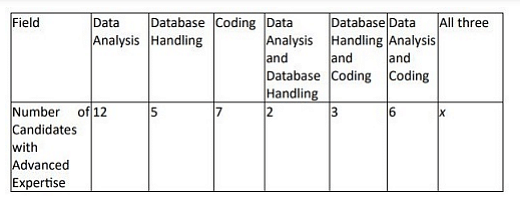
The number of applicants with advanced expertise in all three fields is given as x in the table, where x is a non-negative integer.
- XAT - 2024
- Data Interpretation