Humane Dynamix is a leadership training organization based in Mumbai. Established in 2015, the organization is gradually becoming a leader in behavioral training. In the organization, trainers are assigned to training projects based on their expertise. Corporates seek behavioral training services on a regular basis, from Humane Dynamix, for upskilling their executives. Humane Dynamix is headed by the Chief Executive Officer (CEO), to whom the Training Assignment Officer (TAO) reports. The TAO position rotates among the senior trainers for a fixed tenure; the CEO assigns this position to a senior trainer.
Companies, desirous of hiring Humane Dynamix, share their training needs with the organization. The TAO assigns a trainer to the client. Typically, the satisfied client requests for a particular trainer that the client is satisfied, giving repeat business to Humane Dynamix from the same client company. However, the TAO takes the nal call. Years of training experience plays a big role in client satisfaction, and hence, senior trainers conduct most training programs while the newly recruited trainers apprentice with them. However, the senior trainers have the autonomy to decide on who they want to accept as an apprentice..
Further, during a training program, the senior trainer takes most of the sessions, if not all, while the apprentice helps the senior trainers to organize their sessions, and occasionally take a few sessions. As the apprentices gain experience, they start getting their own independent projects, but that typically takes quite some time..
Dheeraj, a senior trainer, takes over as the TAO. As soon as he assumes the office, the CEO shares a concern with him: “We have a lot of young trainers who we have recently recruited. Since they are not known to the outside world, they do not get enough opportunities. Many of them are impatient to prove their mettle. Unless they are assigned more programs, we risk losing them rapidly.”
Dheeraj knows that his senior colleagues are very good at training, and, hence, they conduct most of the training programs. They keep the clients satisfied, and consequently, bring repeat business. However, as asked by the CEO, Dheeraj needs to do something to enable the young trainers to get more opportunities and increase their training engagements.
Which of the following options should Dheeraj execute to BEST enable the young trainers to get more training opportunities, without affecting their relationships with the client companies?
Show Hint
- Dheeraj should mandate that the senior trainers must allow the young trainers to take at least thirty percent of their training sessions.
- Dheeraj should request the repeat clients to switch to the services of the young trainers who bring a lot of energy to their sessions.
- Dheeraj should assign some of the repeat projects from the satisfied clients with particular senior trainers to the young trainers.
- Dheeraj should request the CEO to urge the senior colleagues in giving up some of their existing clients in the interest of others' careers.
- Dheeraj should explore for those clients who would be comfortable working with the young trainers.
The Correct Option is C
Solution and Explanation
The objective is to increase training opportunities for junior trainers without negatively impacting the client relationships held by senior trainers. Dheeraj requires a solution that benefits both junior trainers and the established client base.
Step 2: Option Evaluation.
- Option A: Mandating a specific percentage of sessions for junior trainers could foster friction between senior and junior trainers and potentially decrease service quality due to senior trainers feeling compelled to relinquish sessions. - Option B: Requesting repeat clients to transition to younger trainers risks damaging established relationships. Clients may react negatively to abrupt changes, leading to alienation and potential business harm. - Option C: Allocating repeat projects from satisfied clients to junior trainers, with continued senior trainer involvement, enables junior trainers to gain experience without compromising client relationships. Senior trainers' expertise remains leveraged, providing junior trainers with needed opportunities, thereby achieving a balance. - Option D: Involving the CEO to pressure senior trainers into relinquishing existing clients for junior trainers could result in dissatisfaction and resentment, potentially damaging internal long-term relationships. - Option E: Identifying clients willing to work with junior trainers is a valid consideration but does not address the immediate need for junior trainers to gain experience through existing client relationships.
Step 3: Solution Implementation.
Option C offers the most balanced and sustainable strategy. By assigning a portion of repeat projects to junior trainers, while ensuring client relationships are maintained, Dheeraj can facilitate junior trainer experience acquisition without undermining senior trainers or negatively impacting business operations.
Final Answer: \[\boxed{\text{C}}\]
Dheeraj decided to assign some of the repeat clients, at random, to their young trainers, to address the concerns of the CEO. Many young trainers appreciated him for giving them more opportunities.
Sudha Iyer, a senior trainer, popular for her training programs in “Deceptive Communication Methods,” was surprised to see that some of her long-standing clients were assigned to a young person. She was concerned that the clients would feel shortchanged. Moreover, she was chagrined that she was not even consulted. This led to the reduction in her number of training hours.
Since Humane Dynamix incentivizes trainers who cross a mandated number of training hours every year, Sudha was also concerned about her possible revenue loss.
Sudha wanted Dheeraj to stop assigning established clients to the young trainers.
Which of the following actions would BEST help Sudha to stop Dheeraj from assigning her programs to the young trainers?
Show Hint
- She should propose training the young trainers in her innovative methods so that they become independent in future.
- She should confront the CEO and share that his concerns should not be addressed at the cost of her revenues.
- She should share with Dheeraj that assigning her client companies to novice trainers will lead to loss of those clients.
- She should approach the CEO and request that Dheeraj be removed from his role as the TAO.
- She should contact the client companies and ask them to reject Dheeraj’s assigned trainers.
The Correct Option is C
Solution and Explanation
Sudha is concerned about client attrition, reduced training hours, and financial loss resulting from Dheeraj's independent decision. She feels excluded and unappreciated due to a lack of consultation. Her concerns encompass both client satisfaction and personal financial impact.
Step 2: Evaluate each option.
- Option A: While training new trainers is beneficial long-term, it does not address Sudha’s immediate issues of client and revenue loss. It is a future solution, not an present one. - Option B: A confrontational approach with the CEO could negatively affect Sudha’s professional reputation and frame the issue as personal gain versus company interest, weakening her position. - Option C: Informing Dheeraj about the business risk of client dissatisfaction with inexperienced trainers is a logical, business-focused argument. This aligns her concerns with organizational objectives, enhancing persuasiveness. - Option D: Requesting the CEO to dismiss Dheeraj is an extreme measure unlikely to be accepted and could damage her credibility and professional relationships. - Option E: Directly contacting clients to reject trainers would disrupt the organizational hierarchy, appearing unprofessional and disloyal, potentially harming her reputation more than benefiting it.
Step 3: Select the best solution.
Option C offers a rational, professional, and business-aligned strategy. By focusing on the risk to client retention and company reputation, rather than her personal losses, Sudha can present a more compelling case to Dheeraj and leadership.
Final Answer: \[\boxed{\text{C}}\]
Dheeraj assigned a repeat client of Nandini Hegde, another very senior trainer, to Kirti Gowda, a promising young trainer.
A few days later, the client company reached out to Nandini, off the record, and informed her that they were very unhappy with Kirti’s training. They also shared that Dheeraj, when informed about this, had claimed that the client would appreciate Kirti with more exposure to her training programs.
What BEST can Nandini do to regain the client for herself, without appearing to be against the organization’s focus on providing the young trainers more opportunities?
Show Hint
- Engage in a follow up conversation with the client, requesting that they communicate their concerns to the CEO of Humane Dynamix directly.
- Share the client’s feedback with Kirti, and ask her to opt out of future training assignments with that client.
- Tell the client that to ensure quality, they must demand her exclusively as the trainer for their upcoming training programs.
- Arrange a meeting with Dheeraj, informing him that she is aware of the situation, and Dheeraj’s actions may lose the client for Humane Dynamix.
- Propose to Dheeraj that in future assignments with the client, Kirti be a co-trainer with Nandini to help improve her performance.
The Correct Option is
Solution and Explanation
Nandini, a senior trainer, has lost a repeat client to Kirti, a junior trainer. The client privately expressed dissatisfaction with Kirti's performance to Nandini. Nandini must restore the client's confidence without hindering the company's objective of providing development opportunities for junior trainers.
Step 2: Evaluate each option.
- Option A: Directing the client to the CEO risks undermining confidence in Humane Dynamix's internal processes and may appear unprofessional by shifting responsibility away from Nandini. - Option B: Requesting Kirti's withdrawal could be perceived as undermining a junior colleague, contradicting the organizational goal of promoting young trainers and potentially causing interpersonal conflict. - Option C: Advising the client to demand Nandini exclusively might seem self-serving, prioritizing Nandini's interests over organizational values and risking alienation of both the client and management. - Option D: Warning Dheeraj about potential client loss might be interpreted as criticism rather than collaborative input. It lacks a constructive solution and could strain leadership relations. - Option E: Proposing co-training enables Nandini to maintain the client relationship while offering Kirti a learning and improvement opportunity. This approach addresses client dissatisfaction, protects Nandini's reputation, and supports the organizational goal of developing junior trainers.
Step 3: Select the best option.
Option E presents the most balanced and constructive solution. It allows Nandini to regain client trust while facilitating Kirti's development through shared responsibility.
Final Answer: \[\boxed{\text{E}}\]
Top Questions on Statements and Conclusions
- In this question, there are three statements followed by conclusions numbered I and II. You have to take the given statements to be true even if they seem to be at variance from commonly known facts and then decide which of the given conclusions logically follow from the three statements.
Statements:- All books are ledgers.
- All pens are keys.
- Some pens are books.
- I. Some ledgers are keys.
- II. Some keys are books.
- VITEEE - 2024
- General Aptitude
- Statements and Conclusions
In the given question, a statement is given followed by some conclusions. Choose the conclusion(s) which logically follow(s) the given statement.
Statement: Few shops on this road have neon lights, but they all have signboards.
Conclusions:
I. Some shops have either signboards.
II. Some shops have no signboards.
III. Some shops have no neon lights.
IV. Some shops have both signboards and neon lights.- CUET (UG) - 2024
- General Aptitude
- Statements and Conclusions
Take the given statements to be true even if they seem to be at variance with commonly known facts. Then decide which of the given conclusions logically follow the given statements.
Statements:- 0% chairs are tables.
- All computers are chairs.
- Some books are tables.
Conclusions:
- Not a single table is a computer.
- Some books are not chairs.
- CUET (UG) - 2024
- General Aptitude
- Statements and Conclusions
- The mark of Kiran is greater than or equal to the marks of Hina. Hina and Tina got equal marks. The mark of Tina is greater than Urvi, but Urvi's marks are less than or equal to the marks of Ira. Based on the above information, which of the following statements is/are definitely true?
I. Urvi got less marks than that of Kiran.
II. Ira's marks are less than or equal to the marks of Tina.- SRCC GBO - 2026
- Logical Ability
- Statements and Conclusions
- Want to practice more? Try solving extra ecology questions todayView All Questions
Questions Asked in XAT exam
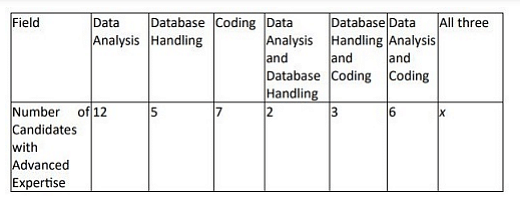
The number of applicants with advanced expertise in all three fields is given as x in the table, where x is a non-negative integer.
- XAT - 2024
- Data Interpretation