Question:medium
Par value system of shares is
Par value system of shares is
Show Hint
Remember that SEBI let companies fix their own face value, so the old compulsory par value rule does not bind Indian companies anymore.
Updated On: Jul 13, 2026
- no more applicable in India
- applicable in India
- applicable in India in selected cases
- none of these
Show Solution
The Correct Option is A
Solution and Explanation
Step 1: Understanding the Concept:
The par value (or face value) of a share is a fixed rupee value stamped on the share, separate from its market price. The question asks whether this fixed par value system still holds in India.
Step 2: Key Formula or Approach:
Recall the SEBI reform that freed companies from a single mandatory face value. Once a firm can choose its own face value for a new issue, the old rigid par value system no longer binds it.
Step 3: Detailed Explanation:
Before this reform, Indian companies mostly issued shares at a standard face value like Rs 10 or Rs 100, and the "par value" idea was central to how shares were priced and compared. After SEBI's change, companies can set the face value at Rs 1, Rs 2, Rs 5, Rs 10, or any figure the board picks. This means the strict, uniform par value rule is not in force anymore. The other choices, "applicable in India" and "applicable in India in selected cases", both wrongly assume the old fixed system still binds companies today.
Step 4: Final Answer:
The par value system, in its old compulsory form, is no more applicable in India.
\[ \boxed{\text{no more applicable in India}} \]
The par value (or face value) of a share is a fixed rupee value stamped on the share, separate from its market price. The question asks whether this fixed par value system still holds in India.
Step 2: Key Formula or Approach:
Recall the SEBI reform that freed companies from a single mandatory face value. Once a firm can choose its own face value for a new issue, the old rigid par value system no longer binds it.
Step 3: Detailed Explanation:
Before this reform, Indian companies mostly issued shares at a standard face value like Rs 10 or Rs 100, and the "par value" idea was central to how shares were priced and compared. After SEBI's change, companies can set the face value at Rs 1, Rs 2, Rs 5, Rs 10, or any figure the board picks. This means the strict, uniform par value rule is not in force anymore. The other choices, "applicable in India" and "applicable in India in selected cases", both wrongly assume the old fixed system still binds companies today.
Step 4: Final Answer:
The par value system, in its old compulsory form, is no more applicable in India.
\[ \boxed{\text{no more applicable in India}} \]
Was this answer helpful?
0
Top Questions on Economy
- Who won the SVERIGES RIKSBANK PRIZE in ECONOMIC Sciences in memory of Alfred Nobel 2024 for studies of how institutions are formed and affect prosperity?
- XAT - 2025
- General Awareness
- Economy
- ______ is a market where economic agents can freely exchange their endowments with each other.
- CUET (UG) - 2024
- Economics
- Economy
- From which year did the era of globalisation, liberalisation, and privatisation begin in India?
- Operation Flood deals with:
- Want to practice more? Try solving extra ecology questions todayView All Questions
Questions Asked in XAT exam
Applicants have been shortlisted for interviews for some data analyst positions. Some of the applicants have advanced expertise in one or more fields among the following: data analysis, database handling and coding. The numbers of applicants with different advanced expertise are given in the 2 × 8 table below.
The number of applicants with advanced expertise in all three fields is given as x in the table, where x is a non-negative integer.
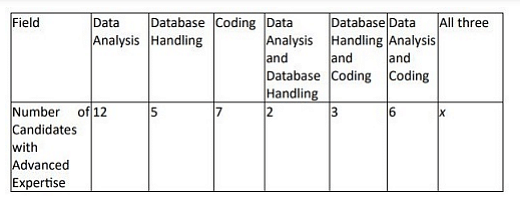
The number of applicants with advanced expertise in all three fields is given as x in the table, where x is a non-negative integer.
- XAT - 2024
- Data Interpretation