N = abc is a three-digit number, where a, b and c are its digits. N is a perfect square of an even number. To find N, which of the following information(s) is/are necessary and sufficient?
A. a, b, c are three consecutive digits but not in order.
B. N is divisible by 18.
C. The units digit of \(N^2\) is c.
A. a, b, c are three consecutive digits but not in order.
B. N is divisible by 18.
C. The units digit of \(N^2\) is c.
Show Hint
- Only A and B together are sufficient
- A and C together are sufficient
- Only B and C together are sufficient
- Either A and C together or B and C together are sufficient
The Correct Option is D
Solution and Explanation
This is a data sufficiency question. N is a three digit number that is the square of an even number, and we are told three extra clues A, B and C. We need to work out which clue, or pair of clues, pins down exactly one value of N, and match that to the given choices.
First list every three digit square of an even number: $100, 144, 196, 256, 324, 400, 484, 576, 676, 784, 900$, coming from squaring $10, 12, 14, \ldots, 30$.
- Clue A alone: A says the digits are three consecutive numbers written out of order. Only $324$ (digits 2, 3, 4) and $576$ (digits 5, 6, 7) qualify, so A alone leaves two possibilities.
- Clue B alone: B says N is divisible by $18$. That matches $144, 324, 576$ and $900$, four possibilities, so B alone is not enough.
- Clue C alone: C says the last digit of $N^2$ matches the last digit of N itself. Several numbers in the list pass this test, so C alone also cannot decide N.
- A with C: A leaves $324$ and $576$. Squaring, $324^2 = 104976$ ends in 6 but $324$ ends in 4, so it fails. $576^2 = 331776$ ends in 6, matching the last digit of $576$, so it passes. A with C gives exactly one answer, $N = 576$.
- B with C: B leaves $144, 324, 576, 900$. Testing clue C the same way singles out $576$ once again as the number that is both a multiple of $18$ and satisfies the squaring condition, so B with C also gives $N = 576$.
Both pairings, A with C and B with C, land on the same value, $N = 576 = 24^2$. Since either pairing alone is enough to solve the puzzle, and no single clue works alone, the right choice is the one that allows either pair.
Let's summarize:
- A alone, B alone, and C alone each leave more than one candidate for N.
- Adding C to A, or adding C to B, both narrow the field down to the single value $N = 576$.
So the correct choice is that either A and C together, or B and C together, are sufficient to find N.
Top Questions on Number System
- Find the number of integers \(n\) such that \(1 \leq n \leq 100\) and \(n^2 + 3n + 2\) is divisible by 5.
- BITSAT - 2025
- Mathematics
- Number System
- Find the smallest number between 2000 and 3000 that is exactly divisible by 21, 24 and 28.
- SNAP - 2024
- Quantitative Aptitude
- Number System
- Based on the given pattern find the next term of the given series: 5, 6, 16, 57, 244, 1245, ?
- SNAP - 2024
- Quantitative Aptitude
- Number System
- There are 3 different types of rice weighing \(435,\ 493,\) and \(551\) kg respectively. The rice is packed in bags so that no two types are mixed and all bags are of equal size. Find the least number of bags.
- SNAP - 2024
- Quantitative Aptitude
- Number System
- Want to practice more? Try solving extra ecology questions todayView All Questions
Questions Asked in XAT exam
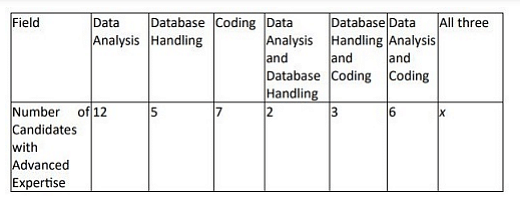
The number of applicants with advanced expertise in all three fields is given as x in the table, where x is a non-negative integer.
- XAT - 2024
- Data Interpretation