N = \((A7A)^{17}\) is a perfect square, where A7A is the three digit number with hundreds digit A, tens digit 7 and units digit A. Which of the following statements is FALSE?
Show Hint
- A is an even digit.
- A is divisible by 3
- When N is divided by 13 we get remainder 3.
- None of these
The Correct Option is C
Solution and Explanation
Here's a different way to pin down A: instead of plugging in every digit from 1 to 9 into $101A+70$, we search directly among the three digit perfect squares for one that has the shape A7A.
First, since $N = (A7A)^{17}$ is a perfect square and 17 is an odd power, the base $m = A7A$ must itself be a perfect square. An odd power of a number is a perfect square only when the number itself is one, because $m^{17} = (m^8)^2 \times m$ and $(m^8)^2$ is already a perfect square on its own.
Now list the three digit perfect squares: $100, 121, 144, 169, 196, 225, 256, 289, 324, 361, 400, 441, 484, 529, 576, 625, 676, 729, 784, 841, 900, 961$.
The shape A7A fixes the tens digit at 7. Scanning the list, only two squares have a tens digit of 7: $576$ and $676$.
- 576: hundreds digit 5, units digit 6. These are not equal, so it does not have the form A7A, which needs the hundreds digit to match the units digit.
- 676: hundreds digit 6, units digit 6. These match, so this is our number: $m = 676 = 26^2$, giving $A = 6$.
Now check the three statements about $N = 676^{17}$:
- $A = 6$ is even, so statement (1) holds.
- $A = 6$ is divisible by 3, so statement (2) holds.
- For statement (3), notice $676 = 26^2$ and $26 = 2 \times 13$, so $676$ is a multiple of 13. Raising a multiple of 13 to any power keeps it a multiple of 13, so $N = 676^{17}$ is a multiple of 13 and leaves remainder 0, not 3, when divided by 13. Statement (3) does not hold.
Let's summarize:
- Searching perfect squares with tens digit 7 quickly gives $m = 676$, so $A = 6$.
- A being even and divisible by 3 both check out.
- N is always a multiple of 13, since 676 already is, so remainder 3 is impossible; the true remainder is 0.
So the false statement is (3): the remainder is not 3, it is 0.
Top Questions on Number System
- Find the number of integers \(n\) such that \(1 \leq n \leq 100\) and \(n^2 + 3n + 2\) is divisible by 5.
- BITSAT - 2025
- Mathematics
- Number System
- Find the smallest number between 2000 and 3000 that is exactly divisible by 21, 24 and 28.
- SNAP - 2024
- Quantitative Aptitude
- Number System
- Based on the given pattern find the next term of the given series: 5, 6, 16, 57, 244, 1245, ?
- SNAP - 2024
- Quantitative Aptitude
- Number System
- There are 3 different types of rice weighing \(435,\ 493,\) and \(551\) kg respectively. The rice is packed in bags so that no two types are mixed and all bags are of equal size. Find the least number of bags.
- SNAP - 2024
- Quantitative Aptitude
- Number System
- Want to practice more? Try solving extra ecology questions todayView All Questions
Questions Asked in XAT exam
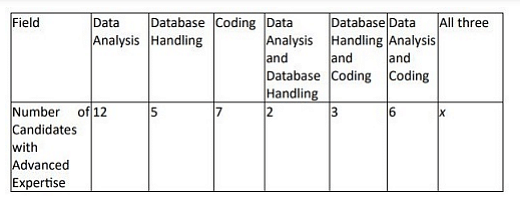
The number of applicants with advanced expertise in all three fields is given as x in the table, where x is a non-negative integer.
- XAT - 2024
- Data Interpretation