Question:medium
Considering only the principal values of the inverse trigonometric functions, evaluate:
\[
\cot^{-1}(\cot(-11))
+10\sin\left(2\cos^{-1}\left(\frac1{\sqrt2}\right)\right)
+10\sin\left(2\tan^{-1}(2)\right)
\]
Considering only the principal values of the inverse trigonometric functions, evaluate:
\[
\cot^{-1}(\cot(-11))
+10\sin\left(2\cos^{-1}\left(\frac1{\sqrt2}\right)\right)
+10\sin\left(2\tan^{-1}(2)\right)
\]
Show Hint
To bring -11 into the cot-inverse principal range (0, pi), work out how many multiples of pi need to be added using the floor of (-11/pi) rather than guessing. For the tan-inverse terms, sketching a quick right triangle for the angle often gets you sine and cosine faster than recalling the double-angle-in-terms-of-tan formula.
Updated On: Aug 17, 2026
- \(3\pi+7\)
- \(7\)
- \(4\pi+7\)
- \(3\pi-5\)
Show Solution
The Correct Option is C
Solution and Explanation
Step 1: Understanding the Concept:
We must evaluate each term of the expression by strictly following the principal value ranges:
- \( \cot^{-1}x \in (0, \pi) \)
- \( \cos^{-1}x \in [0, \pi] \)
- \( \tan^{-1}x \in (-\pi/2, \pi/2) \)
For the first term, we need to find an angle in \( (0, \pi) \) whose cotangent is equal to \( \cot(-11) \).
Step 3: Detailed Explanation:
1. Evaluating \( \cot^{-1}(\cot(-11)) \):
Let \( \cot^{-1}(\cot(-11)) = \theta \). Then \( \cot \theta = \cot(-11) \) and \( \theta \in (0, \pi) \).
We know \( \cot(x) = \cot(n\pi + x) \). We need \( -11 + n\pi \in (0, \pi) \).
Approximate \( \pi \approx 3.14 \).
For \( n = 4 \): \( 4(3.14) - 11 = 12.56 - 11 = 1.56 \). Since \( 1.56 \in (0, 3.14) \), our value is \( 4\pi - 11 \).
2. Evaluating \( 10 \sin(2 \cos^{-1}(1/\sqrt{2})) \):
\( \cos^{-1}(1/\sqrt{2}) = \pi/4 \).
The term is \( 10 \sin(2 \cdot \pi/4) = 10 \sin(\pi/2) = 10 \cdot 1 = 10 \).
3. Evaluating \( 10 \sin(2 \tan^{-1}(2)) \):
Let \( \alpha = \tan^{-1}(2) \), then \( \tan \alpha = 2 \).
We need \( 10 \sin(2\alpha) \). Using the identity \( \sin(2\alpha) = \frac{2\tan\alpha}{1+\tan^2\alpha} \):
\( \sin(2\alpha) = \frac{2(2)}{1+2^2} = \frac{4}{5} \).
The term is \( 10 \cdot (4/5) = 8 \).
4. Total sum:
Sum \( = (4\pi - 11) + 10 + 8 = 4\pi + 7 \).
Step 4: Final Answer:
The total value is \( 4\pi + 7 \).
We must evaluate each term of the expression by strictly following the principal value ranges:
- \( \cot^{-1}x \in (0, \pi) \)
- \( \cos^{-1}x \in [0, \pi] \)
- \( \tan^{-1}x \in (-\pi/2, \pi/2) \)
For the first term, we need to find an angle in \( (0, \pi) \) whose cotangent is equal to \( \cot(-11) \).
Step 3: Detailed Explanation:
1. Evaluating \( \cot^{-1}(\cot(-11)) \):
Let \( \cot^{-1}(\cot(-11)) = \theta \). Then \( \cot \theta = \cot(-11) \) and \( \theta \in (0, \pi) \).
We know \( \cot(x) = \cot(n\pi + x) \). We need \( -11 + n\pi \in (0, \pi) \).
Approximate \( \pi \approx 3.14 \).
For \( n = 4 \): \( 4(3.14) - 11 = 12.56 - 11 = 1.56 \). Since \( 1.56 \in (0, 3.14) \), our value is \( 4\pi - 11 \).
2. Evaluating \( 10 \sin(2 \cos^{-1}(1/\sqrt{2})) \):
\( \cos^{-1}(1/\sqrt{2}) = \pi/4 \).
The term is \( 10 \sin(2 \cdot \pi/4) = 10 \sin(\pi/2) = 10 \cdot 1 = 10 \).
3. Evaluating \( 10 \sin(2 \tan^{-1}(2)) \):
Let \( \alpha = \tan^{-1}(2) \), then \( \tan \alpha = 2 \).
We need \( 10 \sin(2\alpha) \). Using the identity \( \sin(2\alpha) = \frac{2\tan\alpha}{1+\tan^2\alpha} \):
\( \sin(2\alpha) = \frac{2(2)}{1+2^2} = \frac{4}{5} \).
The term is \( 10 \cdot (4/5) = 8 \).
4. Total sum:
Sum \( = (4\pi - 11) + 10 + 8 = 4\pi + 7 \).
Step 4: Final Answer:
The total value is \( 4\pi + 7 \).
Was this answer helpful?
0
Top Questions on Introduction to Trigonometry
- If \(3\tan A = 4 \quad (0^\circ < A < 90^\circ)\), then the value of \(\sin A\) is \dots
- TS POLYCET - 2026
- Mathematics
- Introduction to Trigonometry
- Assertion (A) : For an acute angle \(\theta\), \(\cos \theta\) is always less than 1.
Reason (R) : In a right-angled triangle, hypotenuse is the longest side and \(\cos \theta = \frac{\text{Base}}{\text{Hypotenuse}}\).- CBSE Class X - 2026
- Mathematics
- Introduction to Trigonometry
- If \(\cos A = \frac{4}{5}\), then the value of \(\tan A\) is :
- CBSE Class X - 2026
- Mathematics
- Introduction to Trigonometry
- If \(2 \sin A = 1\), then the value of \(\tan A + \cot A\) is :
- CBSE Class X - 2026
- Mathematics
- Introduction to Trigonometry
- Want to practice more? Try solving extra ecology questions todayView All Questions
Questions Asked in JEE Advanced exam
A thin uniform rod of length L and certain mass is kept on a frictionless horizontal table with a massless string of length L fixed to one end (top view is shown in the figure). The other end of the string is pivoted to a point O. If a horizontal impulse P is imparted to the rod at a distance x = L/n from the mid-point of the rod (see figure), then the rod and string revolve together around the point O, with the rod remaining aligned with the string. In such a case, the value of n is _____.
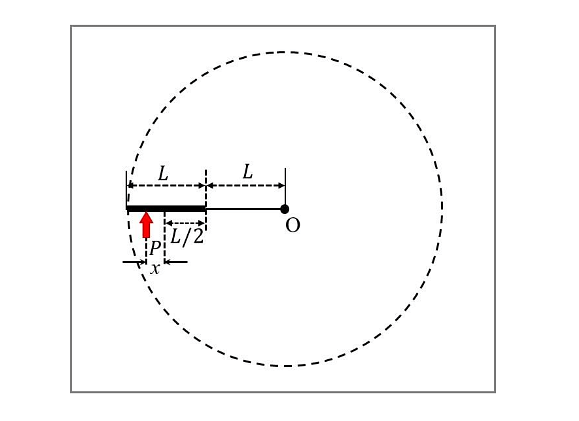
- JEE Advanced - 2024
- Friction