Question:medium
Let \(\mathbb R\) denote the set of all real numbers. Let
\[
f:\mathbb R\to\mathbb R
\]
be an arbitrary function and let
\[
g:\mathbb R\to\mathbb R
\]
be the function defined by
\[
g(x)=xf(x),\qquad \forall x\in\mathbb R
\]
Then which of the following statements is (are) TRUE?
Let \(\mathbb R\) denote the set of all real numbers. Let
\[
f:\mathbb R\to\mathbb R
\]
be an arbitrary function and let
\[
g:\mathbb R\to\mathbb R
\]
be the function defined by
\[
g(x)=xf(x),\qquad \forall x\in\mathbb R
\]
Then which of the following statements is (are) TRUE?
Show Hint
Since g(0) = 0, the derivative of g at 0 is the limit of f(x) as x tends to 0. Use this and test each statement with a counterexample if needed.
Updated On: Nov 19, 2026
- The function \(g\) is always continuous at \(x=0\)
- If \(f\) is continuous at \(x=0\), then \(g\) is differentiable at \(x=0\)
- If \(g\) is differentiable at \(x=0\), then \(f\) is continuous at \(x=0\)
- If \(g\) is differentiable at \(x=0\), then \[\lim_{x\to0}f(x)\] exists
Show Solution
The Correct Option is B, D
Solution and Explanation
Step 1: Rewrite everything with the definition of the derivative:
For $x\ne0$ we can write $f(x)=\dfrac{g(x)}{x}=\dfrac{g(x)-g(0)}{x-0}$, since $g(0)=0$.
So $f(x)$ is the difference quotient of $g$ at $0$. The value $f(0)$ itself plays no role in the limit as $x\to0$.
Step 2: Use this on (B) and (D):
If $g'(0)$ exists, then $\lim_{x\to0}f(x)=g'(0)$ exists. That is exactly statement (D), so (D) is TRUE.
If $f$ is continuous at $0$, then $\lim_{x\to0}f(x)=f(0)$ exists. This limit is the derivative of $g$ at $0$. So $g$ is differentiable at $0$ and (B) is TRUE.
Step 3: Counterexample for (A):
We need a $g$ that jumps at $0$. Let $f(x)=\dfrac{1}{x^2}$ for $x\ne0$ and $f(0)=0$.
Then $g(x)=\dfrac1x$ for $x\ne0$. It blows up near $0$ while $g(0)=0$, so $g$ is not continuous at $0$. (A) is FALSE.
Step 4: Counterexample for (C):
The derivative only needs the limit of $f$ to exist. It does not need that limit to equal $f(0)$.
Take $f(x)=0$ for $x\ne0$ and $f(0)=1$. Then $g(x)=0$ for all $x$, which is differentiable. But $f$ has a removable break at $0$, so it is not continuous. (C) is FALSE.
Final Answer:
B and D are true; A and C are false. \[ \boxed{\text{B, D}} \]
Was this answer helpful?
0
Top Questions on Continuity and differentiability
- Given that: \[ x = a \sin(2t) (1 + \cos(2t)), \quad y = a \cos(2t) (1 - \cos(2t)) \] Find \(\frac{dy}{dx}\).
- MHT CET - 2025
- Mathematics
- Continuity and differentiability
- Let \( f(x) = |1 - 2x| \), then:
- WBJEE - 2025
- Mathematics
- Continuity and differentiability
- A function \( f \) is defined by \( f(x) = 2 + (x - 1)^{2/3} \) on \( [0, 2] \). Which of the following statements is incorrect?
- WBJEE - 2025
- Mathematics
- Continuity and differentiability
- Let \( f : \mathbb{R} \to \mathbb{R} \) be a function given by
\[f(x) = \begin{cases} \frac{1 - \cos 2x}{x^2}, & x < 0 \\\alpha, & x = 0, \text{ where } \alpha, \beta \in \mathbb{R}. \\\beta \sqrt{1 - \cos x} / x, & x > 0 \end{cases} \]
If \( f \) is continuous at \( x = 0 \), then \( \alpha^2 + \beta^2 \) is equal to:- JEE Main - 2024
- Mathematics
- Continuity and differentiability
- Want to practice more? Try solving extra ecology questions todayView All Questions
Questions Asked in JEE Advanced exam
A thin uniform rod of length L and certain mass is kept on a frictionless horizontal table with a massless string of length L fixed to one end (top view is shown in the figure). The other end of the string is pivoted to a point O. If a horizontal impulse P is imparted to the rod at a distance x = L/n from the mid-point of the rod (see figure), then the rod and string revolve together around the point O, with the rod remaining aligned with the string. In such a case, the value of n is _____.
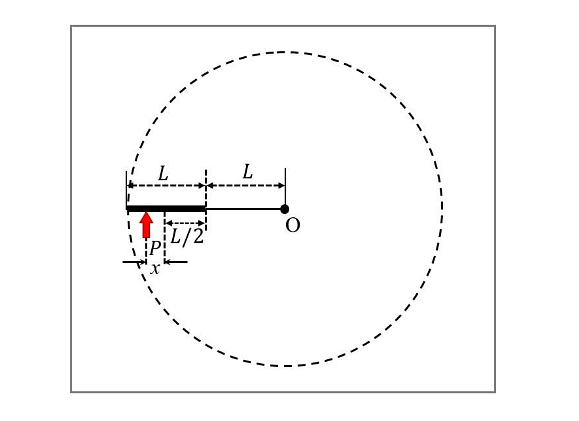
- JEE Advanced - 2024
- Friction