Question:medium
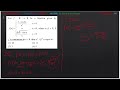
Let \( f : \mathbb{R} \to \mathbb{R} \) be a function given by
\[f(x) = \begin{cases} \frac{1 - \cos 2x}{x^2}, & x < 0 \\\alpha, & x = 0, \text{ where } \alpha, \beta \in \mathbb{R}. \\\beta \sqrt{1 - \cos x} / x, & x > 0 \end{cases} \]
If \( f \) is continuous at \( x = 0 \), then \( \alpha^2 + \beta^2 \) is equal to:
Let \( f : \mathbb{R} \to \mathbb{R} \) be a function given by
\[f(x) = \begin{cases} \frac{1 - \cos 2x}{x^2}, & x < 0 \\\alpha, & x = 0, \text{ where } \alpha, \beta \in \mathbb{R}. \\\beta \sqrt{1 - \cos x} / x, & x > 0 \end{cases} \]
If \( f \) is continuous at \( x = 0 \), then \( \alpha^2 + \beta^2 \) is equal to:
\[f(x) = \begin{cases} \frac{1 - \cos 2x}{x^2}, & x < 0 \\\alpha, & x = 0, \text{ where } \alpha, \beta \in \mathbb{R}. \\\beta \sqrt{1 - \cos x} / x, & x > 0 \end{cases} \]
If \( f \) is continuous at \( x = 0 \), then \( \alpha^2 + \beta^2 \) is equal to:
Updated On: Jan 13, 2026
- 48
- 12
- 3
- 6
Show Solution
The Correct Option is B
Solution and Explanation
For continuity at \(x = 0\), the left-hand limit, right-hand limit, and function value at \(x=0\) must be equal: \( \lim_{x \to 0^-} f(x) = \lim_{x \to 0^+} f(x) = f(0) \).
Left-hand limit evaluation:
\[ \lim_{x \to 0^-} f(x) = \lim_{x \to 0^-} \frac{1 - \cos 2x}{x^2} = 2 \]
This establishes \( f(0) = \alpha = 2 \).
Right-hand limit evaluation:
\[ \lim_{x \to 0^+} f(x) = \lim_{x \to 0^+} \frac{\beta \sqrt{1 - \cos x}}{x} = \frac{\beta}{\sqrt{2}} \]
Equating the right-hand limit to \( f(0) \):
\[ \frac{\beta}{\sqrt{2}} = 2 \implies \beta = 2\sqrt{2} \]
Calculation of \( \alpha^2 + \beta^2 \):
\[ \alpha^2 + \beta^2 = 2^2 + (2\sqrt{2})^2 = 4 + 8 = 12 \]
Was this answer helpful?
0
Learn with videos:
Top Questions on Continuity and differentiability
- Given that: \[ x = a \sin(2t) (1 + \cos(2t)), \quad y = a \cos(2t) (1 - \cos(2t)) \] Find \(\frac{dy}{dx}\).
- MHT CET - 2025
- Mathematics
- Continuity and differentiability
- Let \( f(x) = |1 - 2x| \), then:
- WBJEE - 2025
- Mathematics
- Continuity and differentiability
- A function \( f \) is defined by \( f(x) = 2 + (x - 1)^{2/3} \) on \( [0, 2] \). Which of the following statements is incorrect?
- WBJEE - 2025
- Mathematics
- Continuity and differentiability
- If the function \(f(x) = \frac{\sin 3x + \alpha \sin x - \beta \cos 3x}{x^3},\) \(x \in \mathbb{R} \), is continuous at \( x = 0 \), then \( f(0) \) is equal to:
- JEE Main - 2024
- Mathematics
- Continuity and differentiability
- Want to practice more? Try solving extra ecology questions todayView All Questions
