Question:medium
Let \(\mathbb R\) denote the set of all real numbers. Let
\[
f:\mathbb R\to\mathbb R
\]
be an arbitrary function and let
\[
g:\mathbb R\to\mathbb R
\]
be the function defined by
\[
g(x)=xf(x),\qquad \forall x\in\mathbb R
\]
Then which of the following statements is (are) TRUE?
Let \(\mathbb R\) denote the set of all real numbers. Let
\[
f:\mathbb R\to\mathbb R
\]
be an arbitrary function and let
\[
g:\mathbb R\to\mathbb R
\]
be the function defined by
\[
g(x)=xf(x),\qquad \forall x\in\mathbb R
\]
Then which of the following statements is (are) TRUE?
Show Hint
If:
\[
g(x)=xf(x)
\]
then:
\[
g'(0)=\lim_{x\to0}f(x)
\]
provided the limit exists.
Updated On: Jun 4, 2026
- The function \(g\) is always continuous at \(x=0\)
- If \(f\) is continuous at \(x=0\), then \(g\) is differentiable at \(x=0\)
- If \(g\) is differentiable at \(x=0\), then \(f\) is continuous at \(x=0\)
- If \(g\) is differentiable at \(x=0\), then \[\lim_{x\to0}f(x)\] exists
Show Solution
The Correct Option is B
Solution and Explanation
Step 1: Understanding the Concept:
This question tests definitions of continuity and differentiability at a point. For \( g(x) = xf(x) \), \( g(0) = 0 \cdot f(0) = 0 \).
Continuity at \( 0 \) means \( \lim_{x \to 0} g(x) = g(0) = 0 \).
Differentiability at \( 0 \) means \( \lim_{h \to 0} \frac{g(h) - g(0)}{h} \) exists.
Step 3: Detailed Explanation:
1. Statement (A):
Is \( \lim_{x \to 0} xf(x) \) always \( 0 \)? No.
Consider \( f(x) = 1/x \) for \( x \neq 0 \) and \( f(0) = 0 \). Then \( g(x) = 1 \) for \( x \neq 0 \).
\( \lim_{x \to 0} g(x) = 1 \neq g(0) \). So (A) is False.
2. Statement (B):
If \( f \) is continuous at \( 0 \), then \( \lim_{h \to 0} f(h) = f(0) \).
Checking \( g'(0) = \lim_{h \to 0} \frac{hf(h) - 0}{h} = \lim_{h \to 0} f(h) \).
Since \( f \) is continuous, the limit exists and equals \( f(0) \). So \( g \) is differentiable. Statement (B) is True.
3. Statement (D):
If \( g \) is differentiable at \( 0 \), then by definition, \( \lim_{h \to 0} \frac{g(h) - g(0)}{h} = \lim_{h \to 0} \frac{hf(h)}{h} = \lim_{h \to 0} f(h) \) must exist.
Therefore, if \( g \) is differentiable, \( \lim_{x \to 0} f(x) \) exists. Statement (D) is True.
4. Statement (C):
If \( g \) is differentiable, we know \( \lim_{x \to 0} f(x) = L \) exists. For \( f \) to be continuous, we need \( L = f(0) \).
But \( f \) is an "arbitrary" function. If \( f(x) = 1 \) for \( x \neq 0 \) and \( f(0) = 2 \), then \( g(x) = x \) for \( x \neq 0 \), which is differentiable at \( 0 \) (slope 1), yet \( f \) is not continuous at \( 0 \). Statement (C) is False.
Step 4: Final Answer:
The true statements are (B) and (D).
This question tests definitions of continuity and differentiability at a point. For \( g(x) = xf(x) \), \( g(0) = 0 \cdot f(0) = 0 \).
Continuity at \( 0 \) means \( \lim_{x \to 0} g(x) = g(0) = 0 \).
Differentiability at \( 0 \) means \( \lim_{h \to 0} \frac{g(h) - g(0)}{h} \) exists.
Step 3: Detailed Explanation:
1. Statement (A):
Is \( \lim_{x \to 0} xf(x) \) always \( 0 \)? No.
Consider \( f(x) = 1/x \) for \( x \neq 0 \) and \( f(0) = 0 \). Then \( g(x) = 1 \) for \( x \neq 0 \).
\( \lim_{x \to 0} g(x) = 1 \neq g(0) \). So (A) is False.
2. Statement (B):
If \( f \) is continuous at \( 0 \), then \( \lim_{h \to 0} f(h) = f(0) \).
Checking \( g'(0) = \lim_{h \to 0} \frac{hf(h) - 0}{h} = \lim_{h \to 0} f(h) \).
Since \( f \) is continuous, the limit exists and equals \( f(0) \). So \( g \) is differentiable. Statement (B) is True.
3. Statement (D):
If \( g \) is differentiable at \( 0 \), then by definition, \( \lim_{h \to 0} \frac{g(h) - g(0)}{h} = \lim_{h \to 0} \frac{hf(h)}{h} = \lim_{h \to 0} f(h) \) must exist.
Therefore, if \( g \) is differentiable, \( \lim_{x \to 0} f(x) \) exists. Statement (D) is True.
4. Statement (C):
If \( g \) is differentiable, we know \( \lim_{x \to 0} f(x) = L \) exists. For \( f \) to be continuous, we need \( L = f(0) \).
But \( f \) is an "arbitrary" function. If \( f(x) = 1 \) for \( x \neq 0 \) and \( f(0) = 2 \), then \( g(x) = x \) for \( x \neq 0 \), which is differentiable at \( 0 \) (slope 1), yet \( f \) is not continuous at \( 0 \). Statement (C) is False.
Step 4: Final Answer:
The true statements are (B) and (D).
Was this answer helpful?
0
Top Questions on Continuity and differentiability
- Given that: \[ x = a \sin(2t) (1 + \cos(2t)), \quad y = a \cos(2t) (1 - \cos(2t)) \] Find \(\frac{dy}{dx}\).
- MHT CET - 2025
- Mathematics
- Continuity and differentiability
- Let \( f(x) = |1 - 2x| \), then:
- WBJEE - 2025
- Mathematics
- Continuity and differentiability
- A function \( f \) is defined by \( f(x) = 2 + (x - 1)^{2/3} \) on \( [0, 2] \). Which of the following statements is incorrect?
- WBJEE - 2025
- Mathematics
- Continuity and differentiability
- Let \( f : \mathbb{R} \to \mathbb{R} \) be a function given by
\[f(x) = \begin{cases} \frac{1 - \cos 2x}{x^2}, & x < 0 \\\alpha, & x = 0, \text{ where } \alpha, \beta \in \mathbb{R}. \\\beta \sqrt{1 - \cos x} / x, & x > 0 \end{cases} \]
If \( f \) is continuous at \( x = 0 \), then \( \alpha^2 + \beta^2 \) is equal to:- JEE Main - 2024
- Mathematics
- Continuity and differentiability
- Want to practice more? Try solving extra ecology questions todayView All Questions
Questions Asked in JEE Advanced exam
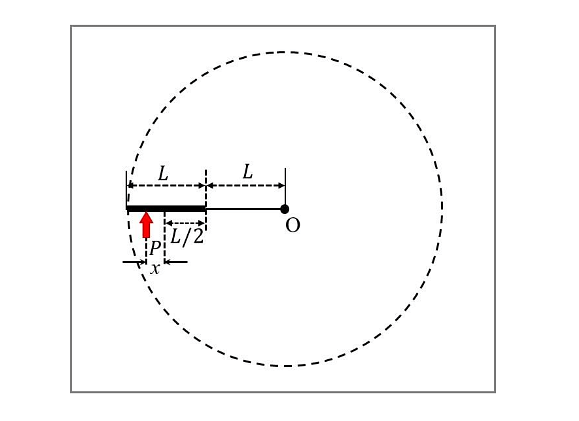
A thin uniform rod of length L and certain mass is kept on a frictionless horizontal table with a massless string of length L fixed to one end (top view is shown in the figure). The other end of the string is pivoted to a point O. If a horizontal impulse P is imparted to the rod at a distance x = L/n from the mid-point of the rod (see figure), then the rod and string revolve together around the point O, with the rod remaining aligned with the string. In such a case, the value of n is _____.
- JEE Advanced - 2024
- Friction