Question:medium
Let \(\mathbb{R}\) denote the set of all real numbers. Consider the polynomial function
\[
f : \mathbb{R} \to \mathbb{R}
\]
defined by
\[
f(x) = \frac{d^{10}}{dx^{10}}\left((x^2 - 1)^{10}\right), \qquad \text{for all } x \in \mathbb{R}.
\]
Here,
\[
\frac{d^{10}}{dx^{10}}\left((x^2 - 1)^{10}\right)
\]
is the \(10^{\text{th}}\) order derivative of the function \((x^2 - 1)^{10}\).
Then which of the following statements is (are) TRUE?
Show Hint
Expand (x^2 - 1)^10 and differentiate term by term; use Leibniz's rule at x = 1 and x = -1 for f(1) + f(-1).
Updated On: Nov 19, 2026
- The coefficient of $x^8$ in the polynomial $f(x)$ is $(-10) \left( \frac{18!}{8!} \right)$
- The value of $f(1) + f(-1)$ is equal to $10! 2^{11}$
- The degree of the polynomial $f(x)$ is 10
- The constant term of the polynomial $f(x)$ is $- \left( \frac{10!}{5!} \right)$
Show Solution
The Correct Option is A, B, C
Solution and Explanation
Step 1: Write the expansion's top and middle terms:
\[ (x^2 - 1)^{10} = x^{20} - 10x^{18} + 45x^{16} - \cdots - 252x^{10} + \cdots + 1 \]
Terms with power below $x^{10}$ vanish after ten derivatives. For a term $x^{n}$ with $n \ge 10$, the tenth derivative is $n(n-1)\cdots(n-9)\,x^{n-10}$.
Step 2: Degree and the x^8 coefficient:
The top term $x^{20}$ gives $20 \cdot 19 \cdots 11\,x^{10} = \dfrac{20!}{10!}x^{10}$. So the degree is $10$ and (C) is correct.
The next term $-10x^{18}$ gives $-10\cdot18\cdot17\cdots9\,x^8 = -10\,\dfrac{18!}{8!}x^8$. No other term gives $x^8$. So (A) is correct.
Step 3: Constant term:
Only the term $-252x^{10}$ can give a constant: $\dfrac{d^{10}}{dx^{10}}x^{10} = 10!$.
So the constant term is $-252\cdot10! = -914{,}457{,}600$. The value $-\dfrac{10!}{5!} = -30240$ is far from this. So (D) is incorrect.
Step 4: f(1) + f(-1) using parity:
The function $(x^2 - 1)^{10}$ is even. The derivative of an even function is odd, and the derivative of an odd function is even. So an even number of derivatives keeps it even.
So $f$ is even and $f(-1) = f(1)$.
Now $f(1)$: with $(x - 1)^{10}(x + 1)^{10}$ and the product rule, any term that still has a factor of $(x - 1)$ is $0$ at $x = 1$. Only the term where all ten derivatives fall on $(x - 1)^{10}$ survives.
\[ f(1) = 10!\times(1 + 1)^{10} = 10!\,2^{10} \]
\[ f(1) + f(-1) = 2\times10!\,2^{10} = 10!\,2^{11} \]
So (B) is correct.
Final Answer:
Options (A), (B) and (C) are correct. \[ \boxed{\text{(A), (B), (C)}} \]
Was this answer helpful?
0
Top Questions on Application of derivatives
- If the function \( f(x) \), defined below, is continuous on the interval \([0,8]\), then: \[ f(x) = \begin{cases} x^2 + ax + b, & 0 \leq x < 2 \\ 3x + 2, & 2 \leq x \leq 4 \\ 2ax + 5b, & 4 < x \leq 8 \end{cases} \]
- BITSAT - 2024
- Mathematics
- Application of derivatives
- If \( x\sqrt{1 + y} + y\sqrt{1 + x} = 0 \), then find \( \frac{dy}{dx} \).
- BITSAT - 2024
- Mathematics
- Application of derivatives
- If \( y = \tan^{-1}\left( \frac{\sqrt{x} - x}{1 + x^{3/2}} \right) \), then \( y'(1) \) is equal to:
- BITSAT - 2024
- Mathematics
- Application of derivatives
- At \( x = \frac{\pi^2}{4} \), \( \frac{d}{dx} \left( \tan^{-1}(\cos\sqrt{x}) + \sec^{-1}(e^x) \right) = \)
- BITSAT - 2024
- Mathematics
- Application of derivatives
- Want to practice more? Try solving extra ecology questions todayView All Questions
Questions Asked in JEE Advanced exam
A thin uniform rod of length L and certain mass is kept on a frictionless horizontal table with a massless string of length L fixed to one end (top view is shown in the figure). The other end of the string is pivoted to a point O. If a horizontal impulse P is imparted to the rod at a distance x = L/n from the mid-point of the rod (see figure), then the rod and string revolve together around the point O, with the rod remaining aligned with the string. In such a case, the value of n is _____.
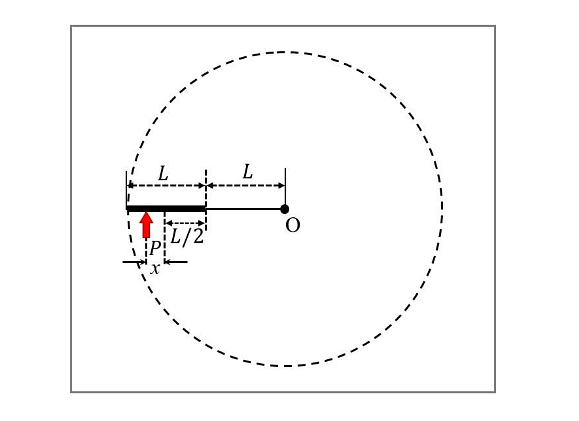
- JEE Advanced - 2024
- Friction