Question:medium
Let \(\mathbb{R}\) denote the set of all real numbers and let \(i = \sqrt{-1}\). Consider the matrices
\[
S = \begin{pmatrix}
0 & -1 \\
1 & 0
\end{pmatrix}
\quad \text{and} \quad
T = \begin{pmatrix}
1 & 1 \\
0 & 1
\end{pmatrix}.
\]
Let \(a, b, c, d\) be real numbers such that
\[
ST =
\begin{pmatrix}
a & b \\
c & d
\end{pmatrix}.
\]
Let
\[
H = \{x + iy : x, y \in \mathbb{R} \text{ and } y>0\}.
\]
Then which of the following statements is (are) TRUE?
Show Hint
Compute ST = [[0,-1],[1,1]], so the map is z -> -1/(z+1). Then test each statement; ST has order 6, so m = 8, 14, 20, ...
Updated On: Nov 19, 2026
- $\frac{b + ia}{d + ic} = i$
- If $\omega = \frac{-1 + i\sqrt{3}}{2}$, then $\frac{a\omega + b}{c\omega + d} = \omega$
- If $m$ is an integer greater than 2 such that $(ST)^2 = (ST)^m$, then $m$ is an integer multiple of 8
- If $z \in H$, then $\frac{az + b}{cz + d} \in H$
Show Solution
The Correct Option is B, D
Solution and Explanation
Step 1: Multiply the matrices:
Rows of $S$ times columns of $T$: the first row $(0, -1)$ gives $(0, -1)$, and the second row $(1, 0)$ gives $(1, 1)$.
So $ST = \begin{pmatrix} 0 & -1 \\ 1 & 1 \end{pmatrix}$. Hence $a = 0,\ b = -1,\ c = 1,\ d = 1$, and $f(z) = \dfrac{az + b}{cz + d} = -\dfrac{1}{z + 1}$.
Step 2: Statement (A) by cross-multiplying:
If $\dfrac{b + ia}{d + ic} = i$, then $b + ia = i(d + ic)$. Put in the values: the left side is $-1$.
The right side is $i(1 + i) = i - 1$. Since $-1 \neq -1 + i$, (A) is incorrect.
Step 3: Statement (B) using the polar form:
$\omega = e^{2\pi i/3}$. Then $\omega + 1 = \dfrac{1 + i\sqrt3}{2} = e^{i\pi/3}$.
\[ f(\omega) = -\frac{1}{e^{i\pi/3}} = e^{i\pi}e^{-i\pi/3} = e^{2\pi i/3} = \omega \]
So (B) is correct. In other words, $\omega$ is a fixed point of the map.
Step 4: Statement (C) using eigenvalues:
The characteristic equation of $ST$ is $\lambda^2 - \lambda + 1 = 0$. The eigenvalues are $e^{\pm i\pi/3}$, which are sixth roots of unity.
So $(ST)^k = I$ exactly when $6 \mid k$. Here $(ST)^{m-2} = I$, so $m - 2 = 6j$, giving $m = 6j + 2$.
For $j = 2$, $m = 14$, which is not divisible by $8$. So (C) is incorrect.
Step 5: Statement (D) using the upper half plane:
The map $z \mapsto z + 1$ keeps the imaginary part. The map $w \mapsto -\dfrac{1}{w}$ sends $H$ to $H$, because $\text{Im}\left(-\dfrac1w\right) = \dfrac{\text{Im}\,w}{|w|^2} > 0$.
The given map is the composition of these two. So $z \in H$ gives $f(z) \in H$, and (D) is correct.
Final Answer:
Options (B) and (D) are correct. \[ \boxed{\text{(B), (D)}} \]
Was this answer helpful?
0
Top Questions on Complex numbers
- The number of all four-digit numbers which begin with 4 and end with either zero or five is
- MHT CET - 2024
- Mathematics
- Complex numbers
- If \( z, \bar{z}, -z, -\bar{z} \) forms a rectangle of area \( 2\sqrt{3} \) square units, then one such \( z \) is:
- BITSAT - 2024
- Mathematics
- Complex numbers
- If \( z_1, z_2, \dots, z_n \) are complex numbers such that \( |z_1| = |z_2| = \dots = |z_n| = 1 \), then \( |z_1 + z_2 + \dots + z_n| \) is equal to:
- BITSAT - 2024
- Mathematics
- Complex numbers
- If \( |z_1| = 2, |z_2| = 3, |z_3| = 4 \) and \( |2z_1 + 3z_2 + 4z_3| = 4 \), then the absolute value of \( 8z_2z_3 + 27z_1z_3 + 64z_1z_2 \) equals:
- BITSAT - 2024
- Mathematics
- Complex numbers
- Want to practice more? Try solving extra ecology questions todayView All Questions
Questions Asked in JEE Advanced exam
A thin uniform rod of length L and certain mass is kept on a frictionless horizontal table with a massless string of length L fixed to one end (top view is shown in the figure). The other end of the string is pivoted to a point O. If a horizontal impulse P is imparted to the rod at a distance x = L/n from the mid-point of the rod (see figure), then the rod and string revolve together around the point O, with the rod remaining aligned with the string. In such a case, the value of n is _____.
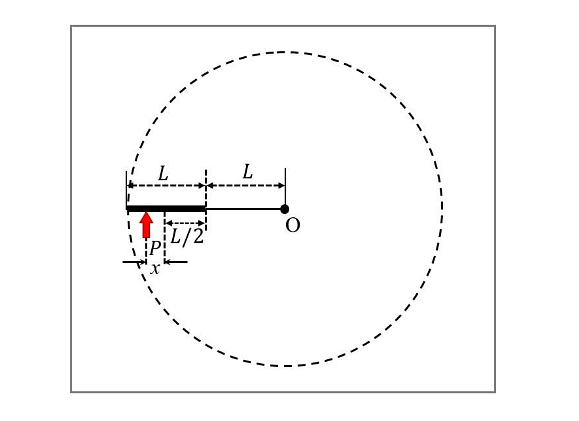
- JEE Advanced - 2024
- Friction