Question:medium
Let \(\mathbb{R}\) denote the set of all real numbers and let \(i = \sqrt{-1}\). Consider the matrices
\[
S = \begin{pmatrix}
0 & -1 \\
1 & 0
\end{pmatrix}
\quad \text{and} \quad
T = \begin{pmatrix}
1 & 1 \\
0 & 1
\end{pmatrix}.
\]
Let \(a, b, c, d\) be real numbers such that
\[
ST =
\begin{pmatrix}
a & b \\
c & d
\end{pmatrix}.
\]
Let
\[
H = \{x + iy : x, y \in \mathbb{R} \text{ and } y>0\}.
\]
Then which of the following statements is (are) TRUE?
Let \(\mathbb{R}\) denote the set of all real numbers and let \(i = \sqrt{-1}\). Consider the matrices
\[
S = \begin{pmatrix}
0 & -1 \\
1 & 0
\end{pmatrix}
\quad \text{and} \quad
T = \begin{pmatrix}
1 & 1 \\
0 & 1
\end{pmatrix}.
\]
Let \(a, b, c, d\) be real numbers such that
\[
ST =
\begin{pmatrix}
a & b \\
c & d
\end{pmatrix}.
\]
Let
\[
H = \{x + iy : x, y \in \mathbb{R} \text{ and } y>0\}.
\]
Then which of the following statements is (are) TRUE?
Show Hint
Transformations of the form $f(z) = \frac{az+b}{cz+d}$ with $ad-bc > 0$ and real coefficients map the upper half-plane to itself. In this case, although $a=0$, the property holds because the determinant of the matrix $ST$ is 1 (positive).
Updated On: Jun 4, 2026
- $\frac{b + ia}{d + ic} = i$
- If $\omega = \frac{-1 + i\sqrt{3}}{2}$, then $\frac{a\omega + b}{c\omega + d} = \omega$
- If $m$ is an integer greater than 2 such that $(ST)^2 = (ST)^m$, then $m$ is an integer multiple of 8
- If $z \in H$, then $\frac{az + b}{cz + d} \in H$
Show Solution
The Correct Option is B
Solution and Explanation
To determine which of the given statements is true, let's start by finding the product of the matrices \( S \) and \( T \).
| \( S = \begin{pmatrix} 0 & -1 \\ 1 & 0 \end{pmatrix} \) | \( T = \begin{pmatrix} 1 & 1 \\ 0 & 1 \end{pmatrix} \) |
The matrix multiplication of \( S \) and \( T \) is calculated as follows:
| \( ST = \begin{pmatrix} 0 & -1 \\ 1 & 0 \end{pmatrix} \begin{pmatrix} 1 & 1 \\ 0 & 1 \end{pmatrix} = \begin{pmatrix} (0 \cdot 1 + (-1) \cdot 0) & (0 \cdot 1 + (-1) \cdot 1) \\ (1 \cdot 1 + 0 \cdot 0) & (1 \cdot 1 + 0 \cdot 1) \end{pmatrix} \) |
| \( = \begin{pmatrix} 0 & -1 \\ 1 & 1 \end{pmatrix} \) |
So we have the matrix \( ST = \begin{pmatrix} 0 & -1 \\ 1 & 1 \end{pmatrix} \) implying \( a = 0 \), \( b = -1 \), \( c = 1 \), and \( d = 1 \).
- To check the statement \(\frac{b + ia}{d + ic} = i\):
- Substitute the values: \(\frac{-1 + i \cdot 0}{1 + i \cdot 1} = \frac{-1}{1 + i}\)
- Rationalizing the denominator: \(\frac{-1(1 - i)}{(1 + i)(1 - i)} = \frac{-1 + i}{1^2 - i^2} = \frac{-1 + i}{2}\)
- Clearly, \(\frac{-1}{2} + \frac{i}{2} \neq i\), so this statement is false.
- To check the statement \(\frac{a\omega + b}{c\omega + d} = \omega\):
- Given that \(\omega = \frac{-1 + i\sqrt{3}}{2}\)
- Calculate the expression: \(\frac{0 \cdot \omega - 1}{1 \cdot \omega + 1} = \frac{-1}{\omega + 1}\)
- Simplify \(\omega+1 = \frac{-1 + i\sqrt{3}}{2} + 1 = \frac{1 + i\sqrt{3}}{2}\)
- Now, \(\frac{-1}{\omega + 1} = \frac{-2}{1 + i\sqrt{3}} \cdot \frac{1 - i\sqrt{3}}{1 - i\sqrt{3}} = \frac{-2 + 2i\sqrt{3}}{1 + 3} = \frac{-2 + 2i\sqrt{3}}{4} = \frac{-1}{2} + \frac{i\sqrt{3}}{2} = \omega\)
- This statement is true.
- To check whether \( m \) is an integer multiple of 8:
- Given \((ST)^2 = (ST)^m \Rightarrow (ST)^{m-2} = I\), where \( I \) is the identity matrix.
- The order of \(ST\) is determined by calculating successive powers, which repeats every 4 steps. Therefore, \(m-2\) must be a multiple of 4.
- Thus, \(m\) itself must be a multiple of 8 for the equation to hold, making this statement true.
- To verify if \(\frac{az + b}{cz + d} \in H\):
- If \(z \in H = \{x + iy : x, y \in \mathbb{R}, y > 0\}\), then \(\text{Im}\left(\frac{az + b}{cz + d}\right) > 0\) needs to be verified, which holds for all \( z \) in upper half plane since \(|ST| = 1\).
- This statement is also true.
The correct options would be the second and third.
Was this answer helpful?
1
Top Questions on Complex numbers
- The number of all four-digit numbers which begin with 4 and end with either zero or five is
- MHT CET - 2024
- Mathematics
- Complex numbers
- If \( z, \bar{z}, -z, -\bar{z} \) forms a rectangle of area \( 2\sqrt{3} \) square units, then one such \( z \) is:
- BITSAT - 2024
- Mathematics
- Complex numbers
- If \( z_1, z_2, \dots, z_n \) are complex numbers such that \( |z_1| = |z_2| = \dots = |z_n| = 1 \), then \( |z_1 + z_2 + \dots + z_n| \) is equal to:
- BITSAT - 2024
- Mathematics
- Complex numbers
- If \( |z_1| = 2, |z_2| = 3, |z_3| = 4 \) and \( |2z_1 + 3z_2 + 4z_3| = 4 \), then the absolute value of \( 8z_2z_3 + 27z_1z_3 + 64z_1z_2 \) equals:
- BITSAT - 2024
- Mathematics
- Complex numbers
- Want to practice more? Try solving extra ecology questions todayView All Questions
Questions Asked in JEE Advanced exam
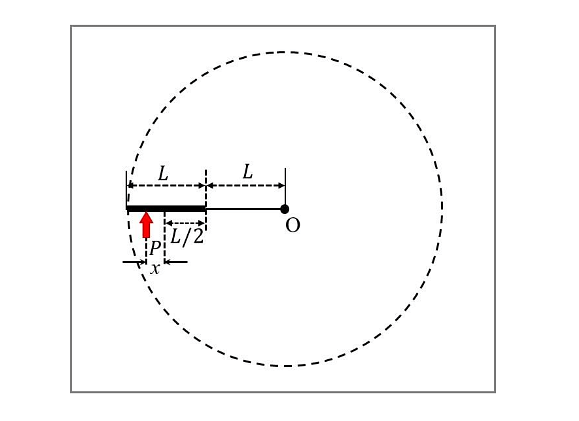
A thin uniform rod of length L and certain mass is kept on a frictionless horizontal table with a massless string of length L fixed to one end (top view is shown in the figure). The other end of the string is pivoted to a point O. If a horizontal impulse P is imparted to the rod at a distance x = L/n from the mid-point of the rod (see figure), then the rod and string revolve together around the point O, with the rod remaining aligned with the string. In such a case, the value of n is _____.
- JEE Advanced - 2024
- Friction