Question:medium
Let $L$ be the straight line joining the points $P(1, 2, -1)$ and $Q(2, 3, 1)$. Let $S$ be the foot of the perpendicular drawn from the point $R(4, -1, 5)$ to the line $L$. Another line passing through $R$ intersects $L$ at a point $T$ such that the point $S$ divides the line segment $PT$ internally in the ratio $|PS| : |ST| = 1 : 2$, where $|PS|$ and $|ST|$ are the lengths of the line segments $PS$ and $ST$, respectively.
Then which of the following statements is (are) TRUE?
Show Hint
S is at t = 2 on the line, so T = P + 6d = (7, 8, 11). The area is half of PT times RS, and the orthocentre lies on RS.
Updated On: Nov 19, 2026
- The orthocentre of the triangle $PRT$ is $\left( \frac{23}{5}, -4, \frac{31}{5} \right)$
- The orthocentre of the triangle $PRT$ is $(4, 3, 5)$
- The area of the triangle $PRT$ is $6\sqrt{5}$
- The area of the triangle $PRT$ is $18\sqrt{5}$
Show Solution
The Correct Option is A, D
Solution and Explanation
Step 1: Use the parameter along L:
Write $L$ as $P + t\vec d$ with $\vec d = (1, 1, 2)$. The point $Q$ is at $t = 1$.
For $S$, project $R$ on the line. $\vec{PR} = (3, -3, 6)$ and $\vec{PR}\cdot\vec d = 12$. Also $|\vec d|^2 = 6$, so $S$ is at $t = 2$, that is $S = (3, 4, 3)$.
$|PS| : |ST| = 1 : 2$ puts $T$ at $t = 6$, so $T = (7, 8, 11)$.
Step 2: Area using the cross product:
\[ \vec{PR} = (3, -3, 6), \qquad \vec{PT} = (6, 6, 12) \]
\[ \vec{PR}\times\vec{PT} = (-3\cdot12 - 6\cdot6,\ 6\cdot6 - 3\cdot12,\ 3\cdot6 + 3\cdot6) = (-72,\ 0,\ 36) \]
\[ |\vec{PR}\times\vec{PT}| = \sqrt{5184 + 1296} = \sqrt{6480} = 36\sqrt5 \]
\[ \text{Area} = \frac12 \times 36\sqrt5 = 18\sqrt5 \]
Step 3: Orthocentre by the two altitude conditions:
The altitude from $R$ lies on $RS$, because $RS \perp PT$. So $H = S + \lambda(R - S) = (3 + \lambda,\ 4 - 5\lambda,\ 3 + 2\lambda)$.
The altitude from $P$ must be perpendicular to $RT$. We have $\vec{TR} = (-3, -9, -6)$ and $\vec{PH} = H - P = (2 + \lambda,\ 2 - 5\lambda,\ 4 + 2\lambda)$.
\[ \vec{PH}\cdot\vec{TR} = -3(2 + \lambda) - 9(2 - 5\lambda) - 6(4 + 2\lambda) = -48 + 30\lambda = 0 \]
So $\lambda = \tfrac{8}{5}$, and
\[ H = \left(3 + \tfrac85,\ 4 - 8,\ 3 + \tfrac{16}{5}\right) = \left(\tfrac{23}{5},\ -4,\ \tfrac{31}{5}\right) \]
Step 4: Compare with the options:
(A) matches $H$, so it is correct. (B) gives a different point, so it is incorrect.
(C) says $6\sqrt5$, which is one third of the true area, so it is incorrect. (D) says $18\sqrt5$, so it is correct.
Final Answer:
Options (A) and (D) are correct. \[ \boxed{\text{(A), (D)}} \]
Was this answer helpful?
0
Top Questions on Three Dimensional Geometry
- The angle between the lines, whose direction cosines \( l, m, n \) satisfy the equations: \[ l + m + n = 0 \quad \text{and} \quad 2l^2 + 2m^2 - n^2 = 0, \] is:
- MHT CET - 2024
- Mathematics
- Three Dimensional Geometry
- The length of the perpendicular drawn from the point \((1, 2, 3)\) to the line \((X - 6)/3 = (y - 7)/2 = (Z - 7)/-2\) is:
- MHT CET - 2024
- Mathematics
- Three Dimensional Geometry
- The area of a triangle with base 12 cm and height 5 cm is?
- MHT CET - 2025
- Mathematics
- Three Dimensional Geometry
- Find the area of a circle whose radius is 7 cm.
- MHT CET - 2025
- Mathematics
- Three Dimensional Geometry
- Want to practice more? Try solving extra ecology questions todayView All Questions
Questions Asked in JEE Advanced exam
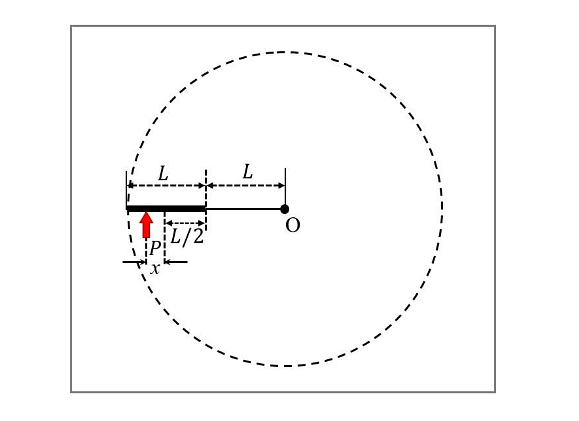
A thin uniform rod of length L and certain mass is kept on a frictionless horizontal table with a massless string of length L fixed to one end (top view is shown in the figure). The other end of the string is pivoted to a point O. If a horizontal impulse P is imparted to the rod at a distance x = L/n from the mid-point of the rod (see figure), then the rod and string revolve together around the point O, with the rod remaining aligned with the string. In such a case, the value of n is _____.
- JEE Advanced - 2024
- Friction