Question:medium
Consider the curve \(C_1\) given by \(y = e^{-x}\) for \(x \in [0, 10\pi]\), and the curve \(C_2\) given by \(y = e^{-x}(\sin x + \cos x)\) for \(x \in [0, 10\pi]\).
Suppose that \(\alpha_1, \alpha_2, \ldots, \alpha_n \in [0, 10\pi]\) are the \(x\)-coordinates of the points of intersection of the curves \(C_1\) and \(C_2\) such that \(\alpha_1 < \alpha_2 < \cdots < \alpha_n\).
Let \(\beta\) be the area of the region enclosed between the curves \(C_1, C_2\), and the lines \(x = \alpha_1\) and \(x = \alpha_4\). Then the value of \[ -\frac{1}{\pi}\ln\!\left(\beta - 2e^{-\pi/2}\right) \] is ______.
Show Hint
The curves meet where sin x + cos x = 1, so alpha_4 = 5 pi/2. An antiderivative of the gap is e^(-x)(1 - cos x), which gives beta = 2e^(-pi/2) + e^(-5pi/2).
Updated On: Nov 19, 2026
Show Solution
Correct Answer: 2.4 - 2.6
Solution and Explanation
Step 1: Intersection points:
The curves meet where $\sin x + \cos x = 1$, because the factor $e^{-x}$ is common and never zero.
Square after rearranging: $\sin x = 1 - \cos x$ gives $2\sin\tfrac{x}{2}\cos\tfrac{x}{2} = 2\sin^2\tfrac{x}{2}$. So $\sin\tfrac{x}{2} = 0$ or $\tan\tfrac{x}{2} = 1$.
That means $x = 2k\pi$ or $x = \tfrac{\pi}{2} + 2k\pi$. The first four values are $0,\ \tfrac{\pi}{2},\ 2\pi,\ \tfrac{5\pi}{2}$, so $\alpha_4 = \tfrac{5\pi}{2}$.
Step 2: Integrate each piece with known formulas:
We know $\int e^{-x}\sin x\,dx = -\tfrac12 e^{-x}(\sin x + \cos x)$ and $\int e^{-x}\cos x\,dx = \tfrac12 e^{-x}(\sin x - \cos x)$.
Add them: $\int e^{-x}(\sin x + \cos x)\,dx = -e^{-x}\cos x$. Also $\int e^{-x}\,dx = -e^{-x}$.
So the signed area of $C_2$ above $C_1$ has the antiderivative
\[ H(x) = -e^{-x}\cos x + e^{-x} = e^{-x}(1 - \cos x) \]
Step 3: Think of H as a height that goes up and down:
The area between the curves equals the total up-and-down movement of $H$, because $H' $ is the signed gap.
From $x = 0$ to $\tfrac{\pi}{2}$, $H$ rises from $0$ to $e^{-\pi/2}$. That is a rise of $e^{-\pi/2}$.
From $\tfrac{\pi}{2}$ to $2\pi$, $H$ falls from $e^{-\pi/2}$ to $0$. That is a fall of $e^{-\pi/2}$.
From $2\pi$ to $\tfrac{5\pi}{2}$, $H$ rises from $0$ to $e^{-5\pi/2}$.
\[ \beta = e^{-\pi/2} + e^{-\pi/2} + e^{-5\pi/2} \]
Step 4: Final computation:
\[ \beta - 2e^{-\pi/2} = e^{-5\pi/2} \]
Take the natural log: $\ln\left(e^{-5\pi/2}\right) = -\tfrac{5\pi}{2}$. Multiply by $-\tfrac{1}{\pi}$.
\[ -\frac{1}{\pi}\times\left(-\frac{5\pi}{2}\right) = 2.5 \]
Final Answer:
The required value is $2.5$. \[ \boxed{2.5} \]
Was this answer helpful?
2
Top Questions on Area under Simple Curves
- The probability distribution of a random variable is given below: \[\begin{array}{|c|c|c|c|c|c|c|c|c|} \hline X = x & 0 & 1 & 2 & 3 & 4 & 5 & 6 & 7 \\ \hline P(X = x) & 0 & K & 2K & 2K & 3K & K^2 & 2K^2 & 7K^2 + K \\ \hline \end{array}\]
Find \( P(0<X<5) \).
- VITEEE - 2024
- Mathematics
- Area under Simple Curves
- What is the area of a triangle with base 8 cm and height 6 cm?
- VITEEE - 2025
- Mathematics
- Area under Simple Curves
- \(f(y - 2)^2 = (x - 1)\) and \(x - 2y + 4 = 0\) then find the area bounded by the curves between the coordinate axis in first quadrant (in sq. units).
- JEE Main - 2024
- Mathematics
- Area under Simple Curves
- Area bounded by \(0 ≤ y ≤ \text {min}(x^2+ 2, 2x + 2)\), \(x∈[0, 3]\), then \(12A\) is
- JEE Main - 2024
- Mathematics
- Area under Simple Curves
- Want to practice more? Try solving extra ecology questions todayView All Questions
Questions Asked in JEE Advanced exam
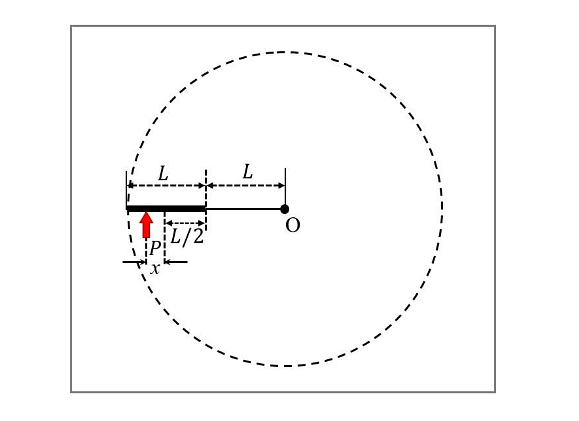
A thin uniform rod of length L and certain mass is kept on a frictionless horizontal table with a massless string of length L fixed to one end (top view is shown in the figure). The other end of the string is pivoted to a point O. If a horizontal impulse P is imparted to the rod at a distance x = L/n from the mid-point of the rod (see figure), then the rod and string revolve together around the point O, with the rod remaining aligned with the string. In such a case, the value of n is _____.
- JEE Advanced - 2024
- Friction