Question:hard
KK, an aspiring entrepreneur, wanted to set up a pen drive manufacturing unit. Since technology was changing very fast, he wanted to carefully judge the demand and the likely profit before investing. A market survey showed he could sell 1 lac (100000) units before customers moved to other gadgets. KK had to bear two kinds of cost: fixed cost (the cost that does not change no matter how many units are made) and variable cost (variable cost per unit times the number of units). He expected the fixed cost to be Rs. 40 lac and the variable cost to be Rs. 100 per unit. He expected to sell each pen drive at Rs. 200.
He discussed his business with a chartered accountant. KK said he was thinking of a loan of Rs. 20 lac at simple interest of \(10\%\) per year to start the business. The chartered accountant told him that in this case KK has to pay interest, followed by \(30\%\) tax. By how much does KK's earnings change with a \(20\%\) growth in sales as against the original sales volume, in both cases considering tax and interest on the loan?
KK, an aspiring entrepreneur, wanted to set up a pen drive manufacturing unit. Since technology was changing very fast, he wanted to carefully judge the demand and the likely profit before investing. A market survey showed he could sell 1 lac (100000) units before customers moved to other gadgets. KK had to bear two kinds of cost: fixed cost (the cost that does not change no matter how many units are made) and variable cost (variable cost per unit times the number of units). He expected the fixed cost to be Rs. 40 lac and the variable cost to be Rs. 100 per unit. He expected to sell each pen drive at Rs. 200.
He discussed his business with a chartered accountant. KK said he was thinking of a loan of Rs. 20 lac at simple interest of \(10\%\) per year to start the business. The chartered accountant told him that in this case KK has to pay interest, followed by \(30\%\) tax. By how much does KK's earnings change with a \(20\%\) growth in sales as against the original sales volume, in both cases considering tax and interest on the loan?
He discussed his business with a chartered accountant. KK said he was thinking of a loan of Rs. 20 lac at simple interest of \(10\%\) per year to start the business. The chartered accountant told him that in this case KK has to pay interest, followed by \(30\%\) tax. By how much does KK's earnings change with a \(20\%\) growth in sales as against the original sales volume, in both cases considering tax and interest on the loan?
Show Hint
Work out net profit (after loan interest and 30% tax) at the original 1 lac units, then again at 1.2 lac units, and compare the two.
Updated On: Jul 10, 2026
- 20%
- 16.7%
- 25.6%
- 34.5%
Show Solution
The Correct Option is D
Solution and Explanation
Step 1: Understanding the Approach:
Instead of recalculating the whole profit and loss twice, we can track just the change caused by the extra sales, since the fixed cost and the loan interest never move.
Step 2: Key Formula:
Each extra unit sold adds its full selling price minus its variable cost to profit before interest and tax (EBIT), because fixed cost is already covered by the original volume. So the rise in EBIT equals the rise in contribution, and fixed cost cancels out of the change.
Step 3: Detailed Working:
Contribution per unit $= 200 - 100 = Rs. 100$.
At the original volume of $100000$ units, contribution $= 100000 \times 100 = Rs. 1,00,00,000$, and EBIT $= 1,00,00,000 - 40,00,000 = Rs. 60,00,000$.
A $20\%$ jump in sales adds $20000$ extra units, worth $20000 \times 100 = Rs. 20,00,000$ of extra contribution. Since fixed cost stays put, EBIT simply rises by this same Rs. $20,00,000$, from Rs. $60,00,000$ to Rs. $80,00,000$.
The loan interest of Rs. $2,00,000$ a year is fixed too, so profit before tax rises from $60,00,000 - 2,00,000 = Rs. 58,00,000$ to $80,00,000 - 2,00,000 = Rs. 78,00,000$, a rise of exactly Rs. $20,00,000$, since the fixed interest cancels out of the difference.
Tax is charged at a flat $30\%$ on profit before tax in both years, so the $(1-0.30)$ factor sits on both the original and the new figure and cancels out when we take a percentage change. This means the percentage change in profit after tax is the same as the percentage change in profit before tax.
Step 4: Final Answer:
Percent change $= \dfrac{20,00,000}{58,00,000} \times 100 \approx 34.5\%$.
So KK's earnings rise by about $34.5\%$, matching option E.
Instead of recalculating the whole profit and loss twice, we can track just the change caused by the extra sales, since the fixed cost and the loan interest never move.
Step 2: Key Formula:
Each extra unit sold adds its full selling price minus its variable cost to profit before interest and tax (EBIT), because fixed cost is already covered by the original volume. So the rise in EBIT equals the rise in contribution, and fixed cost cancels out of the change.
Step 3: Detailed Working:
Contribution per unit $= 200 - 100 = Rs. 100$.
At the original volume of $100000$ units, contribution $= 100000 \times 100 = Rs. 1,00,00,000$, and EBIT $= 1,00,00,000 - 40,00,000 = Rs. 60,00,000$.
A $20\%$ jump in sales adds $20000$ extra units, worth $20000 \times 100 = Rs. 20,00,000$ of extra contribution. Since fixed cost stays put, EBIT simply rises by this same Rs. $20,00,000$, from Rs. $60,00,000$ to Rs. $80,00,000$.
The loan interest of Rs. $2,00,000$ a year is fixed too, so profit before tax rises from $60,00,000 - 2,00,000 = Rs. 58,00,000$ to $80,00,000 - 2,00,000 = Rs. 78,00,000$, a rise of exactly Rs. $20,00,000$, since the fixed interest cancels out of the difference.
Tax is charged at a flat $30\%$ on profit before tax in both years, so the $(1-0.30)$ factor sits on both the original and the new figure and cancels out when we take a percentage change. This means the percentage change in profit after tax is the same as the percentage change in profit before tax.
Step 4: Final Answer:
Percent change $= \dfrac{20,00,000}{58,00,000} \times 100 \approx 34.5\%$.
So KK's earnings rise by about $34.5\%$, matching option E.
Was this answer helpful?
0
Top Questions on Profit and Loss
- Geeta sells A \(→\) 20% (Profit) and B \(→\) 10% (Loss) at the same sp. If she increases SP such that A and B still sold at an equal price and profit of 10% made on B, then profit made on A will be?
- CAT - 2023
- Quantitative Aptitude
- Profit and Loss
- An item is sold with a profit of \(40\%\). If the cost price is reduced by \(40\%\) and Rs. \(5\) are also reduced from it, then the profit will be increased to \(50\%\). Find the final cost price.
- CAT - 2024
- Quantitative Aptitude
- Profit and Loss
- Minu purchases a pair of sunglasses at Rs.1000 and sells to Kanu at 20% profit. Then, Kanu sells it back to Minu at 20% loss. Finally, Minu sells the same pair of sunglasses to Tanu. If the total profit made by Minu from all her transactions is Rs.500, then the percentage of profit made by Minu when she sold the pair of sunglasses to Tanu is
- CAT - 2023
- Quantitative Aptitude
- Profit and Loss
- Jayant bought a certain number of white shirts at the rate of Rs 1000 per piece and a certain number of blue shirts at the rate of Rs 1125 per piece. For each shirt, he then set a fixed market price which was 25% higher than the average cost of all the shirts. He sold all the shirts at a discount of 10% and made a total profit of Rs 51000. If he bought both colors of shirts, then the maximum possible total number of shirts that he could have bought is
- CAT - 2023
- Quantitative Aptitude
- Profit and Loss
- Want to practice more? Try solving extra ecology questions todayView All Questions
Questions Asked in XAT exam
Applicants have been shortlisted for interviews for some data analyst positions. Some of the applicants have advanced expertise in one or more fields among the following: data analysis, database handling and coding. The numbers of applicants with different advanced expertise are given in the 2 × 8 table below.
The number of applicants with advanced expertise in all three fields is given as x in the table, where x is a non-negative integer.
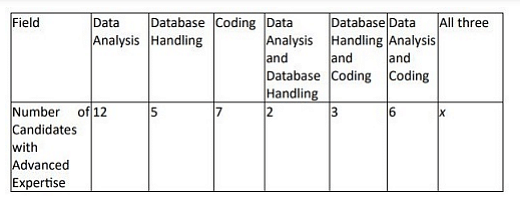
The number of applicants with advanced expertise in all three fields is given as x in the table, where x is a non-negative integer.
- XAT - 2024
- Data Interpretation