Question:medium
In the List-I, four optical effects are mentioned. The physical phenomena of light which are essential to describe these optical effects are given in List-II. Choose the option which describes the correct match between the entries in List-I to those in List-II.
{p{7cm} p{6cm}}
List-I & List-II
(P) Colorful sky in north polar region (Aurora Borealis)
&
(1) Dispersion and reflection
(Q) Partially polarized sunlight
&
(2) Total internal reflection
(R) Rainbow
&
(3) Diffraction
(S) Dark and bright fringes
&
(4) Scattering of light by molecules in the atmosphere
&
(5) Emission of radiation from oxygen and nitrogen atoms excited by charged particles
In the List-I, four optical effects are mentioned. The physical phenomena of light which are essential to describe these optical effects are given in List-II. Choose the option which describes the correct match between the entries in List-I to those in List-II.
{p{7cm} p{6cm}}
List-I & List-II
(P) Colorful sky in north polar region (Aurora Borealis) & (1) Dispersion and reflection
(Q) Partially polarized sunlight & (2) Total internal reflection
(R) Rainbow & (3) Diffraction
(S) Dark and bright fringes & (4) Scattering of light by molecules in the atmosphere
& (5) Emission of radiation from oxygen and nitrogen atoms excited by charged particles
(P) Colorful sky in north polar region (Aurora Borealis) & (1) Dispersion and reflection
(Q) Partially polarized sunlight & (2) Total internal reflection
(R) Rainbow & (3) Diffraction
(S) Dark and bright fringes & (4) Scattering of light by molecules in the atmosphere
& (5) Emission of radiation from oxygen and nitrogen atoms excited by charged particles
Show Hint
Aurora Borealis:
\[
\text{Emission from excited atmospheric atoms}
\]
Rainbow:
\[
\text{Dispersion + internal reflection}
\]
Fringes:
\[
\text{Interference/Diffraction}
\]
Updated On: Jun 4, 2026
- \(P \to 5,\ Q \to 4,\ R \to 1,\ S \to 3\)
- \(P \to 4,\ Q \to 2,\ R \to 1,\ S \to 3\)
- \(P \to 4,\ Q \to 1,\ R \to 2,\ S \to 3\)
- \(P \to 5,\ Q \to 4,\ R \to 1,\ S \to 2\)
Show Solution
The Correct Option is A
Solution and Explanation
Step 1: Understanding the Concept:
This question tests the qualitative understanding of common natural optical phenomena and their physical basis. Most of these effects result from the interaction of light with the atmosphere or specific geometric configurations.
Step 3: Detailed Explanation:
(P) Colorful sky in north polar region (Aurora Borealis): This phenomenon is caused by the interaction of solar wind particles with the Earth's magnetic field, which directs them to the poles. These high-energy particles excite oxygen and nitrogen atoms in the atmosphere. When these atoms de-excite, they emit characteristic radiation. Thus, it matches (5) "Emission of radiation from excited atoms".
(Q) Partially polarized sun light: When unpolarized sunlight enters the atmosphere, it is scattered by gas molecules and small particles. Rayleigh scattering causes the scattered light to become partially polarized, especially when viewed at \( 90^{\circ} \) to the sun's direction. Thus, it matches (4) "Scattering of light by molecules in the atmosphere".
(R) Rainbow: A primary rainbow is formed by the dispersion of sunlight as it enters a raindrop, followed by one internal reflection, and finally dispersion again as it exits. Thus, the essential phenomena are dispersion and reflection. Matches (1).
(S) Dark and bright fringes: These are the result of the superposition of waves, leading to constructive and destructive interference. This is typically observed in diffraction and interference experiments. Matches (3) "Diffraction".
Step 4: Final Answer:
Matching each effect to its fundamental physical cause leads to the combination in option (A).
This question tests the qualitative understanding of common natural optical phenomena and their physical basis. Most of these effects result from the interaction of light with the atmosphere or specific geometric configurations.
Step 3: Detailed Explanation:
(P) Colorful sky in north polar region (Aurora Borealis): This phenomenon is caused by the interaction of solar wind particles with the Earth's magnetic field, which directs them to the poles. These high-energy particles excite oxygen and nitrogen atoms in the atmosphere. When these atoms de-excite, they emit characteristic radiation. Thus, it matches (5) "Emission of radiation from excited atoms".
(Q) Partially polarized sun light: When unpolarized sunlight enters the atmosphere, it is scattered by gas molecules and small particles. Rayleigh scattering causes the scattered light to become partially polarized, especially when viewed at \( 90^{\circ} \) to the sun's direction. Thus, it matches (4) "Scattering of light by molecules in the atmosphere".
(R) Rainbow: A primary rainbow is formed by the dispersion of sunlight as it enters a raindrop, followed by one internal reflection, and finally dispersion again as it exits. Thus, the essential phenomena are dispersion and reflection. Matches (1).
(S) Dark and bright fringes: These are the result of the superposition of waves, leading to constructive and destructive interference. This is typically observed in diffraction and interference experiments. Matches (3) "Diffraction".
Step 4: Final Answer:
Matching each effect to its fundamental physical cause leads to the combination in option (A).
Was this answer helpful?
0
Top Questions on Ray optics and optical instruments
- A light ray passes from air (refractive index = 1) into water (refractive index = 1.33). If the angle of incidence is 30°, what is the angle of refraction in water?
- MHT CET - 2025
- Physics
- Ray optics and optical instruments
- A convex lens has a focal length of 20 cm. An object is placed 30 cm in front of the lens. What is the image distance from the lens?
- MHT CET - 2025
- Physics
- Ray optics and optical instruments
- A lens has focal length $ f = 20 \, \text{cm} $. What is the power of the lens?
- MHT CET - 2025
- Physics
- Ray optics and optical instruments
- An object is placed at a distance of 10 cm from a concave mirror of focal length 15 cm. What is the image distance?
- MHT CET - 2025
- Physics
- Ray optics and optical instruments
- Want to practice more? Try solving extra ecology questions todayView All Questions
Questions Asked in JEE Advanced exam
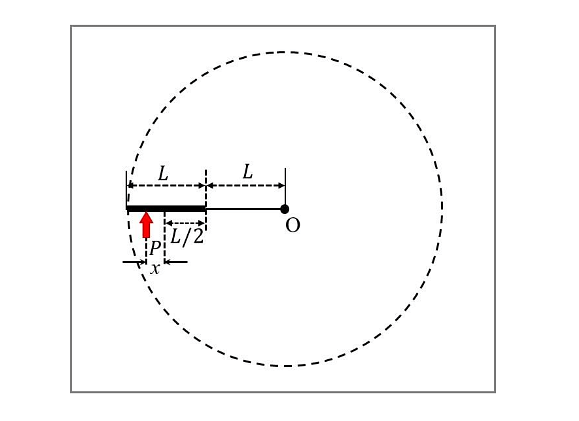
A thin uniform rod of length L and certain mass is kept on a frictionless horizontal table with a massless string of length L fixed to one end (top view is shown in the figure). The other end of the string is pivoted to a point O. If a horizontal impulse P is imparted to the rod at a distance x = L/n from the mid-point of the rod (see figure), then the rod and string revolve together around the point O, with the rod remaining aligned with the string. In such a case, the value of n is _____.
- JEE Advanced - 2024
- Friction