Question:medium
In a vacuum chamber, a particle of charge \(1\,\mu\text{C}\) and mass \(1\,\text{mg}\) is projected with a velocity \((\hat{i}+2\hat{j})\,\text{ms}^{-1}\) from the \(XZ\)-plane at time \(t=0\) in an electric field of \(1\hat{i}\,\text{Vm}^{-1}\). At \(t=0.2\,\text{s}\), the electric field is switched off and a magnetic field of \(6\hat{j}\,\text{T}\) is switched on. The acceleration due to gravity is \(-10\hat{j}\,\text{ms}^{-2}\). Correct option(s) is/are:
In a vacuum chamber, a particle of charge \(1\,\mu\text{C}\) and mass \(1\,\text{mg}\) is projected with a velocity \((\hat{i}+2\hat{j})\,\text{ms}^{-1}\) from the \(XZ\)-plane at time \(t=0\) in an electric field of \(1\hat{i}\,\text{Vm}^{-1}\). At \(t=0.2\,\text{s}\), the electric field is switched off and a magnetic field of \(6\hat{j}\,\text{T}\) is switched on. The acceleration due to gravity is \(-10\hat{j}\,\text{ms}^{-2}\). Correct option(s) is/are:
Show Hint
Neither field has a vertical component, so y = 2t - 5t^2 throughout. The radius after 0.2 s is mv/(qB) with v = 1.2 m/s.
Updated On: Nov 19, 2026
- The vertical distance of the particle from the $XZ$ plane at $t = 0.3 \text{ s}$ is $15 \text{ cm}$.
- The vertical distance of the particle from the $XZ$ plane at $t = 0.4 \text{ s}$ is $10 \text{ cm}$.
- The radius of the trajectory of the particle for $t > 0.2 \text{ s}$ is $20 \text{ cm}$.
- The particle will be in the $XZ$ plane at $t = 0.35 \text{ s}$.
Show Solution
The Correct Option is A, C
Solution and Explanation
Step 1: Spot what is common to the whole motion:
The electric field is along $\hat{i}$ and the magnetic field is along $\hat{j}$. Neither gives a force along $\hat{j}$.
So the only force along the vertical is gravity, for the whole time. The vertical motion is a simple projectile motion.
Step 2: Vertical position at any time:
Start with $v_y = 2\ \text{m/s}$ upward and $g = 10\ \text{m/s}^2$ downward.
\[ y(t) = 2t - 5t^2 \quad \text{for all } t \]
The particle returns to $y = 0$ when $2t = 5t^2$, that is at $t = 0.4\ \text{s}$.
Step 3: Evaluate at the times in the options:
\[ y(0.3) = 0.6 - 0.45 = 0.15\ \text{m} = 15\ \text{cm} \]
\[ y(0.4) = 0.8 - 0.8 = 0 \]
\[ y(0.35) = 0.7 - 0.6125 = 0.0875\ \text{m} = 8.75\ \text{cm} \]
So (A) is correct, (B) is incorrect (the distance is $0$, not $10\ \text{cm}$), and (D) is incorrect (the particle is $8.75\ \text{cm}$ above the plane).
Step 4: Radius of the circle after 0.2 s:
The horizontal velocity at $0.2\ \text{s}$ comes only from the electric force: $v_x = 1 + \dfrac{qE}{m}(0.2) = 1.2\ \text{m/s}$, and $v_z = 0$.
The magnetic field turns this velocity in a circle in the plane perpendicular to $\hat{j}$. Equate the magnetic force to the centripetal force.
\[ qvB = \frac{mv^2}{r} \;\Rightarrow\; r = \frac{mv}{qB} = \frac{10^{-6} \times 1.2}{10^{-6} \times 6} = 0.2\ \text{m} \]
So (C) is correct.
Final Answer:
Options (A) and (C) are correct. \[ \boxed{\text{(A), (C)}} \]
Was this answer helpful?
0
Top Questions on Electromagnetism
- In the circuit shown, find \( C \) if the effective capacitance of the whole circuit is to be 0.5 \(\mu F\). All values in the circuit are in \(\mu F\).

- VITEEE - 2024
- Physics
- Electromagnetism
- A cylinder of fixed capacity of 44.8 litres contains helium gas at standard temperature and pressure. The amount of heat needed to raise the temperature of gas in the cylinder by 20.0°C will be:
- VITEEE - 2024
- Physics
- Electromagnetism
- A heavy box of mass 50 kg is moving on a horizontal surface. If the coefficient of kinetic friction between the box and the horizontal surface is 0.3, then the force of kinetic friction is:
- VITEEE - 2024
- Physics
- Electromagnetism
- A charge particle moving in magnetic field \( B \), has components of velocity along \( B \) as well as perpendicular to \( B \). The path of the charge particle will be:
- VITEEE - 2024
- Physics
- Electromagnetism
- Want to practice more? Try solving extra ecology questions todayView All Questions
Questions Asked in JEE Advanced exam
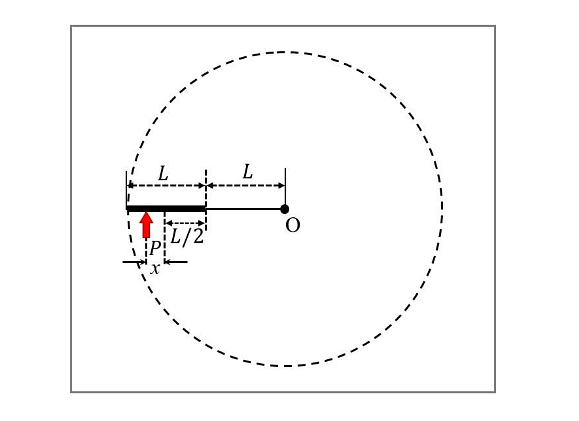
A thin uniform rod of length L and certain mass is kept on a frictionless horizontal table with a massless string of length L fixed to one end (top view is shown in the figure). The other end of the string is pivoted to a point O. If a horizontal impulse P is imparted to the rod at a distance x = L/n from the mid-point of the rod (see figure), then the rod and string revolve together around the point O, with the rod remaining aligned with the string. In such a case, the value of n is _____.
- JEE Advanced - 2024
- Friction