Question:hard
If \(R = \{(1,1), (2,2), (1,2), (2,1), (3,3)\}\) and \(S = \{(1,1), (2,2), (2,3), (3,2), (3,3)\}\) are two relations on the set \(X = \{1, 2, 3\}\), the incorrect statement is:
If \(R = \{(1,1), (2,2), (1,2), (2,1), (3,3)\}\) and \(S = \{(1,1), (2,2), (2,3), (3,2), (3,3)\}\) are two relations on the set \(X = \{1, 2, 3\}\), the incorrect statement is:
Show Hint
Check reflexive, symmetric and transitive for each combination separately; the union of two equivalence relations is not always transitive.
Updated On: Jul 13, 2026
- R and S are both equivalence relations
- \(R \cap S\) is an equivalence relation
- \(R^{-1} \cap S^{-1}\) is an equivalence relation
- \(R \cup S\) is an equivalence relation
Show Solution
The Correct Option is D
Solution and Explanation
Step 1: Think of equivalence relations as partitions.
Every equivalence relation on a set splits that set into disjoint groups, called equivalence classes, and every such grouping (partition) gives back an equivalence relation. This is a cleaner lens to check the four options.
Step 2: Identify the partitions for R and S.
R relates 1 and 2 to each other and leaves 3 alone, so R corresponds to the partition $\{1,2\}, \{3\}$. This is a valid partition of $X = \{1,2,3\}$, so R is an equivalence relation.
S relates 2 and 3 to each other and leaves 1 alone, so S corresponds to the partition $\{1\}, \{2,3\}$. This is also a valid partition, so S is an equivalence relation too.
Step 3: Intersections correspond to a common refinement.
$R \cap S$ keeps only the pairs both relations agree on, which is just $\{(1,1),(2,2),(3,3)\}$, everyone only related to themselves. That is the partition $\{1\},\{2\},\{3\}$, still a valid partition, so $R \cap S$ is an equivalence relation.
Since both R and S are symmetric, reversing all their pairs changes nothing, so $R^{-1} \cap S^{-1}$ gives the exact same set and is an equivalence relation for the same reason.
Step 4: Unions do not correspond to a partition in general.
$R \cup S$ tries to keep 1 and 2 together (from R) and 2 and 3 together (from S) at the same time. But grouping 1 with 2, and 2 with 3, forces 1 and 3 into the same group too if the result is to be a genuine partition, and the pair $(1,3)$ is missing from $R \cup S$.
So $R \cup S$ does not match any valid partition of $X$, which means it cannot be an equivalence relation. Concretely, it fails transitivity since $(1,2)$ and $(2,3)$ are present but $(1,3)$ is not.
Step 5: Match this back to the four statements.
Statement (A), about R and S, is correct. Statements (B) and (C), about the intersections, are correct. Statement (D), claiming $R \cup S$ is an equivalence relation, is the one that is wrong.
\[ \boxed{\text{The incorrect statement is (D)}} \]
Every equivalence relation on a set splits that set into disjoint groups, called equivalence classes, and every such grouping (partition) gives back an equivalence relation. This is a cleaner lens to check the four options.
Step 2: Identify the partitions for R and S.
R relates 1 and 2 to each other and leaves 3 alone, so R corresponds to the partition $\{1,2\}, \{3\}$. This is a valid partition of $X = \{1,2,3\}$, so R is an equivalence relation.
S relates 2 and 3 to each other and leaves 1 alone, so S corresponds to the partition $\{1\}, \{2,3\}$. This is also a valid partition, so S is an equivalence relation too.
Step 3: Intersections correspond to a common refinement.
$R \cap S$ keeps only the pairs both relations agree on, which is just $\{(1,1),(2,2),(3,3)\}$, everyone only related to themselves. That is the partition $\{1\},\{2\},\{3\}$, still a valid partition, so $R \cap S$ is an equivalence relation.
Since both R and S are symmetric, reversing all their pairs changes nothing, so $R^{-1} \cap S^{-1}$ gives the exact same set and is an equivalence relation for the same reason.
Step 4: Unions do not correspond to a partition in general.
$R \cup S$ tries to keep 1 and 2 together (from R) and 2 and 3 together (from S) at the same time. But grouping 1 with 2, and 2 with 3, forces 1 and 3 into the same group too if the result is to be a genuine partition, and the pair $(1,3)$ is missing from $R \cup S$.
So $R \cup S$ does not match any valid partition of $X$, which means it cannot be an equivalence relation. Concretely, it fails transitivity since $(1,2)$ and $(2,3)$ are present but $(1,3)$ is not.
Step 5: Match this back to the four statements.
Statement (A), about R and S, is correct. Statements (B) and (C), about the intersections, are correct. Statement (D), claiming $R \cup S$ is an equivalence relation, is the one that is wrong.
\[ \boxed{\text{The incorrect statement is (D)}} \]
Was this answer helpful?
0
Top Questions on Set Theory
- Consider two sets A = {2, 3, 5, 7, 11, 13} and B = {1, 8, 27}. Let f be a function from A to B such that for every element b in B, there is at least one element a in A such that f(a) = b. Then, the total number of such functions f is
- CAT - 2024
- Quantitative Aptitude
- Set Theory
- An electronic company conducts a survey of 1500 houses for their products. The survey suggested that 862 houses own TV, 783 houses has AC and 736 houses has washing machine. There were 95 houses having only TV, 136 houses having only AC and 88 houses having only washing machine. There were 398 houses having all the three equipments. How many houses have only TV and washing machine but not AC?
- IBSAT
- Quantitative Aptitude
- Set Theory
- Two identical circles intersect so that their centres, and the points at which they intersect, form a square of side 2 cm. What is the area of the portion that is common to both the circles?
- IBSAT
- Quantitative Aptitude
- Set Theory
- A group of 40 students appeared in an examination of 3 subjects – Mathematics, Physics & Chemistry. It was found that all students passed in at least one of the subjects, 20 students passed in Mathematics, 25 students passed in Physics, 16 students passed in Chemistry, at most 11 students passed in both Mathematics and Physics, at most 15 students passed in both Physics and Chemistry, at most 15 students passed in both Mathematics and Chemistry. The maximum number of students passed in all the three subjects is ________.
- JEE Main - 2024
- Mathematics
- Set Theory
- Want to practice more? Try solving extra ecology questions todayView All Questions
Questions Asked in XAT exam
Applicants have been shortlisted for interviews for some data analyst positions. Some of the applicants have advanced expertise in one or more fields among the following: data analysis, database handling and coding. The numbers of applicants with different advanced expertise are given in the 2 × 8 table below.
The number of applicants with advanced expertise in all three fields is given as x in the table, where x is a non-negative integer.
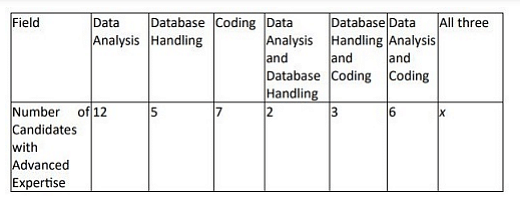
The number of applicants with advanced expertise in all three fields is given as x in the table, where x is a non-negative integer.
- XAT - 2024
- Data Interpretation