Question:hard
If \(n\) is a positive integer, let \(S(n)\) denote the sum of the positive divisors of \(n\), including \(n\) itself, and let \(G(n)\) be the greatest divisor of \(n\). If \(H(n) = \dfrac{G(n)}{S(n)}\), then which of the following is the largest?
If \(n\) is a positive integer, let \(S(n)\) denote the sum of the positive divisors of \(n\), including \(n\) itself, and let \(G(n)\) be the greatest divisor of \(n\). If \(H(n) = \dfrac{G(n)}{S(n)}\), then which of the following is the largest?
Show Hint
The greatest divisor of any n is n itself, so H(n) = n/S(n) is largest when n has the fewest extra divisors, which happens when n is prime.
Updated On: Jul 13, 2026
- \(H(2009)\)
- \(H(2010)\)
- \(H(2011)\)
- \(H(2012)\)
Show Solution
The Correct Option is C
Solution and Explanation
Step 1: Rewrite H(n) using a reciprocal trick.
The greatest divisor of $n$ is $n$ itself, so $G(n) = n$ and $H(n) = n / S(n)$. Divide the numerator and denominator by $n$:
\[ H(n) = \frac{1}{S(n)/n} = \frac{1}{\sum_{d \mid n} \frac{1}{d}} \]
since if $d$ runs over every divisor of $n$, so does $n/d$, which means $S(n)/n$ is just the sum of $1/d$ over every divisor $d$ of $n$. So H(n) is largest exactly when this reciprocal sum is smallest.
Step 2: Figure out which kind of number makes that reciprocal sum small.
Every number has 1 and itself as divisors, contributing $1 + 1/n$ to the sum. Any extra divisor $d$ with $1 < d < n$ adds a further positive term $1/d$ on top of that. A number with no divisors besides 1 and itself, that is, a prime number, has the smallest possible reciprocal sum. Composite numbers always add extra positive terms and push the sum up.
Step 3: Check which of 2009, 2010, 2011, 2012 is prime.
2010 is even, so it is divisible by 2 right away, hence composite.
2009 factors as $7 \times 287 = 7 \times 7 \times 41$, so it is composite.
2012 is even too, in fact $2012 = 4 \times 503$, so it is composite.
2011 is odd, its digit sum is 4 so it is not divisible by 3, it does not end in 0 or 5, and testing every prime up to $\sqrt{2011} \approx 44.8$ (7, 11, 13, up to 43) leaves no exact division, so 2011 is prime.
Step 4: Conclude directly from the reciprocal-sum rule.
Since 2011 is prime, its reciprocal sum is just $1 + \frac{1}{2011} \approx 1.0005$, the smallest of the four choices by a wide margin. 2009, 2010 and 2012 are all composite and carry extra divisors like 2, 3, 7 or 41, each adding a noticeably larger extra term (for example $1/2 = 0.5$ for 2010, or $1/7 \approx 0.143$ for 2009), so their reciprocal sums sit well above 1.0005.
Final Answer:
The smallest reciprocal-divisor sum belongs to 2011, so H(2011) is the largest of the four.
\[ \boxed{\text{Option (C): } H(2011)} \]
The greatest divisor of $n$ is $n$ itself, so $G(n) = n$ and $H(n) = n / S(n)$. Divide the numerator and denominator by $n$:
\[ H(n) = \frac{1}{S(n)/n} = \frac{1}{\sum_{d \mid n} \frac{1}{d}} \]
since if $d$ runs over every divisor of $n$, so does $n/d$, which means $S(n)/n$ is just the sum of $1/d$ over every divisor $d$ of $n$. So H(n) is largest exactly when this reciprocal sum is smallest.
Step 2: Figure out which kind of number makes that reciprocal sum small.
Every number has 1 and itself as divisors, contributing $1 + 1/n$ to the sum. Any extra divisor $d$ with $1 < d < n$ adds a further positive term $1/d$ on top of that. A number with no divisors besides 1 and itself, that is, a prime number, has the smallest possible reciprocal sum. Composite numbers always add extra positive terms and push the sum up.
Step 3: Check which of 2009, 2010, 2011, 2012 is prime.
2010 is even, so it is divisible by 2 right away, hence composite.
2009 factors as $7 \times 287 = 7 \times 7 \times 41$, so it is composite.
2012 is even too, in fact $2012 = 4 \times 503$, so it is composite.
2011 is odd, its digit sum is 4 so it is not divisible by 3, it does not end in 0 or 5, and testing every prime up to $\sqrt{2011} \approx 44.8$ (7, 11, 13, up to 43) leaves no exact division, so 2011 is prime.
Step 4: Conclude directly from the reciprocal-sum rule.
Since 2011 is prime, its reciprocal sum is just $1 + \frac{1}{2011} \approx 1.0005$, the smallest of the four choices by a wide margin. 2009, 2010 and 2012 are all composite and carry extra divisors like 2, 3, 7 or 41, each adding a noticeably larger extra term (for example $1/2 = 0.5$ for 2010, or $1/7 \approx 0.143$ for 2009), so their reciprocal sums sit well above 1.0005.
Final Answer:
The smallest reciprocal-divisor sum belongs to 2011, so H(2011) is the largest of the four.
\[ \boxed{\text{Option (C): } H(2011)} \]
Was this answer helpful?
0
Top Questions on Number System
- Find the number of integers \(n\) such that \(1 \leq n \leq 100\) and \(n^2 + 3n + 2\) is divisible by 5.
- BITSAT - 2025
- Mathematics
- Number System
- Find the smallest number between 2000 and 3000 that is exactly divisible by 21, 24 and 28.
- SNAP - 2024
- Quantitative Aptitude
- Number System
- Based on the given pattern find the next term of the given series: 5, 6, 16, 57, 244, 1245, ?
- SNAP - 2024
- Quantitative Aptitude
- Number System
- There are 3 different types of rice weighing \(435,\ 493,\) and \(551\) kg respectively. The rice is packed in bags so that no two types are mixed and all bags are of equal size. Find the least number of bags.
- SNAP - 2024
- Quantitative Aptitude
- Number System
- Want to practice more? Try solving extra ecology questions todayView All Questions
Questions Asked in XAT exam
Applicants have been shortlisted for interviews for some data analyst positions. Some of the applicants have advanced expertise in one or more fields among the following: data analysis, database handling and coding. The numbers of applicants with different advanced expertise are given in the 2 × 8 table below.
The number of applicants with advanced expertise in all three fields is given as x in the table, where x is a non-negative integer.
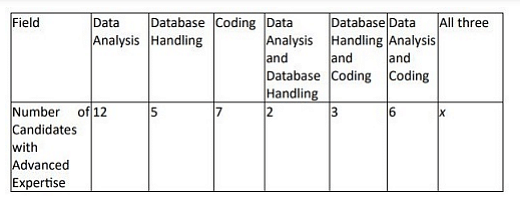
The number of applicants with advanced expertise in all three fields is given as x in the table, where x is a non-negative integer.
- XAT - 2024
- Data Interpretation