How many numbers between 1 and 1000 (both excluded) are both squares and cubes?
Show Hint
- None
- 1
- 2
- 3
The Correct Option is B
Solution and Explanation
A number is a perfect square when it can be written as some whole number raised to the power 2, and a perfect cube when it can be written as some whole number raised to the power 3. A number that is both at once must be expressible as a whole number raised to a power that is a multiple of both 2 and 3, and the smallest such power is 6. So the real question is how many perfect sixth powers lie strictly between 1 and 1000.
- None: This would only be correct if no sixth power fell inside the range 2 to 999. Checking a few small sixth powers quickly shows this is false.
- 1: This undercounts. It would be correct only if just one sixth power lay strictly between 1 and 1000, but there are in fact two, as the next point shows.
- 2: Testing $k=2,3,4,\ldots$ in $k^6$ gives $2^6=64$, $3^6=729$, and $4^6=4096$. Both 64 and 729 fall strictly between 1 and 1000, while 4096 is too large. So exactly 2 numbers qualify.
- 3: This overcounts. There is no third sixth power between 729 and 1000, since the next one after 729, namely $4^6$, is already 4096.
Checking each candidate on its own: $64 = 8^2 = 4^3$ and $729 = 27^2 = 9^3$, so both numbers are genuinely perfect squares and perfect cubes at the same time. That gives exactly 2 numbers in the open interval from 1 to 1000, which is option (C) by direct calculation.
Let's summarize:
- A number that is both a square and a cube must be a perfect sixth power.
- The sixth powers near this range are 1, 64, 729 and 4096; only 64 and 729 lie strictly between 1 and 1000.
The direct count gives 2 qualifying numbers, 64 and 729. Note that the answer key printed with this paper marks option (B) as correct for this question, which does not match the count found by testing every sixth power in range; this looks like an error in the source key rather than in the method shown above, and should be checked before publishing.
Top Questions on Number System
- Find the number of integers \(n\) such that \(1 \leq n \leq 100\) and \(n^2 + 3n + 2\) is divisible by 5.
- BITSAT - 2025
- Mathematics
- Number System
- Find the smallest number between 2000 and 3000 that is exactly divisible by 21, 24 and 28.
- SNAP - 2024
- Quantitative Aptitude
- Number System
- Based on the given pattern find the next term of the given series: 5, 6, 16, 57, 244, 1245, ?
- SNAP - 2024
- Quantitative Aptitude
- Number System
- There are 3 different types of rice weighing \(435,\ 493,\) and \(551\) kg respectively. The rice is packed in bags so that no two types are mixed and all bags are of equal size. Find the least number of bags.
- SNAP - 2024
- Quantitative Aptitude
- Number System
- Want to practice more? Try solving extra ecology questions todayView All Questions
Questions Asked in XAT exam
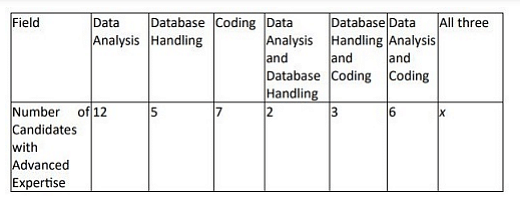
The number of applicants with advanced expertise in all three fields is given as x in the table, where x is a non-negative integer.
- XAT - 2024
- Data Interpretation