Eight sets A, B, C, D, E, F, G and H are such that:
A is a superset of B, but subset of C.
B is a subset of D, but superset of E.
F is a subset of A, but superset of B.
G is a superset of D, but subset of F.
H is a subset of B.
N(A), N(B), N(C), N(D), N(E), N(F), N(G) and N(H) are the number of elements in the sets A, B, C, D, E, F, G and H respectively.
If Q and Z are two new sets, both supersets of H, and N(Q) and N(Z) are the number of elements of the sets Q and Z respectively, then:
Eight sets A, B, C, D, E, F, G and H are such that:
A is a superset of B, but subset of C.
B is a subset of D, but superset of E.
F is a subset of A, but superset of B.
G is a superset of D, but subset of F.
H is a subset of B.
N(A), N(B), N(C), N(D), N(E), N(F), N(G) and N(H) are the number of elements in the sets A, B, C, D, E, F, G and H respectively.
If Q and Z are two new sets, both supersets of H, and N(Q) and N(Z) are the number of elements of the sets Q and Z respectively, then:
Show Hint
- N(H) is the smallest of all
- N(E) is the smallest of all
- N(C) is the greatest of all
- Either N(H) or N(E) is the smallest
The Correct Option is D
Solution and Explanation
Two new sets are added here, Q and Z, but both are only pinned down as supersets of H: N(Q) and N(Z) are at least N(H), with nothing said about how big they can get. To find what must be true, line up every set's position using the passage: H and E both sit inside B, and B sits inside D, which sits inside G, which sits inside F, which sits inside A, which sits inside C.
- N(H) is the smallest of all: this fails as a certainty because E was never compared to H directly. If E turns out smaller than H, this statement breaks.
- N(E) is the smallest of all: fails for the mirror reason, since H could turn out smaller than E instead.
- N(C) is the greatest of all: this held for the original eight sets, but Q and Z are new sets with no upper limit placed on them beyond containing H. Either one could be built bigger than C, so C cannot be guaranteed to stay on top once Q and Z exist.
- Either N(H) or N(E) is the smallest: since every other set, B, D, G, F, A, C, sits at or above B, and both H and E sit at or below B, neither B nor anything above it can undercut both H and E at once. And Q and Z, being supersets of H, can never be smaller than H either. So no matter which of H or E is actually smaller, the overall smallest count among every set in play belongs to one of these two.
The first two options each name one specific set as the smallest, but the passage leaves the H versus E comparison open, so neither can be asserted with certainty. The third option gets knocked out once the unrestricted Q and Z enter the picture. Only the fourth option survives, because it correctly hedges between the two candidates without needing to know which one wins.
Let's summarize:
- H and E are both below every other original set, but never compared with each other, so the smallest count is one of the two, we just cannot say which.
- Q and Z being unrestricted supersets of H means they can beat C in size, so C is no longer guaranteed to be the greatest once they exist.
So the statement that must be true is that either N(H) or N(E) is the smallest. The answer is option (D).
Top Questions on Set Theory
- Consider two sets A = {2, 3, 5, 7, 11, 13} and B = {1, 8, 27}. Let f be a function from A to B such that for every element b in B, there is at least one element a in A such that f(a) = b. Then, the total number of such functions f is
- CAT - 2024
- Quantitative Aptitude
- Set Theory
- An electronic company conducts a survey of 1500 houses for their products. The survey suggested that 862 houses own TV, 783 houses has AC and 736 houses has washing machine. There were 95 houses having only TV, 136 houses having only AC and 88 houses having only washing machine. There were 398 houses having all the three equipments. How many houses have only TV and washing machine but not AC?
- IBSAT
- Quantitative Aptitude
- Set Theory
- Two identical circles intersect so that their centres, and the points at which they intersect, form a square of side 2 cm. What is the area of the portion that is common to both the circles?
- IBSAT
- Quantitative Aptitude
- Set Theory
- A group of 40 students appeared in an examination of 3 subjects – Mathematics, Physics & Chemistry. It was found that all students passed in at least one of the subjects, 20 students passed in Mathematics, 25 students passed in Physics, 16 students passed in Chemistry, at most 11 students passed in both Mathematics and Physics, at most 15 students passed in both Physics and Chemistry, at most 15 students passed in both Mathematics and Chemistry. The maximum number of students passed in all the three subjects is ________.
- JEE Main - 2024
- Mathematics
- Set Theory
- Want to practice more? Try solving extra ecology questions todayView All Questions
Questions Asked in XAT exam
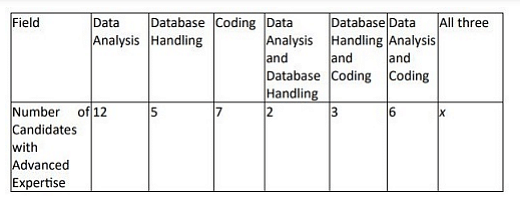
The number of applicants with advanced expertise in all three fields is given as x in the table, where x is a non-negative integer.
- XAT - 2024
- Data Interpretation