Eight sets A, B, C, D, E, F, G and H are such that:
A is a superset of B, but subset of C.
B is a subset of D, but superset of E.
F is a subset of A, but superset of B.
G is a superset of D, but subset of F.
H is a subset of B.
N(A), N(B), N(C), N(D), N(E), N(F), N(G) and N(H) are the number of elements in the sets A, B, C, D, E, F, G and H respectively.
Which one of the following could be FALSE, but not necessarily FALSE?
Eight sets A, B, C, D, E, F, G and H are such that:
A is a superset of B, but subset of C.
B is a subset of D, but superset of E.
F is a subset of A, but superset of B.
G is a superset of D, but subset of F.
H is a subset of B.
N(A), N(B), N(C), N(D), N(E), N(F), N(G) and N(H) are the number of elements in the sets A, B, C, D, E, F, G and H respectively.
Which one of the following could be FALSE, but not necessarily FALSE?
Show Hint
- E is a subset of D
- E is a subset of C
- E is a subset of A
- E is a subset of H
The Correct Option is D
Solution and Explanation
This question is about which containment relationships are locked in by the passage and which are left open. The safest way to check is to picture the sets as one nested arrangement and see what is actually forced.
Reading the eight lines of the passage as a picture: H sits inside B, and E also sits inside B, but nothing tells us how H and E sit relative to each other. From B outward, the picture widens step by step: B sits inside D, D sits inside G, G sits inside F, F sits inside A, and A sits inside C. So starting from E and moving outward, we pass through B, D, G, F, A, and finally C, in that fixed order.
- E is a subset of D: forced true, because E sits inside B and B sits inside D, so E is automatically inside D too.
- E is a subset of C: forced true, because the whole outward chain from E eventually lands inside C.
- E is a subset of A: forced true, for the same reason, since A appears on that same outward chain before C.
- E is a subset of H: this pairs up two sets, E and H, that both sit inside B but were never compared with each other anywhere in the passage. Nothing forces E inside H, and nothing forbids it either.
So the first three statements are always true and can never be false, while the fourth one is genuinely open: it might hold in one valid arrangement of the sets and fail in another.
Let's summarize:
- Every relationship that follows the passage's outward chain, from E to B to D to G to F to A to C, is always true.
- E and H were never compared to each other, so any statement linking them directly is undecided, not fixed.
Since "E is a subset of H" is the only statement not pinned down by the passage, it is the one that could be false without being necessarily false. The answer is option (D).
Top Questions on Set Theory
- Consider two sets A = {2, 3, 5, 7, 11, 13} and B = {1, 8, 27}. Let f be a function from A to B such that for every element b in B, there is at least one element a in A such that f(a) = b. Then, the total number of such functions f is
- CAT - 2024
- Quantitative Aptitude
- Set Theory
- An electronic company conducts a survey of 1500 houses for their products. The survey suggested that 862 houses own TV, 783 houses has AC and 736 houses has washing machine. There were 95 houses having only TV, 136 houses having only AC and 88 houses having only washing machine. There were 398 houses having all the three equipments. How many houses have only TV and washing machine but not AC?
- IBSAT
- Quantitative Aptitude
- Set Theory
- Two identical circles intersect so that their centres, and the points at which they intersect, form a square of side 2 cm. What is the area of the portion that is common to both the circles?
- IBSAT
- Quantitative Aptitude
- Set Theory
- A group of 40 students appeared in an examination of 3 subjects – Mathematics, Physics & Chemistry. It was found that all students passed in at least one of the subjects, 20 students passed in Mathematics, 25 students passed in Physics, 16 students passed in Chemistry, at most 11 students passed in both Mathematics and Physics, at most 15 students passed in both Physics and Chemistry, at most 15 students passed in both Mathematics and Chemistry. The maximum number of students passed in all the three subjects is ________.
- JEE Main - 2024
- Mathematics
- Set Theory
- Want to practice more? Try solving extra ecology questions todayView All Questions
Questions Asked in XAT exam
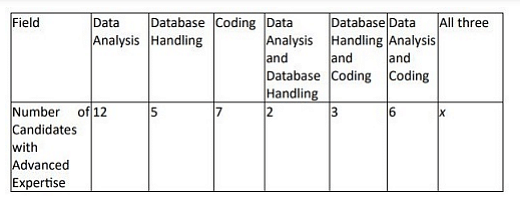
The number of applicants with advanced expertise in all three fields is given as x in the table, where x is a non-negative integer.
- XAT - 2024
- Data Interpretation