Question:medium
Each of the following questions is followed by two statements, I and II. Answer as follows:
Mark option (1) if the question can be answered using statement I alone, but not using statement II alone.
Mark option (2) if the question can be answered using statement II alone, but not using statement I alone.
Mark option (3) if the question can be answered using both statements I and II together, but not by using either statement alone.
Mark option (4) if the question cannot be answered even using both statements I and II together.
A, B, C and D are points on a straight line. Is AB = BC = CD?
I. AC = 2 CD
II. AB = BC
Each of the following questions is followed by two statements, I and II. Answer as follows:
Mark option (1) if the question can be answered using statement I alone, but not using statement II alone.
Mark option (2) if the question can be answered using statement II alone, but not using statement I alone.
Mark option (3) if the question can be answered using both statements I and II together, but not by using either statement alone.
Mark option (4) if the question cannot be answered even using both statements I and II together.
A, B, C and D are points on a straight line. Is AB = BC = CD?
I. AC = 2 CD
II. AB = BC
Mark option (1) if the question can be answered using statement I alone, but not using statement II alone.
Mark option (2) if the question can be answered using statement II alone, but not using statement I alone.
Mark option (3) if the question can be answered using both statements I and II together, but not by using either statement alone.
Mark option (4) if the question cannot be answered even using both statements I and II together.
A, B, C and D are points on a straight line. Is AB = BC = CD?
I. AC = 2 CD
II. AB = BC
Show Hint
Write AC = AB + BC and turn each statement into an equation in three unknowns; check if one equation alone forces all three lengths equal, or if you need both together.
Updated On: Jul 13, 2026
- The question can be answered using statement I alone, but not using statement II alone.
- The question can be answered using statement II alone, but not using statement I alone.
- The question can be answered using both statements I and II together, but not by using either statement alone.
- The question cannot be answered even using both statements I and II together.
Show Solution
The Correct Option is C
Solution and Explanation
Step 1: Assign variables.
Let $AB = p$, $BC = q$, $CD = r$, all positive lengths, with A, B, C, D lying on the line in that order, so $AC = p + q$.
The question is whether $p = q = r$ must hold.
Step 2: Check statement I on its own.
Statement I says $AC = 2CD$, so $p + q = 2r$.
Try $p = 2$, $q = 2$, $r = 2$: this fits since $4 = 2 \times 2$, and here $p = q = r$.
Try $p = 1$, $q = 3$, $r = 2$: this also fits since $4 = 2 \times 2$, but here $p \ne q$.
Two different sets of values satisfy the same equation and give opposite answers to the question, so statement I alone cannot settle it.
Step 3: Check statement II on its own.
Statement II says $AB = BC$, so $p = q$.
This says nothing about $r$. $r$ could equal $p$ or be any other length, so we still cannot decide if $p = q = r$.
Statement II alone also fails.
Step 4: Use both statements together.
From statement II, $p = q$, so $AC = p + q = 2p$.
From statement I, $AC = 2r$.
Setting these equal: $2p = 2r$, so $p = r$.
Combined with $p = q$, we now get $p = q = r$, which means $AB = BC = CD$ always holds once both statements are used.
Final Answer:
Neither statement alone fixes the answer, but together they force $AB = BC = CD$ every time.
\[ \boxed{\text{Option (3): both statements together are needed}} \]
Let $AB = p$, $BC = q$, $CD = r$, all positive lengths, with A, B, C, D lying on the line in that order, so $AC = p + q$.
The question is whether $p = q = r$ must hold.
Step 2: Check statement I on its own.
Statement I says $AC = 2CD$, so $p + q = 2r$.
Try $p = 2$, $q = 2$, $r = 2$: this fits since $4 = 2 \times 2$, and here $p = q = r$.
Try $p = 1$, $q = 3$, $r = 2$: this also fits since $4 = 2 \times 2$, but here $p \ne q$.
Two different sets of values satisfy the same equation and give opposite answers to the question, so statement I alone cannot settle it.
Step 3: Check statement II on its own.
Statement II says $AB = BC$, so $p = q$.
This says nothing about $r$. $r$ could equal $p$ or be any other length, so we still cannot decide if $p = q = r$.
Statement II alone also fails.
Step 4: Use both statements together.
From statement II, $p = q$, so $AC = p + q = 2p$.
From statement I, $AC = 2r$.
Setting these equal: $2p = 2r$, so $p = r$.
Combined with $p = q$, we now get $p = q = r$, which means $AB = BC = CD$ always holds once both statements are used.
Final Answer:
Neither statement alone fixes the answer, but together they force $AB = BC = CD$ every time.
\[ \boxed{\text{Option (3): both statements together are needed}} \]
Was this answer helpful?
0
Top Questions on Geometry
- A rectangle \(ABCD\) has sides \(AB = 45 \, \text{cm}\) and \(BC = 26 \, \text{cm}\). Point \(E\) is the midpoint of side \(CD\). Find the radius of the incircle of the triangle \(\triangle AED\).
- CAT - 2024
- Quantitative Aptitude
- Geometry
- The coordinates of the foot of perpendicular from the point \( (2, 3) \) on the line \( y = 3x + 4 \) is given by:
- VITEEE - 2024
- Mathematics
- Geometry
- The points A(4, -2, 1), B(7, -4, 7), C(2, -5, 10), and D(-1, -3, 4) are the vertices of a:
- VITEEE - 2024
- Mathematics
- Geometry
- If A, B, C, D are the angles of a quadrilateral, then \[ \frac{\tan A + \tan B + \tan C + \tan D}{\cot A + \cot B + \cot C + \cot D} = \]
- VITEEE - 2024
- Mathematics
- Geometry
- Want to practice more? Try solving extra ecology questions todayView All Questions
Questions Asked in XAT exam
Applicants have been shortlisted for interviews for some data analyst positions. Some of the applicants have advanced expertise in one or more fields among the following: data analysis, database handling and coding. The numbers of applicants with different advanced expertise are given in the 2 × 8 table below.
The number of applicants with advanced expertise in all three fields is given as x in the table, where x is a non-negative integer.
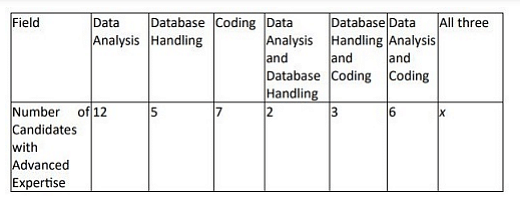
The number of applicants with advanced expertise in all three fields is given as x in the table, where x is a non-negative integer.
- XAT - 2024
- Data Interpretation