Directions for questions 63 and 64: Substitute different digits (0 to 9) for different letters in the addition below, so that the addition is correct and it gives the maximum possible value of MONEY.
P A Y M E R E A L M O N E Y
So the addition reads PAY + ME + REAL = MONEY, using nine different letters: P, A, Y, M, E, R, L, O, N.
64. The resulting value of 'MONEY' is:
| P | A | Y | ||
| M | E | |||
| R | E | A | L | |
| M | O | N | E | Y |
64. The resulting value of 'MONEY' is:
Show Hint
- 10364
- 10563
- 10978
- 19627
The Correct Option is D
Solution and Explanation
We need the maximum value of MONEY in the cryptarithm PAY + ME + REAL = MONEY, where P, A, Y, M, E, R, L, O and N are nine different digits, each standing for exactly one digit from 0 to 9, with no letter repeating a digit used by another letter.
Since REAL can be at most 9999 and PAY and ME add only a few hundred more at most, the total cannot go much beyond 11000, so the sum MONEY, being a 5-digit number, must begin with M = 1. This is the first digit fixed, and it stays fixed for every other column we work out next.
Column by column: the units place gives Y + E + L ending in Y, so the extra part must vanish into a carry, giving E + L = 10, with a carry of 1 into the tens place. The tens place gives A + M + A + 1 ending in E, and with M = 1 this becomes $2A + 2 = E + 10$, so $2A = E + 8$, with another carry of 1 into the hundreds place. The hundreds place gives P + E + 1 ending in N, so N is whatever P and E add up to once that carried 1 is folded in.
To push MONEY as high as possible, we look for the value of E that keeps the hundreds and tens digits of MONEY large while still letting all nine letters take different digits. E = 2 works well here: it gives A = 5 from $2A = 10$, and L = 8 from $E + L = 10$. Completing the remaining letters so that every one of the nine stays a distinct digit gives P = 3, R = 4, O = 9 and N = 6.
Let's summarize:
- M must be 1, since the total of the three numbers cannot reach much past 11000.
- The units and tens columns force E + L = 10 and 2A = E + 8.
- E = 2 is the choice that completes the grid with nine distinct digits and the largest possible MONEY.
Putting it all together, with M = 1, O = 9, N = 6, E = 2 and Y = 7, the completed value is MONEY = 19627.
Top Questions on Cryptography
- If a cryptanalyst only knows the encryption algorithm and ciphertext, then which type of attack can be performed by him?
- CUET (PG) - 2025
- Data Science
- Cryptography
- If it is known that a given ciphertext is Caesar Cipher, then a brute-force cryptanalysis requires \(\underline{\hspace{1cm}}\) keys to try.
- CUET (PG) - 2025
- Data Science
- Cryptography
- Explain the process of Asymmetric Encryption using public and private keys.
- WBBSE XII - 2026
- Cyber Security
- Cryptography
- What is Digital Steganography, and how does it differ from encryption?
- WBBSE XII - 2026
- Cyber Security
- Cryptography
- Want to practice more? Try solving extra ecology questions todayView All Questions
Questions Asked in XAT exam
The number of applicants with advanced expertise in all three fields is given as x in the table, where x is a non-negative integer.
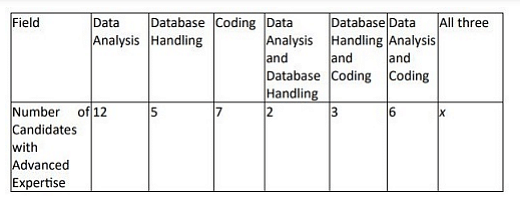
- XAT - 2024
- Data Interpretation