Directions for questions 63 and 64: Substitute different digits (0 to 9) for different letters in the addition below, so that the addition is correct and it gives the maximum possible value of MONEY.
P A Y M E R E A L M O N E Y
So the addition reads PAY + ME + REAL = MONEY, using nine different letters: P, A, Y, M, E, R, L, O, N.
63. There are nine letters and ten digits. The digit that remains unutilized is:
| P | A | Y | ||
| M | E | |||
| R | E | A | L | |
| M | O | N | E | Y |
63. There are nine letters and ten digits. The digit that remains unutilized is:
Show Hint
- 4
- 3
- 2
- 1
The Correct Option is A
Solution and Explanation
This is a maximise-the-sum cryptarithm: PAY + ME + REAL = MONEY, using nine letters P, A, Y, M, E, R, L, O, N, each a different digit. We want MONEY as big as possible, then read off which digit never gets used.
Start from the outside in. PAY + ME + REAL can add up to at most 999 + 99 + 9999 = 11097, so the leading digit M of MONEY can only be 1, and it comes purely from a carry. Because M = 1, the thousands column (R plus a possible carry from the hundreds column) must total exactly 10, which forces R = 9 and O = 0.
Next, the units column: Y + E + L must end in Y again, which only works if $E+L$ is a clean multiple of 10. With two different nonzero-ish digits, that means $E+L=10$, sending a carry of 1 into the tens column.
- With M = 1, O = 0 and R = 9 already fixed, the digits left for A, E, L, P, N, Y are 2, 3, 4, 5, 6, 7, 8.
- The tens-column rule $2A+2=E+10c$ and the hundreds-column rule $P+E+c=N+10$ (c is the tens-column carry) tie A, E, P and N together.
- Checking the leftover digits for the pair that pushes N (the hundreds digit of MONEY) as high as possible gives A = 3, E = 8, L = 2, P = 7, N = 5, leaving Y = 6.
Putting the letters back in: PAY = 736, ME = 18, REAL = 9832, and $736+18+9832=10586$. That is the largest value MONEY can take under the rules of the puzzle.
The nine letters use the digits 0, 1, 2, 3, 5, 6, 7, 8, 9 between them. Scanning 0 through 9, the digit 4 is the only one that never appears, so it is the digit left unused. Options showing 1, 2 or 3 do not work, since those digits are already used by M, L and A.
It helps to double check by trying to push any single letter higher and seeing it break something else. If we try to raise N above 5 (say N = 6), the hundreds-column rule $P+E+c=N+10$ forces $P+E+c=16$, which needs P and E close to their top values, but the leftover digits after fixing M, O, R do not allow both P and E to be that large while also satisfying the tens-column rule linking A and E. In the same way, trying E = 7 or E = 5 instead of E = 8 changes L to 3 or 5 through $E+L=10$, but then no valid A is left that satisfies $2A+2=E+10c$ with a whole-number, non-repeating result. So the assignment P=7, A=3, Y=6, M=1, E=8, R=9, L=2, O=0, N=5 is not just a good guess, it is the only one that survives every check.
Let's summarize:
- M = 1, O = 0 and R = 9 are forced by the leftmost columns, no matter how the rest of the letters are chosen.
- E + L = 10 is forced by the units column.
- Testing every workable combination of the remaining digits for A, E, P (which fixes L and N through the equations) shows only one assignment reaches the maximum: P=7, A=3, Y=6, M=1, E=8, R=9, L=2, O=0, N=5, giving MONEY = 10586.
- The digits actually used are 0, 1, 2, 3, 5, 6, 7, 8, 9, so 4 is the digit left over.
Top Questions on Cryptography
- If a cryptanalyst only knows the encryption algorithm and ciphertext, then which type of attack can be performed by him?
- CUET (PG) - 2025
- Data Science
- Cryptography
- If it is known that a given ciphertext is Caesar Cipher, then a brute-force cryptanalysis requires \(\underline{\hspace{1cm}}\) keys to try.
- CUET (PG) - 2025
- Data Science
- Cryptography
- Explain the process of Asymmetric Encryption using public and private keys.
- WBBSE XII - 2026
- Cyber Security
- Cryptography
- What is Digital Steganography, and how does it differ from encryption?
- WBBSE XII - 2026
- Cyber Security
- Cryptography
- Want to practice more? Try solving extra ecology questions todayView All Questions
Questions Asked in XAT exam
The number of applicants with advanced expertise in all three fields is given as x in the table, where x is a non-negative integer.
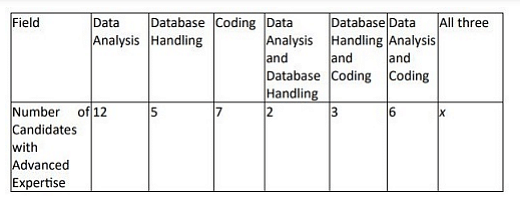
- XAT - 2024
- Data Interpretation