Directions for Q125-129: The following set of questions is based on a decision-making situation described below. Read the passage and answer the questions that follow.
Ram Kumar, an overworked executive in Delhi, has to decide on the travel plan for attending his friend's marriage in Ajmer, Rajasthan. He has barely managed to get leave from his boss, so he must make sure he reaches Ajmer at least on the day of the marriage. Since it had been a while since his last break, he also planned to visit a few tourist spots along the way to de-stress after a year of demanding work.
As per his plan, Ram would start from Delhi and first visit the Bharatpur bird sanctuary, staying at the forest guest house for some time. He would then travel to Jodhpur for a day or two of sightseeing, and from Jodhpur move to Jaipur to spend a few days visiting the city. After that he would travel on to Ajmer, where his friend's wedding would take place.
Leg 1, Delhi to Bharatpur (bus, taxi or train, all three taking 12 hours): the probability of reaching on time is 0.65 by bus, 0.75 by taxi and 0.9 by train.
Leg 2, Bharatpur to Jodhpur (train, bus or private taxi): the probability of reaching on time is 0.9 by train (12 hours), 0.8 by bus (16 hours) and 0.85 by taxi (14 hours).
Leg 3, Jodhpur to Jaipur (flight, train, bus or taxi): the probability of reaching on time is 0.85 by flight (2 hours), 0.9 by train (10 hours), 0.65 by bus (15 hours) and 0.7 by taxi (15 hours).
Leg 4, Jaipur to Ajmer (train, bus or taxi): the probability of reaching on time is 0.75 by train (4 hours), 0.55 by bus (5 hours) and 0.55 by taxi (5 hours).
Since both Jaipur and Jodhpur have airports, Ram could also fly directly from Delhi to either city, or use a flight partway along with a combination of land transport.
Q127. Ram's younger brother Shyam gets to know of Ram's travel plans and wants to come along. Unlike Ram, Shyam enjoys the scenery en route and wants Ram to maximise the total travel time. To do this, the itinerary Ram should decide on is:
I. Delhi to Bharatpur by train; Bharatpur to Jodhpur by bus; Jodhpur to Jaipur by bus; Jaipur to Ajmer by bus
II. Delhi to Bharatpur by bus; Bharatpur to Jodhpur by bus; Jodhpur to Jaipur by taxi; Jaipur to Ajmer by taxi
III. Delhi to Bharatpur by bus; Bharatpur to Jodhpur by bus; Jodhpur to Jaipur by bus; Jaipur to Ajmer by bus
IV. Delhi to Bharatpur by taxi; Bharatpur to Jodhpur by bus; Jodhpur to Jaipur by taxi; Jaipur to Ajmer by bus
V. Delhi to Bharatpur by taxi; Bharatpur to Jodhpur by taxi; Jodhpur to Jaipur by taxi; Jaipur to Ajmer by taxi
Ram Kumar, an overworked executive in Delhi, has to decide on the travel plan for attending his friend's marriage in Ajmer, Rajasthan. He has barely managed to get leave from his boss, so he must make sure he reaches Ajmer at least on the day of the marriage. Since it had been a while since his last break, he also planned to visit a few tourist spots along the way to de-stress after a year of demanding work.
As per his plan, Ram would start from Delhi and first visit the Bharatpur bird sanctuary, staying at the forest guest house for some time. He would then travel to Jodhpur for a day or two of sightseeing, and from Jodhpur move to Jaipur to spend a few days visiting the city. After that he would travel on to Ajmer, where his friend's wedding would take place.
Leg 1, Delhi to Bharatpur (bus, taxi or train, all three taking 12 hours): the probability of reaching on time is 0.65 by bus, 0.75 by taxi and 0.9 by train.
Leg 2, Bharatpur to Jodhpur (train, bus or private taxi): the probability of reaching on time is 0.9 by train (12 hours), 0.8 by bus (16 hours) and 0.85 by taxi (14 hours).
Leg 3, Jodhpur to Jaipur (flight, train, bus or taxi): the probability of reaching on time is 0.85 by flight (2 hours), 0.9 by train (10 hours), 0.65 by bus (15 hours) and 0.7 by taxi (15 hours).
Leg 4, Jaipur to Ajmer (train, bus or taxi): the probability of reaching on time is 0.75 by train (4 hours), 0.55 by bus (5 hours) and 0.55 by taxi (5 hours).
Since both Jaipur and Jodhpur have airports, Ram could also fly directly from Delhi to either city, or use a flight partway along with a combination of land transport.
I. Delhi to Bharatpur by train; Bharatpur to Jodhpur by bus; Jodhpur to Jaipur by bus; Jaipur to Ajmer by bus
II. Delhi to Bharatpur by bus; Bharatpur to Jodhpur by bus; Jodhpur to Jaipur by taxi; Jaipur to Ajmer by taxi
III. Delhi to Bharatpur by bus; Bharatpur to Jodhpur by bus; Jodhpur to Jaipur by bus; Jaipur to Ajmer by bus
IV. Delhi to Bharatpur by taxi; Bharatpur to Jodhpur by bus; Jodhpur to Jaipur by taxi; Jaipur to Ajmer by bus
V. Delhi to Bharatpur by taxi; Bharatpur to Jodhpur by taxi; Jodhpur to Jaipur by taxi; Jaipur to Ajmer by taxi
Show Hint
- I only
- I and II
- I, II and III
- I, II, III and IV
The Correct Option is D
Solution and Explanation
Shyam wants the slowest possible trip, so this time we hunt for the maximum total time rather than the minimum. Leg 1 is always 12 hours no matter the mode. On leg 2 the slowest mode is bus at 16 hours. On leg 3, bus and taxi are tied for slowest at 15 hours. On leg 4, bus and taxi are tied for slowest at 5 hours. Adding these up, the highest total any itinerary can reach is $12 + 16 + 15 + 5 = 48$ hours.
- I: train, bus, bus, bus = $12 + 16 + 15 + 5 = 48$ hours. Hits the maximum.
- II: bus, bus, taxi, taxi = $12 + 16 + 15 + 5 = 48$ hours. Hits the maximum.
- III: bus, bus, bus, bus = $12 + 16 + 15 + 5 = 48$ hours. Hits the maximum.
- IV: taxi, bus, taxi, bus = $12 + 16 + 15 + 5 = 48$ hours. Hits the maximum.
- V: taxi, taxi, taxi, taxi = $12 + 14 + 15 + 5 = 46$ hours. Falls short, since leg 2's taxi (14 h) is 2 hours faster than leg 2's bus (16 h).
Four of the five itineraries, I, II, III and IV, all reach the same 48 hour maximum because leg 1 does not matter (all its modes tie at 12 hours) and each of these four picks a slowest-or-tied-for-slowest mode on legs 2, 3 and 4. Only V breaks the pattern by using taxi instead of bus on leg 2.
Let's summarize:
- The maximum possible travel time for the whole trip is 48 hours.
- I, II, III and IV each reach 48 hours; V falls 2 hours short at 46 hours.
So the itineraries that maximise travel time are I, II, III and IV.
Top Questions on Analytical Decision Making
- Tech predictions often fail not because of wrong models or a lack of imagination, but due to lack of humility in admitting our uncertainty about the future.( Maximum 250 words )
- XAT - 2024
- Decision Making
- Analytical Decision Making
- There’s a community 30 km outside of the main city. Mr. S started a grocery business in the community after winning the bid by offering way above the rent initially drafted by the community council. The community council, led by Mr. D, agreed to the offer with a performance review every three years. Mr. S also agreed to provide an additional 15% of his grocery sales to the council, banking on the prospect of selling in higher volumes. After setting up his business, Mr. S noticed that SUV owners in the community usually bought goods in bulk from the city once a week and used his store primarily for daily necessities and occasional big purchases like mixer grinders.
- XAT - 2025
- Decision Making
- Analytical Decision Making
- Arya, a graduate from a reputable institute, got a job in an IT company but became bored after a year. Her best friend S, who worked at the same company, joined a top-tier B-school for an MBA, which tempted Arya to pursue the same path. Her friend assured her that an MBA would boost her career prospects and salary. Arya started preparing for an MBA while continuing her job, but the challenge of balancing preparation with work made her consider leaving the job.
- XAT - 2025
- Decision Making
- Analytical Decision Making
- A person suffering from Aichmophobia is most likely to be afraid of which of the following object?
- MAH MBA CET - 2025
- General Awareness
- Analytical Decision Making
- Want to practice more? Try solving extra ecology questions todayView All Questions
Questions Asked in XAT exam
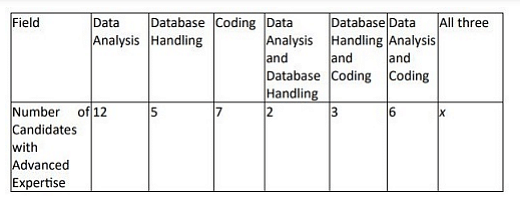
The number of applicants with advanced expertise in all three fields is given as x in the table, where x is a non-negative integer.
- XAT - 2024
- Data Interpretation