Question:medium
Directions: Each of the following questions is followed by two statements. Mark option (1) if the question can be answered using statement I alone. Mark option (2) if the question can be answered using statement II alone. Mark option (3) if both statements I and II together are needed to answer the question. Mark option (4) if the question cannot be answered even using both statements together.
A cube is painted on all sides and is cut into smaller cubes, all of the same size. How many of the smaller cubes do not have any side painted?
I. 8 of the smaller cubes are painted on three sides.
II. The number of smaller cubes is 64.
Directions: Each of the following questions is followed by two statements. Mark option (1) if the question can be answered using statement I alone. Mark option (2) if the question can be answered using statement II alone. Mark option (3) if both statements I and II together are needed to answer the question. Mark option (4) if the question cannot be answered even using both statements together.
A cube is painted on all sides and is cut into smaller cubes, all of the same size. How many of the smaller cubes do not have any side painted?
I. 8 of the smaller cubes are painted on three sides.
II. The number of smaller cubes is 64.
A cube is painted on all sides and is cut into smaller cubes, all of the same size. How many of the smaller cubes do not have any side painted?
I. 8 of the smaller cubes are painted on three sides.
II. The number of smaller cubes is 64.
Show Hint
Recall that the corner cubes (3 faces painted) always number 8 for any cube size, so that fact alone fixes nothing. You need the total count of small cubes to pin down the cube's size.
Updated On: Jul 13, 2026
- The question can be answered using statement I alone
- The question can be answered using statement II alone
- The question can be answered only if both statements I and II are used together
- The question cannot be answered even using both statements together
Show Solution
The Correct Option is B
Solution and Explanation
This is a data sufficiency question about a painted cube cut into equal smaller cubes. We need the count of small cubes with zero painted faces, and we check if statement I, statement II, or both give us that count.
First, set up the general rule. If the big cube is cut into $n^3$ equal pieces along each edge, then:
- Corner cubes (3 faces painted) = 8, always, for any $n \geq 2$.
- Edge cubes (2 faces painted) = $12(n-2)$.
- Face cubes (1 face painted) = $6(n-2)^2$.
- Fully unpainted (inside) cubes = $(n-2)^3$.
- Statement I: 8 smaller cubes are painted on three sides. This matches the corner-cube count, but the corner count is 8 for every value of $n$ from 2 upward. Since this fact holds true for $n=2,3,4,5,...$, it never pins down which $n$ we actually have. Without a fixed $n$, the formula $(n-2)^3$ cannot be worked out. So statement I alone tells us nothing new about the unpainted count.
- Statement II: the number of smaller cubes is 64. Since $n^3 = 64$, solving gives $n = 4$ directly. Plugging into the unpainted-cube formula: $(4-2)^3 = 2^3 = 8$. This one statement completely fixes the answer.
So statement II by itself settles the question with an answer of 8 unpainted cubes, while statement I by itself gives no new information at all. That means the correct choice is that the question can be answered using statement II alone.
Let's summarize:
- The corner-cube count (3 faces painted) is always 8 regardless of cube size, so statement I is a constant fact, not useful data.
- Knowing the total count of small cubes (64) fixes $n=4$, which is enough to work out the unpainted cubes directly.
The question is answered using statement II alone, so the correct option is (2).
\[ \boxed{\text{Answer: Statement II alone is sufficient}} \]Was this answer helpful?
0
Top Questions on Number System
- Find the number of integers \(n\) such that \(1 \leq n \leq 100\) and \(n^2 + 3n + 2\) is divisible by 5.
- BITSAT - 2025
- Mathematics
- Number System
- Find the smallest number between 2000 and 3000 that is exactly divisible by 21, 24 and 28.
- SNAP - 2024
- Quantitative Aptitude
- Number System
- Based on the given pattern find the next term of the given series: 5, 6, 16, 57, 244, 1245, ?
- SNAP - 2024
- Quantitative Aptitude
- Number System
- There are 3 different types of rice weighing \(435,\ 493,\) and \(551\) kg respectively. The rice is packed in bags so that no two types are mixed and all bags are of equal size. Find the least number of bags.
- SNAP - 2024
- Quantitative Aptitude
- Number System
- Want to practice more? Try solving extra ecology questions todayView All Questions
Questions Asked in XAT exam
Applicants have been shortlisted for interviews for some data analyst positions. Some of the applicants have advanced expertise in one or more fields among the following: data analysis, database handling and coding. The numbers of applicants with different advanced expertise are given in the 2 × 8 table below.
The number of applicants with advanced expertise in all three fields is given as x in the table, where x is a non-negative integer.
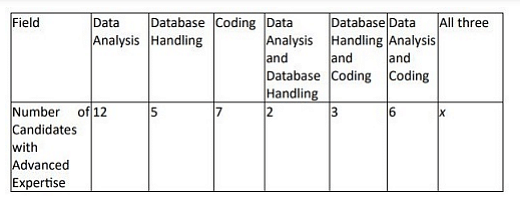
The number of applicants with advanced expertise in all three fields is given as x in the table, where x is a non-negative integer.
- XAT - 2024
- Data Interpretation