Directions: Each of the following questions is followed by two statements, labelled (A) and (B). Decide whether the statements are sufficient to conclusively answer the question, and choose:
(A) if Statement (A) alone is sufficient but Statement (B) alone is not.
(B) if Statement (B) alone is sufficient but Statement (A) alone is not.
(C) if Statement (A) and Statement (B) together are sufficient, but neither alone is sufficient.
(D) if either Statement (A) alone or Statement (B) alone is sufficient.
(E) if both statements together are still not sufficient.
Let \(f : N \to N\) (N is the set of all natural numbers). How many solutions are there to the equation \(f(x) = 1485\)?
(A) For \(a, b \in N\), \(f(10a+b) = f(a) + 12b\).
(B) The maximum value of b is 9.
(A) if Statement (A) alone is sufficient but Statement (B) alone is not.
(B) if Statement (B) alone is sufficient but Statement (A) alone is not.
(C) if Statement (A) and Statement (B) together are sufficient, but neither alone is sufficient.
(D) if either Statement (A) alone or Statement (B) alone is sufficient.
(E) if both statements together are still not sufficient.
Let \(f : N \to N\) (N is the set of all natural numbers). How many solutions are there to the equation \(f(x) = 1485\)?
(A) For \(a, b \in N\), \(f(10a+b) = f(a) + 12b\).
(B) The maximum value of b is 9.
Show Hint
- (A) Statement (A) alone is sufficient, but Statement (B) alone is not sufficient.
- (B) Statement (B) alone is sufficient, but Statement (A) alone is not sufficient.
- (C) Statement (A) and Statement (B) together are sufficient, but neither alone is sufficient.
- (E) Both Statement (A) and Statement (B) together are not sufficient to answer the question.
The Correct Option is D
Solution and Explanation
Let's try to actually push the recursion through with an example, to see exactly where it breaks down.
Take $x = 1485$. Splitting off the last digit, $1485 = 10(148) + 5$, so by Statement (A),
$$f(1485) = f(148) + 12(5) = f(148) + 60$$Now split $148 = 10(14)+8$:
$$f(148) = f(14) + 12(8) = f(14) + 96$$Now split $14 = 10(1) + 4$:
$$f(14) = f(1) + 12(4) = f(1) + 48$$Chaining all of this together:
$$f(1485) = f(1) + 48 + 96 + 60 = f(1) + 204$$So the equation $f(1485) = 1485$ (using the value 1485 for both x and the target) would reduce to $f(1) = 1281$, but that is a red herring: the question wants $f(x)=1485$ for some unknown x, and the exact same issue would occur for any candidate x we try. Every chain of substitutions eventually bottoms out at $f(1)$ or another single digit's value under f, and neither Statement (A) nor Statement (B) tells us what f is on the digits 0 through 9.
Without that starting value, we cannot turn the recursion into an actual number, so we cannot check which x (if any) makes $f(x)=1485$, and we cannot even say how many such x exist. Statement (B) ("maximum value of b is 9") is just restating that b is a digit; it adds no new connection between f and x.
Let's summarize:
- Statement (A) gives a recursive rule but no base case for single-digit inputs.
- Statement (B) adds nothing about f itself.
- Without a starting value for f, the number of solutions to $f(x)=1485$ cannot be found, even using both statements together.
So both statements together are still not sufficient to answer the question.
Top Questions on Number System
- Find the number of integers \(n\) such that \(1 \leq n \leq 100\) and \(n^2 + 3n + 2\) is divisible by 5.
- BITSAT - 2025
- Mathematics
- Number System
- Find the smallest number between 2000 and 3000 that is exactly divisible by 21, 24 and 28.
- SNAP - 2024
- Quantitative Aptitude
- Number System
- Based on the given pattern find the next term of the given series: 5, 6, 16, 57, 244, 1245, ?
- SNAP - 2024
- Quantitative Aptitude
- Number System
- There are 3 different types of rice weighing \(435,\ 493,\) and \(551\) kg respectively. The rice is packed in bags so that no two types are mixed and all bags are of equal size. Find the least number of bags.
- SNAP - 2024
- Quantitative Aptitude
- Number System
- Want to practice more? Try solving extra ecology questions todayView All Questions
Questions Asked in XAT exam
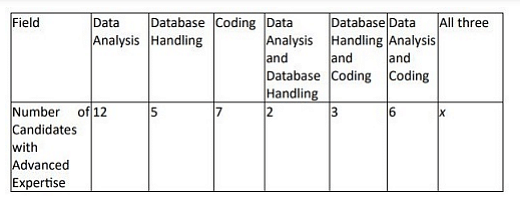
The number of applicants with advanced expertise in all three fields is given as x in the table, where x is a non-negative integer.
- XAT - 2024
- Data Interpretation