Directions: Each group of questions is based on a set of conditions. Read the passage below and answer the question that follows.
A retail electronics chain has six new mobile phone models, T, V, W, X, Y and Z. Each model comes with at least one of three options: digital camera, music player and office document viewer. No model has any other option. The following conditions apply:
- V has both a digital camera and an office document viewer.
- W has a digital camera and a music player.
- W and Y have no options in common.
- V and Z have exactly one option in common.
- T has fewer options than Z.
For this question only, replace the rule "X has more options than W" with this new rule: "X and W have exactly two options in common." All the other rules above still apply.
Which one of the following must be false?
A retail electronics chain has six new mobile phone models, T, V, W, X, Y and Z. Each model comes with at least one of three options: digital camera, music player and office document viewer. No model has any other option. The following conditions apply:
- V has both a digital camera and an office document viewer.
- W has a digital camera and a music player.
- W and Y have no options in common.
- V and Z have exactly one option in common.
- T has fewer options than Z.
Which one of the following must be false?
Show Hint
Work out X's full option set from the replaced rule and the Z and T counts first, then compare it directly against V's fixed set of digital camera and document viewer.
- T and X have no options in common.
- X and Z have no options in common.
- V and X have exactly two options in common.
- V and X have exactly one option in common.
The Correct Option is D
Solution and Explanation
Six mobile phones, T, V, W, X, Y and Z, each carry at least one of three options: digital camera, music player and document viewer. V carries digital camera and document viewer. W carries digital camera and music player. W and Y share nothing, so Y carries only the document viewer. V and Z share exactly one option, and T carries fewer options than Z. For this question, the usual rule "X has more options than W" is replaced with "X and W have exactly two options in common," and we need the statement that must be false.
- T and X have no options in common: Nothing pins T's exact set against X's three options, so this can hold in a valid case; it does not have to be false.
- X and Z have no options in common: Depending on which single option Z shares with V, this can also hold without breaking any rule.
- V and X have exactly two options in common: Since W only carries digital camera and music player, sharing exactly two options with W means X carries both of those. Bringing in the count requirements tied to Z and T then pushes X to also carry the document viewer, giving X all three options. V, with digital camera and document viewer, then shares both of those with X, so this statement is true, not false.
- V and X have exactly one option in common: Since X ends up carrying all three options, V and X always share two options together, digital camera and document viewer, never just one. This statement can never be true.
Let's summarize:
- V, W and Y are fixed directly by the given clues; X is pinned down by the replaced rule together with the Z and T counts.
- X ends up carrying all three options, so V and X always share exactly two of them.
- The claim of exactly one shared option between V and X is the one that never matches reality.
So the statement that must be false is that V and X have exactly one option in common.
Top Questions on Analytical Decision Making
- Tech predictions often fail not because of wrong models or a lack of imagination, but due to lack of humility in admitting our uncertainty about the future.( Maximum 250 words )
- XAT - 2024
- Decision Making
- Analytical Decision Making
- There’s a community 30 km outside of the main city. Mr. S started a grocery business in the community after winning the bid by offering way above the rent initially drafted by the community council. The community council, led by Mr. D, agreed to the offer with a performance review every three years. Mr. S also agreed to provide an additional 15% of his grocery sales to the council, banking on the prospect of selling in higher volumes. After setting up his business, Mr. S noticed that SUV owners in the community usually bought goods in bulk from the city once a week and used his store primarily for daily necessities and occasional big purchases like mixer grinders.
- XAT - 2025
- Decision Making
- Analytical Decision Making
- Arya, a graduate from a reputable institute, got a job in an IT company but became bored after a year. Her best friend S, who worked at the same company, joined a top-tier B-school for an MBA, which tempted Arya to pursue the same path. Her friend assured her that an MBA would boost her career prospects and salary. Arya started preparing for an MBA while continuing her job, but the challenge of balancing preparation with work made her consider leaving the job.
- XAT - 2025
- Decision Making
- Analytical Decision Making
- A person suffering from Aichmophobia is most likely to be afraid of which of the following object?
- MAH MBA CET - 2025
- General Awareness
- Analytical Decision Making
- Want to practice more? Try solving extra ecology questions todayView All Questions
Questions Asked in XAT exam
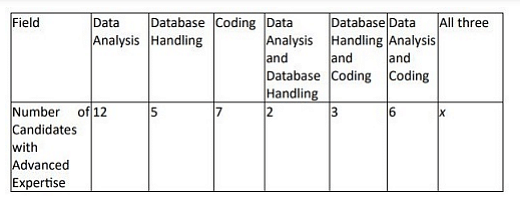
The number of applicants with advanced expertise in all three fields is given as x in the table, where x is a non-negative integer.
- XAT - 2024
- Data Interpretation