Question:hard
Directions: Each group of questions in this section is based on a set of conditions. Choose the response that most accurately and completely answers each question.
(Questions 108 to 112): Krishnapuram's town council has exactly three members: Arjun, Karn, and Bhim. During one week, the council members vote on exactly three bills: a recreation bill, a school bill, and a tax bill. Each council member votes either for or against each bill. The following is known:
- Each member of the council votes for at least one of the bills and against at least one of the bills.
- Exactly two members of the council vote for the recreation bill.
- Exactly one member of the council votes for the school bill.
- Exactly one member of the council votes for the tax bill.
- Arjun votes for the recreation bill and against the school bill.
- Karn votes against the recreation bill.
- Bhim votes against the tax bill.
112. If one of the members of the council votes against exactly the same bills as does another member of the council, then which one of the following statements must be true?
Directions: Each group of questions in this section is based on a set of conditions. Choose the response that most accurately and completely answers each question.
(Questions 108 to 112): Krishnapuram's town council has exactly three members: Arjun, Karn, and Bhim. During one week, the council members vote on exactly three bills: a recreation bill, a school bill, and a tax bill. Each council member votes either for or against each bill. The following is known:
112. If one of the members of the council votes against exactly the same bills as does another member of the council, then which one of the following statements must be true?
(Questions 108 to 112): Krishnapuram's town council has exactly three members: Arjun, Karn, and Bhim. During one week, the council members vote on exactly three bills: a recreation bill, a school bill, and a tax bill. Each council member votes either for or against each bill. The following is known:
- Each member of the council votes for at least one of the bills and against at least one of the bills.
- Exactly two members of the council vote for the recreation bill.
- Exactly one member of the council votes for the school bill.
- Exactly one member of the council votes for the tax bill.
- Arjun votes for the recreation bill and against the school bill.
- Karn votes against the recreation bill.
- Bhim votes against the tax bill.
112. If one of the members of the council votes against exactly the same bills as does another member of the council, then which one of the following statements must be true?
Show Hint
Fix Arjun, Karn and Bhim's known votes first, use the recreation-bill count to place Bhim, then test the four ways to place the single for-votes on school and tax to see which one gives two members an identical against-set.
Updated On: Jul 13, 2026
- Arjun votes for the tax bill
- Karn votes for the recreation bill.
- Karn votes against the school bill.
- Bhim votes for exactly one bill.
Show Solution
The Correct Option is D
Solution and Explanation
This question is a three-person, three-bill grid puzzle. Instead of testing every arrangement at once, it helps to fix the certain votes first and treat the "for" bill assignments as slots to be filled one at a time.
- Fixed votes: Arjun is for-recreation and against-school (given). Karn is against-recreation (given). Bhim is against-tax (given). Since exactly two members vote for recreation and Karn is already fixed against it, Bhim must be the second for-recreation vote, alongside Arjun.
- School bill: only one member votes for it, and Arjun is against it, so the lone for-school voter is either Karn or Bhim.
- Tax bill: only one member votes for it, and Bhim is against it, so the lone for-tax voter is either Arjun or Karn.
- Applying "at least one for, at least one against": Karn is already against recreation, so Karn must pick up at least one for-vote from school or tax, otherwise Karn would be against all three bills, which the rules forbid.
- Testing the four slot combinations for (school-for, tax-for) gives four grids. Three are ruled out: one makes Karn vote against all three bills (not allowed), and the remaining two give three members with three different against-sets, so no pair matches. Only the grid where Karn takes both the school-for and the tax-for slot produces two members, Arjun and Bhim, who vote against exactly the same pair of bills (school and tax). That is the grid this question is describing.
In that grid: Arjun is for recreation only; Karn is for school and tax (against recreation); Bhim is for recreation only. Checking the options: Arjun does not vote for tax, Karn does not vote for recreation, Karn does not vote against school (he votes for it), and Bhim votes for exactly one bill (recreation). So the statement that must be true is that Bhim votes for exactly one bill.
Let's summarize:
- Fix the certain votes and the recreation-bill count first; this pins Bhim to a for-recreation vote.
- The extra condition (two members with an identical against-set) filters four possible grids down to exactly one.
- In that one valid grid, only Bhim votes for exactly one bill.
So the correct statement is: Bhim votes for exactly one bill.
Was this answer helpful?
0
Top Questions on Analytical Decision Making
- Tech predictions often fail not because of wrong models or a lack of imagination, but due to lack of humility in admitting our uncertainty about the future.( Maximum 250 words )
- XAT - 2024
- Decision Making
- Analytical Decision Making
- There’s a community 30 km outside of the main city. Mr. S started a grocery business in the community after winning the bid by offering way above the rent initially drafted by the community council. The community council, led by Mr. D, agreed to the offer with a performance review every three years. Mr. S also agreed to provide an additional 15% of his grocery sales to the council, banking on the prospect of selling in higher volumes. After setting up his business, Mr. S noticed that SUV owners in the community usually bought goods in bulk from the city once a week and used his store primarily for daily necessities and occasional big purchases like mixer grinders.
- XAT - 2025
- Decision Making
- Analytical Decision Making
- Arya, a graduate from a reputable institute, got a job in an IT company but became bored after a year. Her best friend S, who worked at the same company, joined a top-tier B-school for an MBA, which tempted Arya to pursue the same path. Her friend assured her that an MBA would boost her career prospects and salary. Arya started preparing for an MBA while continuing her job, but the challenge of balancing preparation with work made her consider leaving the job.
- XAT - 2025
- Decision Making
- Analytical Decision Making
- A person suffering from Aichmophobia is most likely to be afraid of which of the following object?
- MAH MBA CET - 2025
- General Awareness
- Analytical Decision Making
- Want to practice more? Try solving extra ecology questions todayView All Questions
Questions Asked in XAT exam
Applicants have been shortlisted for interviews for some data analyst positions. Some of the applicants have advanced expertise in one or more fields among the following: data analysis, database handling and coding. The numbers of applicants with different advanced expertise are given in the 2 × 8 table below.
The number of applicants with advanced expertise in all three fields is given as x in the table, where x is a non-negative integer.
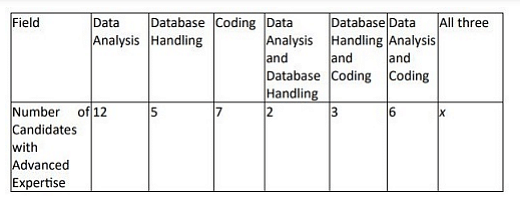
The number of applicants with advanced expertise in all three fields is given as x in the table, where x is a non-negative integer.
- XAT - 2024
- Data Interpretation