Question:hard
Decisions are often 'risky' in the sense that their outcomes are not known with certainty. Presented with a choice between a risky prospect that offers a 50 percent chance to win $200 (otherwise nothing) and an alternative of receiving $100 for sure, most people prefer the sure gain over the gamble, although the two prospects have the same expected value. Preference for a sure outcome over a risky prospect of equal expected value is called risk averse; people tend to be risk averse when choosing between prospects with positive outcomes, a pattern explained by diminishing sensitivity: the utility from a small increase in wealth falls as the wealth already held rises, so the person's utility function \(u\) is concave for gains. A convex utility function is the mirror image of this: it gives MORE weight to the extreme, spread-out outcome of a gamble than to a 'safer,' more sure-like outcome of the same expected value, and a person with such a function is called risk taking or risk seeking.
Based on the above, look at the decision situation faced by Babitha.
Babitha played a game in which she had three options, with probabilities 0.4, 0.5 and 0.8 respectively. The gains from the three outcomes are likely to be $100, $80 and $50 respectively. An expert has pointed out that Babitha is a risk taking person. According to the expected utility hypothesis, which option is Babitha most likely to favour?
Decisions are often 'risky' in the sense that their outcomes are not known with certainty. Presented with a choice between a risky prospect that offers a 50 percent chance to win $200 (otherwise nothing) and an alternative of receiving $100 for sure, most people prefer the sure gain over the gamble, although the two prospects have the same expected value. Preference for a sure outcome over a risky prospect of equal expected value is called risk averse; people tend to be risk averse when choosing between prospects with positive outcomes, a pattern explained by diminishing sensitivity: the utility from a small increase in wealth falls as the wealth already held rises, so the person's utility function \(u\) is concave for gains. A convex utility function is the mirror image of this: it gives MORE weight to the extreme, spread-out outcome of a gamble than to a 'safer,' more sure-like outcome of the same expected value, and a person with such a function is called risk taking or risk seeking.
Based on the above, look at the decision situation faced by Babitha.
Babitha played a game in which she had three options, with probabilities 0.4, 0.5 and 0.8 respectively. The gains from the three outcomes are likely to be $100, $80 and $50 respectively. An expert has pointed out that Babitha is a risk taking person. According to the expected utility hypothesis, which option is Babitha most likely to favour?
Based on the above, look at the decision situation faced by Babitha.
Babitha played a game in which she had three options, with probabilities 0.4, 0.5 and 0.8 respectively. The gains from the three outcomes are likely to be $100, $80 and $50 respectively. An expert has pointed out that Babitha is a risk taking person. According to the expected utility hypothesis, which option is Babitha most likely to favour?
Show Hint
All three options tie at an expected value of $40, so the tie has to be broken by Babitha's convex, risk-seeking utility function, which favours the most extreme, lowest-probability, highest-payoff option.
Updated On: Jul 10, 2026
- First
- Second
- Third
- Babitha would be indifferent to all three options.
Show Solution
The Correct Option is A
Solution and Explanation
Step 1: Notice the trap: check expected value first.
$0.4 \times 100 = 40$, $0.5 \times 80 = 40$, $0.8 \times 50 = 40$. Every option gives exactly $40 in expected value, so a person deciding purely on expected value would truly be indifferent between them, this is the trap the fourth option is designed to catch. But the question specifically asks us to use the expected utility hypothesis for a risk-taking person, not plain expected value.
Step 2: Translate 'risk taking' into a shape of utility function.
A risk-seeking (risk-taking) person has a convex utility curve, meaning the marginal utility of an extra dollar of gain INCREASES with the amount at stake, rather than decreasing the way it does for a risk-averse, concave utility holder. A convex curve rewards the more extreme, higher-variance outcome more than the safer one, even when both have identical expected value.
Step 3: Compare the three options on variance, not just expected value.
The first option (0.4 probability, $100 gain) has the widest gap between its 'win' and 'no win' outcomes, so it is the highest-variance, most extreme of the three. The third option (0.8 probability, $50 gain) is the closest to a near-certain small gain, so it is the lowest-variance, most 'sure-like' choice.
Step 4: Match Babitha's risk-taking profile to the ranking.
A convex utility function assigns the first (highest-variance) option the highest expected utility among the three, even though all three tie on plain expected value. Since Babitha is risk taking, she is most likely to pick the option that a convex utility function ranks highest, which is the first option, not the second, third, or a tie between all three.
Final Answer:
Babitha is most likely to favour the First option. \[ \boxed{\text{First}} \]
$0.4 \times 100 = 40$, $0.5 \times 80 = 40$, $0.8 \times 50 = 40$. Every option gives exactly $40 in expected value, so a person deciding purely on expected value would truly be indifferent between them, this is the trap the fourth option is designed to catch. But the question specifically asks us to use the expected utility hypothesis for a risk-taking person, not plain expected value.
Step 2: Translate 'risk taking' into a shape of utility function.
A risk-seeking (risk-taking) person has a convex utility curve, meaning the marginal utility of an extra dollar of gain INCREASES with the amount at stake, rather than decreasing the way it does for a risk-averse, concave utility holder. A convex curve rewards the more extreme, higher-variance outcome more than the safer one, even when both have identical expected value.
Step 3: Compare the three options on variance, not just expected value.
The first option (0.4 probability, $100 gain) has the widest gap between its 'win' and 'no win' outcomes, so it is the highest-variance, most extreme of the three. The third option (0.8 probability, $50 gain) is the closest to a near-certain small gain, so it is the lowest-variance, most 'sure-like' choice.
Step 4: Match Babitha's risk-taking profile to the ranking.
A convex utility function assigns the first (highest-variance) option the highest expected utility among the three, even though all three tie on plain expected value. Since Babitha is risk taking, she is most likely to pick the option that a convex utility function ranks highest, which is the first option, not the second, third, or a tie between all three.
Final Answer:
Babitha is most likely to favour the First option. \[ \boxed{\text{First}} \]
Was this answer helpful?
0
Top Questions on Analytical Decision Making
- Tech predictions often fail not because of wrong models or a lack of imagination, but due to lack of humility in admitting our uncertainty about the future.( Maximum 250 words )
- XAT - 2024
- Decision Making
- Analytical Decision Making
- There’s a community 30 km outside of the main city. Mr. S started a grocery business in the community after winning the bid by offering way above the rent initially drafted by the community council. The community council, led by Mr. D, agreed to the offer with a performance review every three years. Mr. S also agreed to provide an additional 15% of his grocery sales to the council, banking on the prospect of selling in higher volumes. After setting up his business, Mr. S noticed that SUV owners in the community usually bought goods in bulk from the city once a week and used his store primarily for daily necessities and occasional big purchases like mixer grinders.
- XAT - 2025
- Decision Making
- Analytical Decision Making
- Arya, a graduate from a reputable institute, got a job in an IT company but became bored after a year. Her best friend S, who worked at the same company, joined a top-tier B-school for an MBA, which tempted Arya to pursue the same path. Her friend assured her that an MBA would boost her career prospects and salary. Arya started preparing for an MBA while continuing her job, but the challenge of balancing preparation with work made her consider leaving the job.
- XAT - 2025
- Decision Making
- Analytical Decision Making
- A person suffering from Aichmophobia is most likely to be afraid of which of the following object?
- MAH MBA CET - 2025
- General Awareness
- Analytical Decision Making
- Want to practice more? Try solving extra ecology questions todayView All Questions
Questions Asked in XAT exam
Applicants have been shortlisted for interviews for some data analyst positions. Some of the applicants have advanced expertise in one or more fields among the following: data analysis, database handling and coding. The numbers of applicants with different advanced expertise are given in the 2 × 8 table below.
The number of applicants with advanced expertise in all three fields is given as x in the table, where x is a non-negative integer.
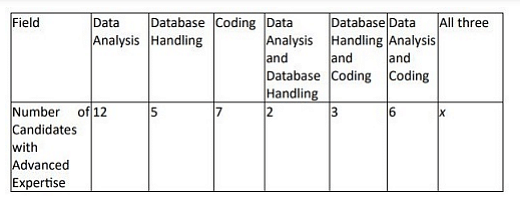
The number of applicants with advanced expertise in all three fields is given as x in the table, where x is a non-negative integer.
- XAT - 2024
- Data Interpretation