Question:medium
Correct statement(s) about the compounds P, Q and R is(are)
\( \text{Xe(g)} + \text{F}_2\text{(g)} \xrightarrow{\text{873 K, 7 bar}}{\text{P}} \)
(1 : 5 ratio)
\( \text{P} + \text{O}_2\text{F}_2 \xrightarrow{\text{143 K}}{\text{Q}} + \text{O}_2 \)
\( \text{Q} + \text{H}_2\text{O} \xrightarrow{\text{complete hydrolysis}}{\text{R}} + \text{HF} \)
Correct statement(s) about the compounds P, Q and R is(are)
\( \text{Xe(g)} + \text{F}_2\text{(g)} \xrightarrow{\text{873 K, 7 bar}}{\text{P}} \)
(1 : 5 ratio)
\( \text{P} + \text{O}_2\text{F}_2 \xrightarrow{\text{143 K}}{\text{Q}} + \text{O}_2 \)
\( \text{Q} + \text{H}_2\text{O} \xrightarrow{\text{complete hydrolysis}}{\text{R}} + \text{HF} \)
\( \text{Xe(g)} + \text{F}_2\text{(g)} \xrightarrow{\text{873 K, 7 bar}}{\text{P}} \)
(1 : 5 ratio)
\( \text{P} + \text{O}_2\text{F}_2 \xrightarrow{\text{143 K}}{\text{Q}} + \text{O}_2 \)
\( \text{Q} + \text{H}_2\text{O} \xrightarrow{\text{complete hydrolysis}}{\text{R}} + \text{HF} \)
Show Hint
For xenon compounds:
- XeF$_2$: Linear, 3 lone pairs.
- XeF$_4$: Square planar, 2 lone pairs.
- XeF$_6$: Distorted octahedral, 1 lone pair.
- XeO$_3$: Trigonal pyramidal, 1 lone pair.
- XeOF$_4$: Square pyramidal, 1 lone pair.
Remember that XeF$_2$, XeF$_4$, XeF$_6$ are strong fluorinating agents. Also, hydrolysis of higher xenon fluorides leads to xenon oxyfluorides or xenon oxides.
- XeF$_2$: Linear, 3 lone pairs.
- XeF$_4$: Square planar, 2 lone pairs.
- XeF$_6$: Distorted octahedral, 1 lone pair.
- XeO$_3$: Trigonal pyramidal, 1 lone pair.
- XeOF$_4$: Square pyramidal, 1 lone pair.
Remember that XeF$_2$, XeF$_4$, XeF$_6$ are strong fluorinating agents. Also, hydrolysis of higher xenon fluorides leads to xenon oxyfluorides or xenon oxides.
Updated On: Jun 4, 2026
- P has two lone pairs of electrons on the central atom.
- Q has a perfect octahedral geometry.
- Q can act as a fluorinating agent.
- The molecular structure of R is trigonal pyramidal.
Show Solution
The Correct Option is A
Solution and Explanation
Step 1: Understanding the Question:
The question presents a three-step reaction sequence involving xenon, fluorine, and other reagents to form compounds P, Q, and R. We need to identify the correct statements about these compounds. This question might have multiple correct answers.
Step 2: Key Formula or Approach:
1. Identify compounds P, Q, and R by analyzing each reaction step.
2. Determine the properties, geometry, and hybridization for each compound using VSEPR theory and knowledge of chemical reactions.
Step 3: Detailed Explanation:
Let's identify P, Q, and R:
Reaction 1: \( \text{Xe(g) + \text{F}_2\text{(g)} \xrightarrow{\text{873 K, 7 bar}}{\text{P}} \)}
Xenon reacts with fluorine under specific conditions to form xenon fluorides. The ratio 1:5 of Xe:F$_2$ is important. Higher ratios of F$_2$ tend to form higher fluorides.
Given the conditions (high temperature, 1:5 ratio), this reaction yields XeF$_4$ (xenon tetrafluoride) or XeF$_6$ (xenon hexafluoride). XeF$_6$ is formed at higher fluorine ratios (1:20) and higher temperatures/pressures. At 1:5, it is usually XeF$_4$. Let's assume P = XeF$_4$ first.
Reaction 2: \( \text{P} + \text{O}_2\text{F}_2 \xrightarrow{\text{143 K}}{\text{Q}} + \text{O}_2 \)
This is a known reaction used for the synthesis of XeF$_6$. $O_2F_2$ is a powerful fluorinating agent.
If P = XeF$_4$, then $XeF_4 + O_2F_2 \xrightarrow{143 K} XeF_6 + O_2$. So, Q = XeF$_6$.
Reaction 3: \( \text{Q} + \text{H}_2\text{O} \xrightarrow{\text{complete hydrolysis}}{\text{R}} + \text{HF} \)
Xenon hexafluoride (XeF$_6$) undergoes complete hydrolysis with water. Complete hydrolysis of XeF$_6$ yields xenon trioxide ($XeO_3$) and hydrofluoric acid (HF).
$XeF_6 + 3H_2O \rightarrow XeO_3 + 6HF$. So, R = XeO$_3$.
Now let's evaluate the statements based on P=XeF$_4$, Q=XeF$_6$, R=XeO$_3$:
(A) P has two lone pairs of electrons on the central atom.
P = XeF$_4$. Central atom is Xe.
Valence electrons of Xe = 8.
Xe forms 4 single bonds with F. So, 4 bonding pairs.
Remaining electrons = $8 - 4 = 4$. So, 2 lone pairs.
Steric number = $4 + 2 = 6$. Electron geometry: Octahedral. Molecular geometry: Square planar.
This statement is Correct.
(B) Q has a perfect octahedral geometry.
Q = XeF$_6$. Central atom is Xe.
Valence electrons of Xe = 8.
Xe forms 6 single bonds with F. So, 6 bonding pairs.
Remaining electrons = $8 - 6 = 2$. So, 1 lone pair.
Steric number = $6 + 1 = 7$. Electron geometry: Pentagonal bipyramidal.
Molecular geometry: Distorted octahedral (due to the presence of one lone pair). It is not a perfect octahedral geometry.
This statement is Incorrect.
(C) Q can act as a fluorinating agent.
Q = XeF$_6$. Xenon hexafluoride is a very powerful fluorinating agent. It can react with other compounds to transfer fluorine atoms, often oxidizing the other compound. For example, $XeF_6 + H_2O \rightarrow XeOF_4 + 2HF$. It can also react with silica to form $XeOF_4$.
This statement is Correct.
(D) The molecular structure of R is trigonal pyramidal.
R = XeO$_3$. Central atom is Xe.
Valence electrons of Xe = 8.
Xe forms 3 double bonds with O. So, 3 sigma bonds. (Xe also has one lone pair).
Remaining electrons = $8 - (3 \times 2) = 2$. So, 1 lone pair.
Steric number = $3 + 1 = 4$. Electron geometry: Tetrahedral.
Molecular geometry: Trigonal pyramidal (due to the presence of one lone pair).
This statement is Correct.
We have found three correct statements (A, C, D). The question allows for multiple correct answers.
Step 4: Final Answer:
Statements (A), (C), and (D) are correct.
The question presents a three-step reaction sequence involving xenon, fluorine, and other reagents to form compounds P, Q, and R. We need to identify the correct statements about these compounds. This question might have multiple correct answers.
Step 2: Key Formula or Approach:
1. Identify compounds P, Q, and R by analyzing each reaction step.
2. Determine the properties, geometry, and hybridization for each compound using VSEPR theory and knowledge of chemical reactions.
Step 3: Detailed Explanation:
Let's identify P, Q, and R:
Reaction 1: \( \text{Xe(g) + \text{F}_2\text{(g)} \xrightarrow{\text{873 K, 7 bar}}{\text{P}} \)}
Xenon reacts with fluorine under specific conditions to form xenon fluorides. The ratio 1:5 of Xe:F$_2$ is important. Higher ratios of F$_2$ tend to form higher fluorides.
Given the conditions (high temperature, 1:5 ratio), this reaction yields XeF$_4$ (xenon tetrafluoride) or XeF$_6$ (xenon hexafluoride). XeF$_6$ is formed at higher fluorine ratios (1:20) and higher temperatures/pressures. At 1:5, it is usually XeF$_4$. Let's assume P = XeF$_4$ first.
Reaction 2: \( \text{P} + \text{O}_2\text{F}_2 \xrightarrow{\text{143 K}}{\text{Q}} + \text{O}_2 \)
This is a known reaction used for the synthesis of XeF$_6$. $O_2F_2$ is a powerful fluorinating agent.
If P = XeF$_4$, then $XeF_4 + O_2F_2 \xrightarrow{143 K} XeF_6 + O_2$. So, Q = XeF$_6$.
Reaction 3: \( \text{Q} + \text{H}_2\text{O} \xrightarrow{\text{complete hydrolysis}}{\text{R}} + \text{HF} \)
Xenon hexafluoride (XeF$_6$) undergoes complete hydrolysis with water. Complete hydrolysis of XeF$_6$ yields xenon trioxide ($XeO_3$) and hydrofluoric acid (HF).
$XeF_6 + 3H_2O \rightarrow XeO_3 + 6HF$. So, R = XeO$_3$.
Now let's evaluate the statements based on P=XeF$_4$, Q=XeF$_6$, R=XeO$_3$:
(A) P has two lone pairs of electrons on the central atom.
P = XeF$_4$. Central atom is Xe.
Valence electrons of Xe = 8.
Xe forms 4 single bonds with F. So, 4 bonding pairs.
Remaining electrons = $8 - 4 = 4$. So, 2 lone pairs.
Steric number = $4 + 2 = 6$. Electron geometry: Octahedral. Molecular geometry: Square planar.
This statement is Correct.
(B) Q has a perfect octahedral geometry.
Q = XeF$_6$. Central atom is Xe.
Valence electrons of Xe = 8.
Xe forms 6 single bonds with F. So, 6 bonding pairs.
Remaining electrons = $8 - 6 = 2$. So, 1 lone pair.
Steric number = $6 + 1 = 7$. Electron geometry: Pentagonal bipyramidal.
Molecular geometry: Distorted octahedral (due to the presence of one lone pair). It is not a perfect octahedral geometry.
This statement is Incorrect.
(C) Q can act as a fluorinating agent.
Q = XeF$_6$. Xenon hexafluoride is a very powerful fluorinating agent. It can react with other compounds to transfer fluorine atoms, often oxidizing the other compound. For example, $XeF_6 + H_2O \rightarrow XeOF_4 + 2HF$. It can also react with silica to form $XeOF_4$.
This statement is Correct.
(D) The molecular structure of R is trigonal pyramidal.
R = XeO$_3$. Central atom is Xe.
Valence electrons of Xe = 8.
Xe forms 3 double bonds with O. So, 3 sigma bonds. (Xe also has one lone pair).
Remaining electrons = $8 - (3 \times 2) = 2$. So, 1 lone pair.
Steric number = $3 + 1 = 4$. Electron geometry: Tetrahedral.
Molecular geometry: Trigonal pyramidal (due to the presence of one lone pair).
This statement is Correct.
We have found three correct statements (A, C, D). The question allows for multiple correct answers.
Step 4: Final Answer:
Statements (A), (C), and (D) are correct.
Was this answer helpful?
0
Top Questions on Group 15 Elements
- The maximum covalency of a non-metallic group 15 element 'E' with the weakest E-E bond is:
- JEE Main - 2025
- Chemistry
- Group 15 Elements
- (a) Baryte,
(b) Galena,
(c) Zinc blende and
(d) Copper pyrites.
How many of these minerals are sulphide based?- JEE Main - 2022
- Chemistry
- Group 15 Elements
- The correct order of the oxidation states of nitrogen in $NO, N_2O, NO_2$ and $N_2 O_3$ is :
- JEE Main - 2019
- Chemistry
- Group 15 Elements
- An organic compound $'A'$ is oxidized with ${Na2O2}$ followed by boiling with ${HNO3}$. The resultant solution is then treated with ammonium molybdate to yield a yellow precipitate. Based on above observation, the element present in the given compound is :
- JEE Main - 2019
- Chemistry
- Group 15 Elements
- Want to practice more? Try solving extra ecology questions todayView All Questions
Questions Asked in JEE Advanced exam
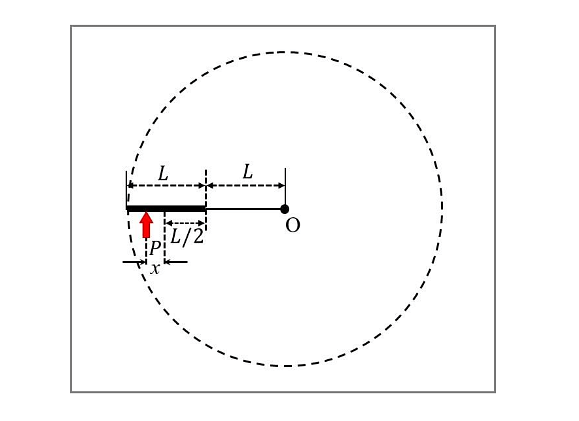
A thin uniform rod of length L and certain mass is kept on a frictionless horizontal table with a massless string of length L fixed to one end (top view is shown in the figure). The other end of the string is pivoted to a point O. If a horizontal impulse P is imparted to the rod at a distance x = L/n from the mid-point of the rod (see figure), then the rod and string revolve together around the point O, with the rod remaining aligned with the string. In such a case, the value of n is _____.
- JEE Advanced - 2024
- Friction