Question:medium
Consider the function
\[
f:\left(-\frac{\pi}{2},\frac{\pi}{2}\right)\to(-\infty,\infty)
\]
defined by
\[
f(x)=\left(|x|+|x-1|\right)\sin x+[x\sin x]
\]
where \([x\sin x]\) denotes the greatest integer less than or equal to \(x\sin x\).
Let \(\alpha\) be the total number of points in the interval
\[
\left(-\frac{\pi}{2},\frac{\pi}{2}\right)
\]
at which \(f\) is NOT continuous, and let \(\beta\) be the total number of points in the interval
\[
\left(-\frac{\pi}{2},\frac{\pi}{2}\right)
\]
at which \(f\) is NOT differentiable.
Then the value of
\[
\alpha+\beta
\]
is ________.
Consider the function
\[
f:\left(-\frac{\pi}{2},\frac{\pi}{2}\right)\to(-\infty,\infty)
\]
defined by
\[
f(x)=\left(|x|+|x-1|\right)\sin x+[x\sin x]
\]
where \([x\sin x]\) denotes the greatest integer less than or equal to \(x\sin x\).
Let \(\alpha\) be the total number of points in the interval
\[
\left(-\frac{\pi}{2},\frac{\pi}{2}\right)
\]
at which \(f\) is NOT continuous, and let \(\beta\) be the total number of points in the interval
\[
\left(-\frac{\pi}{2},\frac{\pi}{2}\right)
\]
at which \(f\) is NOT differentiable.
Then the value of
\[
\alpha+\beta
\]
is ________.
Show Hint
Greatest integer functions are discontinuous whenever the inside expression crosses an integer value.
Updated On: Jun 4, 2026
Show Solution
Correct Answer: 3
Solution and Explanation
Step 1: Understanding the Concept:
We analyze the function in two parts: \( g(x) = (|x| + |x-1|) \sin x \) and \( h(x) = [x \sin x] \). Continuity and differentiability depend on the behavior of the absolute values and the jump points of the greatest integer function.
Step 3: Detailed Explanation:
1. Analysis of \( g(x) = (|x| + |x-1|) \sin x \):
The term is continuous everywhere.
At \( x=0 \): \( g(x) \) behaves like \( (x+1)x = x^2+x \) for \( x>0 \) and \( (-x+1)x = -x^2+x \) for \( x<0 \).
The derivative from right is 1, and from left is 1. Thus, it is differentiable at \( x=0 \). (Basically \( |x| \sin x \) is differentiable because \( \sin 0 = 0 \)).
At \( x=1 \): \( |x-1| \) has a sharp corner. Since \( \sin 1 \neq 0 \), \( g(x) \) is non-differentiable at \( x=1 \).
2. Analysis of \( h(x) = [x \sin x] \):
Let \( p(x) = x \sin x \). In the range \( (-\pi/2, \pi/2) \), \( p(x) \) is even and increases from \( p(0) = 0 \) to \( p(\pi/2) = \pi/2 \approx 1.57 \).
The greatest integer function \( [p(x)] \) jumps where \( p(x) \) takes integer values.
In our range, \( p(x) \) reaches \( 1 \). Let \( p(x_0) = 1 \). Since \( p(x) \) is even, \( p(-x_0) = 1 \) as well.
At \( x=0 \), \( p(0)=0 \). Near 0, \( p(x) \) is small and positive, so \( [p(x)] = 0 \). Continuous and differentiable at \( x=0 \).
At \( x = \pm x_0 \), the function \( h(x) \) jumps from 0 to 1 (or vice versa). These are points of discontinuity and non-differentiability.
3. Conclusion for \( \alpha \) (Discontinuity):
\( f(x) \) is discontinuous only where \( h(x) \) is discontinuous.
Points are \( x = x_0 \) and \( x = -x_0 \). So \( \alpha = 2 \).
4. Conclusion for \( \beta \) (Non-differentiability):
Points of non-differentiability:
- Discontinuity points \( \pm x_0 \) (Total 2).
- Sharp point of \( |x-1| \) at \( x=1 \) (Total 1).
So \( \beta = 2 + 1 = 3 \).
5. Final result:
\( \alpha + \beta = 2 + 3 = 5 \).
Step 4: Final Answer:
The sum \( \alpha + \beta \) is 5.
We analyze the function in two parts: \( g(x) = (|x| + |x-1|) \sin x \) and \( h(x) = [x \sin x] \). Continuity and differentiability depend on the behavior of the absolute values and the jump points of the greatest integer function.
Step 3: Detailed Explanation:
1. Analysis of \( g(x) = (|x| + |x-1|) \sin x \):
The term is continuous everywhere.
At \( x=0 \): \( g(x) \) behaves like \( (x+1)x = x^2+x \) for \( x>0 \) and \( (-x+1)x = -x^2+x \) for \( x<0 \).
The derivative from right is 1, and from left is 1. Thus, it is differentiable at \( x=0 \). (Basically \( |x| \sin x \) is differentiable because \( \sin 0 = 0 \)).
At \( x=1 \): \( |x-1| \) has a sharp corner. Since \( \sin 1 \neq 0 \), \( g(x) \) is non-differentiable at \( x=1 \).
2. Analysis of \( h(x) = [x \sin x] \):
Let \( p(x) = x \sin x \). In the range \( (-\pi/2, \pi/2) \), \( p(x) \) is even and increases from \( p(0) = 0 \) to \( p(\pi/2) = \pi/2 \approx 1.57 \).
The greatest integer function \( [p(x)] \) jumps where \( p(x) \) takes integer values.
In our range, \( p(x) \) reaches \( 1 \). Let \( p(x_0) = 1 \). Since \( p(x) \) is even, \( p(-x_0) = 1 \) as well.
At \( x=0 \), \( p(0)=0 \). Near 0, \( p(x) \) is small and positive, so \( [p(x)] = 0 \). Continuous and differentiable at \( x=0 \).
At \( x = \pm x_0 \), the function \( h(x) \) jumps from 0 to 1 (or vice versa). These are points of discontinuity and non-differentiability.
3. Conclusion for \( \alpha \) (Discontinuity):
\( f(x) \) is discontinuous only where \( h(x) \) is discontinuous.
Points are \( x = x_0 \) and \( x = -x_0 \). So \( \alpha = 2 \).
4. Conclusion for \( \beta \) (Non-differentiability):
Points of non-differentiability:
- Discontinuity points \( \pm x_0 \) (Total 2).
- Sharp point of \( |x-1| \) at \( x=1 \) (Total 1).
So \( \beta = 2 + 1 = 3 \).
5. Final result:
\( \alpha + \beta = 2 + 3 = 5 \).
Step 4: Final Answer:
The sum \( \alpha + \beta \) is 5.
Was this answer helpful?
0
Top Questions on Continuity and differentiability
- Given that: \[ x = a \sin(2t) (1 + \cos(2t)), \quad y = a \cos(2t) (1 - \cos(2t)) \] Find \(\frac{dy}{dx}\).
- MHT CET - 2025
- Mathematics
- Continuity and differentiability
- Let \( f(x) = |1 - 2x| \), then:
- WBJEE - 2025
- Mathematics
- Continuity and differentiability
- A function \( f \) is defined by \( f(x) = 2 + (x - 1)^{2/3} \) on \( [0, 2] \). Which of the following statements is incorrect?
- WBJEE - 2025
- Mathematics
- Continuity and differentiability
- Let \( f : \mathbb{R} \to \mathbb{R} \) be a function given by
\[f(x) = \begin{cases} \frac{1 - \cos 2x}{x^2}, & x < 0 \\\alpha, & x = 0, \text{ where } \alpha, \beta \in \mathbb{R}. \\\beta \sqrt{1 - \cos x} / x, & x > 0 \end{cases} \]
If \( f \) is continuous at \( x = 0 \), then \( \alpha^2 + \beta^2 \) is equal to:- JEE Main - 2024
- Mathematics
- Continuity and differentiability
- Want to practice more? Try solving extra ecology questions todayView All Questions
Questions Asked in JEE Advanced exam
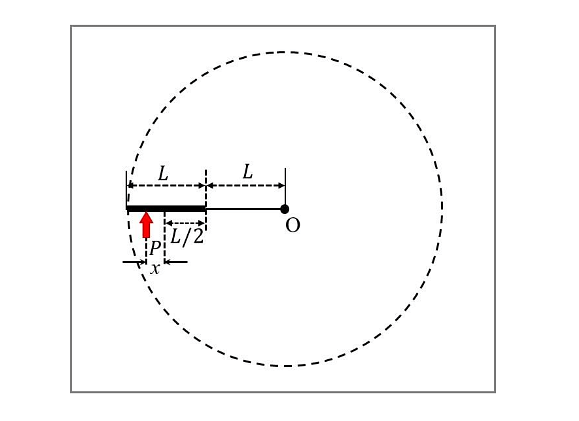
A thin uniform rod of length L and certain mass is kept on a frictionless horizontal table with a massless string of length L fixed to one end (top view is shown in the figure). The other end of the string is pivoted to a point O. If a horizontal impulse P is imparted to the rod at a distance x = L/n from the mid-point of the rod (see figure), then the rod and string revolve together around the point O, with the rod remaining aligned with the string. In such a case, the value of n is _____.
- JEE Advanced - 2024
- Friction