Question:medium
Consider an electric dipole comprising two charges \(+q\) and \(-q\), each with mass \(m\), separated by a fixed distance \(d\) and initially at rest with its dipole moment pointing along \(\hat{i}\). A uniform electric field \(E\hat{j}\) is turned on at time \(t=0\) and it is turned off at \(t=t_f\), when the dipole moment makes an angle \(\theta_f\) with \(\hat{i}\). Neglecting any sources of energy loss, correct option(s) is/are:
Consider an electric dipole comprising two charges \(+q\) and \(-q\), each with mass \(m\), separated by a fixed distance \(d\) and initially at rest with its dipole moment pointing along \(\hat{i}\). A uniform electric field \(E\hat{j}\) is turned on at time \(t=0\) and it is turned off at \(t=t_f\), when the dipole moment makes an angle \(\theta_f\) with \(\hat{i}\). Neglecting any sources of energy loss, correct option(s) is/are:
Show Hint
A uniform field gives zero net force and a torque that gives kinetic energy qEd sin(theta). Use I = md^2/2 for the rotation.
Updated On: Nov 19, 2026
- The center of mass of the dipole is deflected towards $\hat{j}$ in the presence of the field.
- If the magnitude of the final angular velocity $\omega_f = \sqrt{\frac{2qE}{md}}$, then $\theta_f = \frac{\pi}{6}$.
- If $\theta_f = \pi/3$, then the change in kinetic energy of the dipole is given by $2\sqrt{3}qEd$.
- For $\theta_f = \pi/4$, the dipole rotates around its center of mass with a constant angular velocity after $t > t_f$.
Show Solution
The Correct Option is B, D
Solution and Explanation
Step 1: Write the rotational equation:
A uniform field exerts equal and opposite forces, so there is no net force. The centre of mass never moves, and the motion is pure rotation about it.
Let $\theta$ be the angle of the dipole from $\hat{i}$. The torque is $\tau = pE\cos\theta = qdE\cos\theta$, because $\vec p \times \vec E$ has magnitude $pE$ times the sine of the angle between $\vec p$ and $\hat{j}$.
The moment of inertia about the centre is $I = 2m(d/2)^2 = md^2/2$.
Step 2: Angular acceleration:
\[ \alpha = \frac{\tau}{I} = \frac{2qE}{md}\cos\theta \]
Step 3: Integrate with respect to angle:
Write $\alpha = \omega\,\dfrac{d\omega}{d\theta}$. Starting from rest at $\theta = 0$:
\[ \int_0^{\omega}\omega\,d\omega = \frac{2qE}{md}\int_0^{\theta}\cos\theta\,d\theta \;\Rightarrow\; \frac{\omega^2}{2} = \frac{2qE}{md}\sin\theta \]
\[ \omega^2 = \frac{4qE}{md}\sin\theta \]
Step 4: Work done and kinetic energy:
The kinetic energy is $\tfrac12 I\omega^2 = \tfrac12\cdot\dfrac{md^2}{2}\cdot\dfrac{4qE\sin\theta}{md} = qEd\sin\theta$.
Step 5: Judge option (A):
No net force, so no sideways drift of the centre of mass. Option (A) is wrong.
Step 6: Judge option (B):
If $\omega_f^2 = \dfrac{2qE}{md}$ then $\sin\theta_f = \dfrac{1}{2}$, so $\theta_f = \dfrac{\pi}{6}$ when the field is switched off on the first swing.
(B) is correct. The angle $5\pi/6$ would also give the same speed, so the official key also lists (D) alone as acceptable.
Step 7: Judge option (C):
At $\theta_f = \pi/3$: $K = qEd\sin 60^\circ = 0.866\,qEd$. The option says $2\sqrt{3}\,qEd \approx 3.46\,qEd$. So (C) is wrong.
Step 8: Judge option (D):
For $t > t_f$ the torque is zero, so $\alpha = 0$ and $\omega$ stays equal to its value at $t_f$.
At $\pi/4$ that value is not zero, so the dipole turns steadily. (D) is correct.
Final Answer:
Options (B) and (D) are correct. \[ \boxed{\text{(B), (D)}} \]
Was this answer helpful?
0
Top Questions on Electrostatics
A 10 $\mu\text{C}$ charge is placed in an electric field of $ 5 \times 10^3 \text{N/C} $. What is the force experienced by the charge?
- MHT CET - 2025
- Physics
- Electrostatics
- A capacitor has a capacitance of $ 5 \, \mu\text{F} $ and a potential difference of $ 10 \, \text{V} $ is applied across it. What is the charge on the capacitor?
- MHT CET - 2025
- Physics
- Electrostatics
- Two charges of +3 μC and –3 μC are placed 2 cm apart in air. What is the electric potential energy of the system? (Take \( k = 9 \times 10^9 \) Nm\(^2\)/C\(^2\))
- BITSAT - 2025
- Physics
- Electrostatics
- A uniformly charged ring of radius \( R \) carries total charge \( Q \). Find the electric field at a point on the axis at a distance \( x = \frac{R}{\sqrt{2}} \) from the center.
- BITSAT - 2025
- Physics
- Electrostatics
- Want to practice more? Try solving extra ecology questions todayView All Questions
Questions Asked in JEE Advanced exam
A thin uniform rod of length L and certain mass is kept on a frictionless horizontal table with a massless string of length L fixed to one end (top view is shown in the figure). The other end of the string is pivoted to a point O. If a horizontal impulse P is imparted to the rod at a distance x = L/n from the mid-point of the rod (see figure), then the rod and string revolve together around the point O, with the rod remaining aligned with the string. In such a case, the value of n is _____.
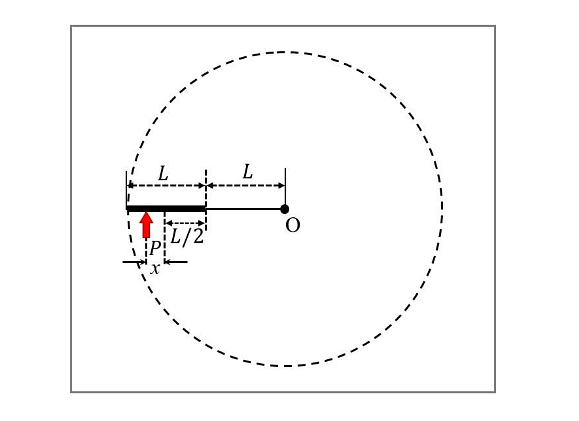
- JEE Advanced - 2024
- Friction