Question:medium
At a given temperature, \(0.45\,\text{g}\) of acetic acid in \(50\,\text{mL}\) of water is shaken with \(1.0\,\text{g}\) of charcoal and the pH of the resulting solution is \(3.0\). Assume, the adsorption of acetic acid from the aqueous solution by charcoal follows Freundlich isotherm,
\[
\frac{x}{m} = kC^{1/n}
\]
If the plot of \(\log_{10}(x/m)\) against \(\log_{10} C\) gives a straight line with slope \(1\), the value of \(k\) in \(\text{L mol}^{-1}\) is _______.
Given: The molar mass of acetic acid is \(60\,\text{g mol}^{-1}\).
The acid dissociation constant of acetic acid is \(1.0 \times 10^{-5}\) at the given temperature.
\(x\) is the mass (in grams) of acetic acid adsorbed.
\(m\) is the mass (in grams) of charcoal.
\(C\) is the equilibrium concentration of acetic acid in the solution after the adsorption is complete.
\(k\) and \(n\) are constants for acetic acid–charcoal system at the given temperature.
At a given temperature, \(0.45\,\text{g}\) of acetic acid in \(50\,\text{mL}\) of water is shaken with \(1.0\,\text{g}\) of charcoal and the pH of the resulting solution is \(3.0\). Assume, the adsorption of acetic acid from the aqueous solution by charcoal follows Freundlich isotherm,
\[ \frac{x}{m} = kC^{1/n} \]
If the plot of \(\log_{10}(x/m)\) against \(\log_{10} C\) gives a straight line with slope \(1\), the value of \(k\) in \(\text{L mol}^{-1}\) is _______.
Given: The molar mass of acetic acid is \(60\,\text{g mol}^{-1}\).
The acid dissociation constant of acetic acid is \(1.0 \times 10^{-5}\) at the given temperature.
\(x\) is the mass (in grams) of acetic acid adsorbed.
\(m\) is the mass (in grams) of charcoal.
\(C\) is the equilibrium concentration of acetic acid in the solution after the adsorption is complete.
\(k\) and \(n\) are constants for acetic acid–charcoal system at the given temperature.
\[ \frac{x}{m} = kC^{1/n} \]
If the plot of \(\log_{10}(x/m)\) against \(\log_{10} C\) gives a straight line with slope \(1\), the value of \(k\) in \(\text{L mol}^{-1}\) is _______.
Given: The molar mass of acetic acid is \(60\,\text{g mol}^{-1}\).
The acid dissociation constant of acetic acid is \(1.0 \times 10^{-5}\) at the given temperature.
\(x\) is the mass (in grams) of acetic acid adsorbed.
\(m\) is the mass (in grams) of charcoal.
\(C\) is the equilibrium concentration of acetic acid in the solution after the adsorption is complete.
\(k\) and \(n\) are constants for acetic acid–charcoal system at the given temperature.
Show Hint
For adsorption problems, carefully distinguish between initial and equilibrium concentrations. Use pH to find $[H^+]$ and then $K_a$ to find the equilibrium concentration of the undissociated acid. Account for the amount adsorbed ($x$) by subtracting the equilibrium amount in solution from the initial amount.
Updated On: Jun 4, 2026
Show Solution
Solution and Explanation
Step 1: Understanding the Question:
The problem involves the adsorption of acetic acid by charcoal, which follows the Freundlich isotherm. We are given initial conditions, final pH, and information about the plot of the Freundlich isotherm in logarithmic form. We need to find the value of the constant \(k\).
Step 2: Key Formula or Approach:
1. Freundlich isotherm (logarithmic form): Given as $\log_{10}(x/m) = \log_{10}k + \frac{1}{n} \log_{10}C$.
2. From the plot information: Slope of $\log_{10}(x/m)$ vs $\log_{10}C$ is 1. This means $\frac{1}{n} = 1 \Rightarrow n=1$.
3. Acid dissociation of acetic acid: $CH_3COOH \rightleftharpoons CH_3COO^- + H^+$.
The acid dissociation constant $K_a = \frac{[CH_3COO^-][H^+]}{[CH_3COOH]}$.
4. pH relation: $pH = -\log_{10}[H^+]$.
Step 3: Detailed Explanation:
Given:
- Initial mass of acetic acid = 0.45 g.
- Volume of water = 50 mL = 0.050 L.
- Mass of charcoal ($m$) = 1.0 g.
- Equilibrium pH of the solution = 3.0.
- Molar mass of acetic acid = 60 g mol\(^{-1}\).
- $K_a$ for acetic acid = $1.0 \times 10^{-5}$.
- From the plot, slope = $\frac{1}{n} = 1 \Rightarrow n = 1$.
Part 1: Calculate equilibrium concentration of $H^+$ and $CH_3COOH$ (C).
- From pH = 3.0, we get $[H^+] = 10^{-3} \text{ mol L}^{-1}$.
- For a weak acid $CH_3COOH$, in equilibrium:
\[ CH_3COOH \rightleftharpoons CH_3COO^- + H^+ \]
Let the initial concentration of undissociated $CH_3COOH$ at equilibrium be $C$.
Then at equilibrium: $[CH_3COOH] = C - [H^+]$.
$[CH_3COO^-] \approx [H^+]$ (assuming initial dissociation is mainly from $CH_3COOH$).
Using $K_a = \frac{[CH_3COO^-][H^+]}{[CH_3COOH]}$:
$1.0 \times 10^{-5} = \frac{(10^{-3})(10^{-3})}{C - 10^{-3}}$
$1.0 \times 10^{-5} = \frac{10^{-6}}{C - 10^{-3}}$
$C - 10^{-3} = \frac{10^{-6}}{1.0 \times 10^{-5}} = 10^{-1} = 0.1$
$C = 0.1 + 10^{-3} = 0.1 + 0.001 = 0.101 \text{ mol L}^{-1}$.
This is the equilibrium concentration of acetic acid in the solution. So $C = 0.101 \text{ M}$.
Part 2: Calculate mass of acetic acid in solution and adsorbed (\(x\)).
- Total initial moles of acetic acid = $\frac{0.45 \text{ g}}{60 \text{ g mol}^{-1}} = 0.0075 \text{ mol}$.
- Initial concentration of acetic acid = $\frac{0.0075 \text{ mol}}{0.050 \text{ L}} = 0.15 \text{ mol L}^{-1}$. (This is not used if we directly calculate from adsorbed amount).
- Moles of acetic acid remaining in solution at equilibrium = $C \times \text{Volume} = 0.101 \text{ mol L}^{-1} \times 0.050 \text{ L} = 0.00505 \text{ mol}$.
- Mass of acetic acid remaining in solution = $0.00505 \text{ mol} \times 60 \text{ g mol}^{-1} = 0.303 \text{ g}$.
- Mass of acetic acid adsorbed (\(x\)) = Initial mass - Mass remaining in solution
$x = 0.45 \text{ g} - 0.303 \text{ g} = 0.147 \text{ g}$.
Part 3: Calculate \(k\).
- We have \( x = 0.147 \text{ g} \).
- Mass of charcoal ($m$) = 1.0 g.
- Equilibrium concentration ($C$) = 0.101 M.
- $\frac{1}{n} = 1$, so $n=1$.
- Freundlich isotherm: $\frac{x}{m} = kC^{1/n}$ becomes $\frac{x}{m} = kC$.
\[ k = \frac{x/m}{C} = \frac{0.147 \text{ g} / 1.0 \text{ g}}{0.101 \text{ mol L}^{-1}} \]
\[ k = \frac{0.147}{0.101} \]
\[ k \approx 1.455 \]
Step 4: Final Answer:
The calculated value of \(k\) is 1.5 L mol\(^{-1}\).
The problem involves the adsorption of acetic acid by charcoal, which follows the Freundlich isotherm. We are given initial conditions, final pH, and information about the plot of the Freundlich isotherm in logarithmic form. We need to find the value of the constant \(k\).
Step 2: Key Formula or Approach:
1. Freundlich isotherm (logarithmic form): Given as $\log_{10}(x/m) = \log_{10}k + \frac{1}{n} \log_{10}C$.
2. From the plot information: Slope of $\log_{10}(x/m)$ vs $\log_{10}C$ is 1. This means $\frac{1}{n} = 1 \Rightarrow n=1$.
3. Acid dissociation of acetic acid: $CH_3COOH \rightleftharpoons CH_3COO^- + H^+$.
The acid dissociation constant $K_a = \frac{[CH_3COO^-][H^+]}{[CH_3COOH]}$.
4. pH relation: $pH = -\log_{10}[H^+]$.
Step 3: Detailed Explanation:
Given:
- Initial mass of acetic acid = 0.45 g.
- Volume of water = 50 mL = 0.050 L.
- Mass of charcoal ($m$) = 1.0 g.
- Equilibrium pH of the solution = 3.0.
- Molar mass of acetic acid = 60 g mol\(^{-1}\).
- $K_a$ for acetic acid = $1.0 \times 10^{-5}$.
- From the plot, slope = $\frac{1}{n} = 1 \Rightarrow n = 1$.
Part 1: Calculate equilibrium concentration of $H^+$ and $CH_3COOH$ (C).
- From pH = 3.0, we get $[H^+] = 10^{-3} \text{ mol L}^{-1}$.
- For a weak acid $CH_3COOH$, in equilibrium:
\[ CH_3COOH \rightleftharpoons CH_3COO^- + H^+ \]
Let the initial concentration of undissociated $CH_3COOH$ at equilibrium be $C$.
Then at equilibrium: $[CH_3COOH] = C - [H^+]$.
$[CH_3COO^-] \approx [H^+]$ (assuming initial dissociation is mainly from $CH_3COOH$).
Using $K_a = \frac{[CH_3COO^-][H^+]}{[CH_3COOH]}$:
$1.0 \times 10^{-5} = \frac{(10^{-3})(10^{-3})}{C - 10^{-3}}$
$1.0 \times 10^{-5} = \frac{10^{-6}}{C - 10^{-3}}$
$C - 10^{-3} = \frac{10^{-6}}{1.0 \times 10^{-5}} = 10^{-1} = 0.1$
$C = 0.1 + 10^{-3} = 0.1 + 0.001 = 0.101 \text{ mol L}^{-1}$.
This is the equilibrium concentration of acetic acid in the solution. So $C = 0.101 \text{ M}$.
Part 2: Calculate mass of acetic acid in solution and adsorbed (\(x\)).
- Total initial moles of acetic acid = $\frac{0.45 \text{ g}}{60 \text{ g mol}^{-1}} = 0.0075 \text{ mol}$.
- Initial concentration of acetic acid = $\frac{0.0075 \text{ mol}}{0.050 \text{ L}} = 0.15 \text{ mol L}^{-1}$. (This is not used if we directly calculate from adsorbed amount).
- Moles of acetic acid remaining in solution at equilibrium = $C \times \text{Volume} = 0.101 \text{ mol L}^{-1} \times 0.050 \text{ L} = 0.00505 \text{ mol}$.
- Mass of acetic acid remaining in solution = $0.00505 \text{ mol} \times 60 \text{ g mol}^{-1} = 0.303 \text{ g}$.
- Mass of acetic acid adsorbed (\(x\)) = Initial mass - Mass remaining in solution
$x = 0.45 \text{ g} - 0.303 \text{ g} = 0.147 \text{ g}$.
Part 3: Calculate \(k\).
- We have \( x = 0.147 \text{ g} \).
- Mass of charcoal ($m$) = 1.0 g.
- Equilibrium concentration ($C$) = 0.101 M.
- $\frac{1}{n} = 1$, so $n=1$.
- Freundlich isotherm: $\frac{x}{m} = kC^{1/n}$ becomes $\frac{x}{m} = kC$.
\[ k = \frac{x/m}{C} = \frac{0.147 \text{ g} / 1.0 \text{ g}}{0.101 \text{ mol L}^{-1}} \]
\[ k = \frac{0.147}{0.101} \]
\[ k \approx 1.455 \]
Step 4: Final Answer:
The calculated value of \(k\) is 1.5 L mol\(^{-1}\).
Was this answer helpful?
0
Top Questions on Surface Chemistry
- What is the polymer of elastomer?
- MHT CET - 2024
- Chemistry
- Surface Chemistry
- Which of the following ligands has two donor atoms?
- MHT CET - 2024
- Chemistry
- Surface Chemistry
- When ammoniacal silver nitrate reacts with organic compounds, this test is called:
- MHT CET - 2024
- Chemistry
- Surface Chemistry
- What is the IUPAC name and bond length of propan-1-ol and cyclobutane?
- MHT CET - 2024
- Chemistry
- Surface Chemistry
- Want to practice more? Try solving extra ecology questions todayView All Questions
Questions Asked in JEE Advanced exam
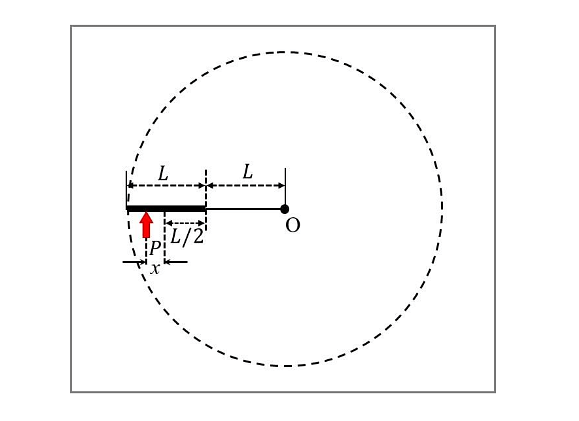
A thin uniform rod of length L and certain mass is kept on a frictionless horizontal table with a massless string of length L fixed to one end (top view is shown in the figure). The other end of the string is pivoted to a point O. If a horizontal impulse P is imparted to the rod at a distance x = L/n from the mid-point of the rod (see figure), then the rod and string revolve together around the point O, with the rod remaining aligned with the string. In such a case, the value of n is _____.
- JEE Advanced - 2024
- Friction