Question:medium
An equilateral triangle is formed by joining the midpoints of the sides of a given equilateral triangle. A third equilateral triangle is formed inside the second equilateral triangle in the same way, and so on. If this process continues indefinitely, then the sum of the areas of all such triangles, when the side of the first triangle is 16 cm, is:
An equilateral triangle is formed by joining the midpoints of the sides of a given equilateral triangle. A third equilateral triangle is formed inside the second equilateral triangle in the same way, and so on. If this process continues indefinitely, then the sum of the areas of all such triangles, when the side of the first triangle is 16 cm, is:
Show Hint
Each new triangle has half the side and one quarter the area of the one before it, so sum the resulting infinite geometric series with first term 64 root 3 and ratio 1/4.
Updated On: Jul 13, 2026
- \(256\sqrt{3}\) sq cm
- \(\dfrac{256}{3}\sqrt{3}\) sq cm
- \(\dfrac{64}{3}\sqrt{3}\) sq cm
- \(64\sqrt{3}\) sq cm
Show Solution
The Correct Option is B
Solution and Explanation
Step 1: List the side lengths of the shrinking triangles.
Starting from a side of 16, joining midpoints repeatedly gives sides 16, 8, 4, 2, 1, and so on forever, each one exactly half of the last, because the segment joining the midpoints of two sides of a triangle is always half the third side, a direct result of the midpoint theorem.
Step 2: Compute the area of each triangle one by one using $A = \dfrac{\sqrt{3}}{4}a^2$.
$A_1 = \dfrac{\sqrt{3}}{4}(16^2) = \dfrac{\sqrt{3}}{4}(256) = 64\sqrt{3}$
$A_2 = \dfrac{\sqrt{3}}{4}(8^2) = \dfrac{\sqrt{3}}{4}(64) = 16\sqrt{3}$
$A_3 = \dfrac{\sqrt{3}}{4}(4^2) = \dfrac{\sqrt{3}}{4}(16) = 4\sqrt{3}$
$A_4 = \dfrac{\sqrt{3}}{4}(2^2) = \dfrac{\sqrt{3}}{4}(4) = \sqrt{3}$
Step 3: Notice the pattern between consecutive areas.
Dividing each area by the one before it: $16\sqrt{3}/64\sqrt{3} = 1/4$, and $4\sqrt{3}/16\sqrt{3} = 1/4$, and $\sqrt{3}/4\sqrt{3} = 1/4$ again. So each area is exactly one quarter of the one before it, confirming a geometric series with first term $64\sqrt{3}$ and common ratio $1/4$.
Step 4: Add up the series using the infinite sum formula.
For a geometric series with $|r| < 1$, the sum to infinity is $\dfrac{\text{first term}}{1-r}$:
\[ \text{Sum} = \dfrac{64\sqrt{3}}{1 - 1/4} = \dfrac{64\sqrt{3}}{3/4} \]
Step 5: Simplify the fraction.
Dividing by $3/4$ is the same as multiplying by $4/3$:
\[ \dfrac{64\sqrt{3}}{3/4} = 64\sqrt{3} \times \dfrac{4}{3} = \dfrac{256\sqrt{3}}{3} \]
Step 6: State the final total.
So the combined area of every triangle in this never ending sequence adds up to $\dfrac{256}{3}\sqrt{3}$ sq cm, matching option (B).
\[ \boxed{\dfrac{256\sqrt{3}}{3} \text{ sq cm}} \]
Starting from a side of 16, joining midpoints repeatedly gives sides 16, 8, 4, 2, 1, and so on forever, each one exactly half of the last, because the segment joining the midpoints of two sides of a triangle is always half the third side, a direct result of the midpoint theorem.
Step 2: Compute the area of each triangle one by one using $A = \dfrac{\sqrt{3}}{4}a^2$.
$A_1 = \dfrac{\sqrt{3}}{4}(16^2) = \dfrac{\sqrt{3}}{4}(256) = 64\sqrt{3}$
$A_2 = \dfrac{\sqrt{3}}{4}(8^2) = \dfrac{\sqrt{3}}{4}(64) = 16\sqrt{3}$
$A_3 = \dfrac{\sqrt{3}}{4}(4^2) = \dfrac{\sqrt{3}}{4}(16) = 4\sqrt{3}$
$A_4 = \dfrac{\sqrt{3}}{4}(2^2) = \dfrac{\sqrt{3}}{4}(4) = \sqrt{3}$
Step 3: Notice the pattern between consecutive areas.
Dividing each area by the one before it: $16\sqrt{3}/64\sqrt{3} = 1/4$, and $4\sqrt{3}/16\sqrt{3} = 1/4$, and $\sqrt{3}/4\sqrt{3} = 1/4$ again. So each area is exactly one quarter of the one before it, confirming a geometric series with first term $64\sqrt{3}$ and common ratio $1/4$.
Step 4: Add up the series using the infinite sum formula.
For a geometric series with $|r| < 1$, the sum to infinity is $\dfrac{\text{first term}}{1-r}$:
\[ \text{Sum} = \dfrac{64\sqrt{3}}{1 - 1/4} = \dfrac{64\sqrt{3}}{3/4} \]
Step 5: Simplify the fraction.
Dividing by $3/4$ is the same as multiplying by $4/3$:
\[ \dfrac{64\sqrt{3}}{3/4} = 64\sqrt{3} \times \dfrac{4}{3} = \dfrac{256\sqrt{3}}{3} \]
Step 6: State the final total.
So the combined area of every triangle in this never ending sequence adds up to $\dfrac{256}{3}\sqrt{3}$ sq cm, matching option (B).
\[ \boxed{\dfrac{256\sqrt{3}}{3} \text{ sq cm}} \]
Was this answer helpful?
0
Top Questions on Sequences and Series
- The radius of the base of a cone is increasing at the rate of 3 cm/minute and the altitude is decreasing at the rate of 4 cm/minute. The rate of change of lateral surface when the radius is 7 cm and altitude is 24 cm is:
- VITEEE - 2024
- Mathematics
- Sequences and Series
- Let \( \alpha = 1^2 + 4^2 + 8^2 + 13^2 + 19^2 + 26^2 + \ldots \) up to 10 terms and \( \beta = \sum_{n=1}^{10} n^4 \). If \( 4\alpha - \beta = 55k + 40 \), then \( k \) is equal to \(\_\_\_\_\_\_\_\_\_\).
- JEE Main - 2024
- Mathematics
- Sequences and Series
- If \( 8 = 3 + \frac{1}{4}(3 + p) + \frac{1}{4^2}(3 + 2p) + \frac{1}{4^3}(3 + 3p) + \ldots \infty \), then the value of \( p \) is ______.
- JEE Main - 2024
- Mathematics
- Sequences and Series
- Let 3, a, b, c be in A.P. and 3, a – 1, b + l, c + 9 be in G.P. Then, the arithmetic mean of a, b and c is :
- JEE Main - 2024
- Mathematics
- Sequences and Series
- Want to practice more? Try solving extra ecology questions todayView All Questions
Questions Asked in XAT exam
Applicants have been shortlisted for interviews for some data analyst positions. Some of the applicants have advanced expertise in one or more fields among the following: data analysis, database handling and coding. The numbers of applicants with different advanced expertise are given in the 2 × 8 table below.
The number of applicants with advanced expertise in all three fields is given as x in the table, where x is a non-negative integer.
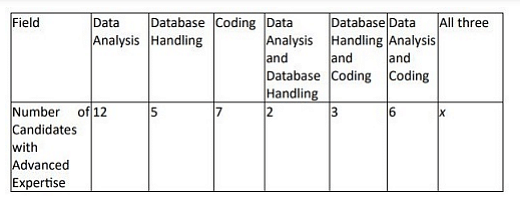
The number of applicants with advanced expertise in all three fields is given as x in the table, where x is a non-negative integer.
- XAT - 2024
- Data Interpretation