Question:easy
All the parliamentarians whom the reporter interviewed told that they had voted as per their conscience. Therefore, probably all the parliamentarians voted as per their conscience. This argument is an example of:
All the parliamentarians whom the reporter interviewed told that they had voted as per their conscience. Therefore, probably all the parliamentarians voted as per their conscience. This argument is an example of:
Show Hint
Notice the move from "the ones interviewed" (a sample) to "probably all" (the whole group), and the hedging word "probably" itself.
Updated On: Jul 10, 2026
- Inductive generalization
- Predictive argument
- Generalization based on authority
- Deduction generalization
Show Solution
The Correct Option is A
Solution and Explanation
Only the parliamentarians the reporter actually interviewed are the source of the claim, yet the conclusion reaches out to all parliamentarians, with the hedge word "probably" attached.
- Inductive generalization: this is exactly a move from an observed sample to a probable claim about the wider group it was drawn from, which is what happens here: interviewed parliamentarians to all parliamentarians, with "probably" signalling the uncertainty that comes with generalizing from a sample.
- Predictive argument: this would forecast something not yet known to have happened. The voting has already taken place, so there is nothing being predicted, only generalized.
- Generalization based on authority: this would need an expert or trusted source being cited as proof. The parliamentarians are the people the claim is about, not authorities vouching for someone else's claim, so this label is wrong.
- Deduction generalization: a real deduction needs a premise that already covers the entire group and delivers a certain conclusion. Here the premise covers only a sample, and the conclusion is hedged with "probably", the opposite of a deduction's certainty.
The sample-to-whole-group move with a probability hedge is the signature of inductive generalization, so that is the answer.
Let's summarize:
- Generalizing from an observed sample to the whole group, with a hedge like "probably", is inductive reasoning.
- A true deduction needs full coverage in its premise and gives a certain, not probable, conclusion.
So the correct choice is "inductive generalization".
Was this answer helpful?
0
Top Questions on Critical Reasoning
- Read the following statements and answer the question that follows.
A. Back then, they were owned by companies and installed on their premises.
B. Rooms and servers began to replace computer mainframes in the 1990’s.
C. These were supplemented by processors from Intel, which by the mid-2000s translated its dominance of PC semiconductors into a near monopoly of the server market.
D. They mostly ran on chips made by IBM and HP, the big tech of the day.
E. Things started to change once again around a decade ago, when Amazon began selling some of its spare server capacity.
Which of the following combinations is the MOST logically ordered?- XAT - 2024
- Verbal and Logical Ability
- Critical Reasoning
- Go through the statements below and answer the question that follows.
A. Maybe you have survived major trauma and have a hard time feeling safe.
B. You’ll probably discover that your fear and struggles make sense on account of what you’ve lived through.
C. Instead of beating yourself up for reacting in ways you don’t understand, you can develop compassion for yourself and what you’ve been through.
D. Perhaps you have experienced a sudden death, and you are often anxious about the health of your loved ones.
E. You may also find out that you have more strength than you knew, the same strength that has sustained you this far….
Which of the following combinations is the MOST logically ordered?- XAT - 2024
- Verbal and Logical Ability
- Critical Reasoning
- Read the following paragraph and answer the question that follows.
Fear is the greatest motivator of all time. Conflict born of fear is behind our every action, driving us forward like the cogs of a clock. Fear is desire’s dark dress, its doppelgänger. “Love and dread are brothers,” says Julian of Norwich. As desire is wanting and fear is not-wanting, they become inexorably linked; just as desire can be destructive (the desire for power), fear can be constructive (fear of hurting another); fear of poverty becomes desire for wealth.
Which of the following statements can be BEST concluded from the paragraph?- XAT - 2024
- Verbal and Logical Ability
- Critical Reasoning
- Read the following paragraphs and answer the question that follows.
Paragraph 1: Here are some handy rules of thumb. Anyone who calls themselves a thought leader is to be avoided. A man who does not wear socks cannot be trusted. And a company that holds an employee-appreciation day does not appreciate its employees.
Paragraph 2: It is not just that the message sent by acknowledging staff for one out of 260-odd working days is a bit of a giveaway (there isn’t a love-your-spouse day ... for the same reason). It is also that the ideas are usually so tragically unappreciative. You have worked hard all year so you get a slice of cold pizza or a rock stamped with the words “You rock”?
Which of the following BEST describes the relationship of the first paragraph with the second paragraph?- XAT - 2024
- Verbal and Logical Ability
- Critical Reasoning
- Want to practice more? Try solving extra ecology questions todayView All Questions
Questions Asked in XAT exam
Applicants have been shortlisted for interviews for some data analyst positions. Some of the applicants have advanced expertise in one or more fields among the following: data analysis, database handling and coding. The numbers of applicants with different advanced expertise are given in the 2 × 8 table below.
The number of applicants with advanced expertise in all three fields is given as x in the table, where x is a non-negative integer.
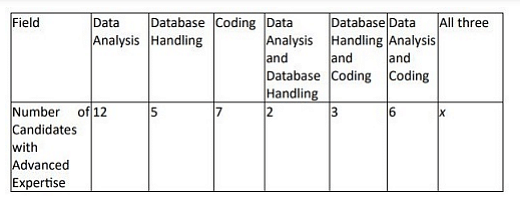
The number of applicants with advanced expertise in all three fields is given as x in the table, where x is a non-negative integer.
- XAT - 2024
- Data Interpretation