\(ABCD\) is a trapezium, such that \(AB\), \(DC\) are parallel and \(BC\) is perpendicular to them. If \(\angle DAB = 45^{\circ}\), \(BC = 2\) cm and \(CD = 3\) cm, then \(AB = ?\)
Show Hint
- 5 cm
- 4 cm
- 3 cm
- 2 cm
The Correct Option is A
Solution and Explanation
Here is a more direct geometric way to solve this, without using coordinates.
Since $DC$ is parallel to $AB$ and $BC$ is perpendicular to both, $ABCD$ is a right trapezium with right angles at $B$ and $C$. Drop a perpendicular from $D$ down to side $AB$, meeting it at point $E$. Since $DC$ is parallel to $AB$ and $BC$ is already perpendicular to both, the figure $BCDE$ is a rectangle: $BE = CD = 3$ cm and $DE = BC = 2$ cm.
Now look at triangle $ADE$. Since $E$ lies on $AB$ between $A$ and $B$ (because $AB$ is longer than $CD$), $AE = AB - BE = AB - 3$. The angle $\angle DAE$ is the same as $\angle DAB = 45^{\circ}$, since $E$ sits on segment $AB$.
Triangle $ADE$ has a right angle at $E$, because $DE$ is perpendicular to $AB$, being a side of rectangle $BCDE$. With a right angle at $E$ and an acute angle of $45^{\circ}$ at $A$, the third angle at $D$ must also be $45^{\circ}$. This makes triangle $ADE$ an isosceles right triangle, so its two legs are equal: $AE = DE$.
Since $DE = 2$ cm, the height of the trapezium, we get $AE = 2$ cm as well.
Let's summarize:
- $BE = CD = 3$ cm, being opposite sides of rectangle $BCDE$.
- $AE = DE = 2$ cm, because triangle $ADE$ is a 45-45-90 right triangle.
- $AB = AE + EB = 2 + 3 = 5$ cm.
So $AB = 5$ cm, confirming option (A), and matching the coordinate-based calculation using a completely different, purely geometric route.
Top Questions on Geometry
- A rectangle \(ABCD\) has sides \(AB = 45 \, \text{cm}\) and \(BC = 26 \, \text{cm}\). Point \(E\) is the midpoint of side \(CD\). Find the radius of the incircle of the triangle \(\triangle AED\).
- CAT - 2024
- Quantitative Aptitude
- Geometry
- The coordinates of the foot of perpendicular from the point \( (2, 3) \) on the line \( y = 3x + 4 \) is given by:
- VITEEE - 2024
- Mathematics
- Geometry
- The points A(4, -2, 1), B(7, -4, 7), C(2, -5, 10), and D(-1, -3, 4) are the vertices of a:
- VITEEE - 2024
- Mathematics
- Geometry
- If A, B, C, D are the angles of a quadrilateral, then \[ \frac{\tan A + \tan B + \tan C + \tan D}{\cot A + \cot B + \cot C + \cot D} = \]
- VITEEE - 2024
- Mathematics
- Geometry
- Want to practice more? Try solving extra ecology questions todayView All Questions
Questions Asked in XAT exam
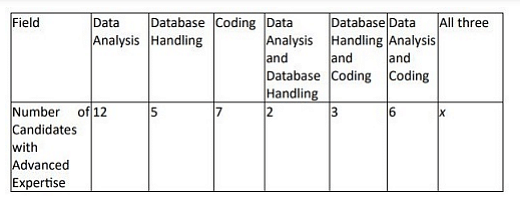
The number of applicants with advanced expertise in all three fields is given as x in the table, where x is a non-negative integer.
- XAT - 2024
- Data Interpretation