Question:hard
ABCD is a square with sides of length 10 units. OCD is an isosceles triangle with base CD. OC cuts AB at point Q and OD cuts AB at point P. The area of trapezoid PQCD is 80 square units. The altitude from O of the triangle OPQ is:
ABCD is a square with sides of length 10 units. OCD is an isosceles triangle with base CD. OC cuts AB at point Q and OD cuts AB at point P. The area of trapezoid PQCD is 80 square units. The altitude from O of the triangle OPQ is:
Show Hint
Triangle OPQ is similar to triangle OCD because PQ (on AB) is parallel to CD; use the ratio of their altitudes to set up an area equation.
Updated On: Jul 10, 2026
- 12
- 13
- 14
- 15
Show Solution
The Correct Option is D
Solution and Explanation
Step 1: Use the ratio of areas of similar triangles instead of expanding algebra.
Triangles OPQ and OCD are similar since PQ is parallel to CD. If k is the ratio of their altitudes (altitude of OPQ over altitude of OCD), then the ratio of their areas is $k^2$.
Step 2: Express the altitudes.
Let h be the altitude of triangle OPQ (what we want). Since AB sits exactly 10 units above CD, the altitude of the full triangle OCD is $h + 10$. So $k = \dfrac{h}{h+10}$.
Step 3: Write the trapezoid area as a fraction of the big triangle.
Area of trapezoid PQCD = Area(OCD) minus Area(OPQ) = Area(OCD)$\left(1 - k^2\right)$, and Area(OCD) $= \dfrac{1}{2}(10)(h+10) = 5(h+10)$. So \[ 5(h+10)\left[1 - \left(\frac{h}{h+10}\right)^2\right] = 80 \]
Step 4: Simplify using the difference of squares.
$1 - \left(\dfrac{h}{h+10}\right)^2 = \dfrac{(h+10)^2 - h^2}{(h+10)^2} = \dfrac{20h + 100}{(h+10)^2}$, so the equation becomes \[ \frac{5(20h+100)}{h+10} = 80 \] \[ 5(20h + 100) = 80(h+10) \]
Step 5: Solve the linear equation.
\[ 100h + 500 = 80h + 800 \] \[ 20h = 300 \] \[ h = 15 \]
Final Answer:
\[ \boxed{15} \]
Triangles OPQ and OCD are similar since PQ is parallel to CD. If k is the ratio of their altitudes (altitude of OPQ over altitude of OCD), then the ratio of their areas is $k^2$.
Step 2: Express the altitudes.
Let h be the altitude of triangle OPQ (what we want). Since AB sits exactly 10 units above CD, the altitude of the full triangle OCD is $h + 10$. So $k = \dfrac{h}{h+10}$.
Step 3: Write the trapezoid area as a fraction of the big triangle.
Area of trapezoid PQCD = Area(OCD) minus Area(OPQ) = Area(OCD)$\left(1 - k^2\right)$, and Area(OCD) $= \dfrac{1}{2}(10)(h+10) = 5(h+10)$. So \[ 5(h+10)\left[1 - \left(\frac{h}{h+10}\right)^2\right] = 80 \]
Step 4: Simplify using the difference of squares.
$1 - \left(\dfrac{h}{h+10}\right)^2 = \dfrac{(h+10)^2 - h^2}{(h+10)^2} = \dfrac{20h + 100}{(h+10)^2}$, so the equation becomes \[ \frac{5(20h+100)}{h+10} = 80 \] \[ 5(20h + 100) = 80(h+10) \]
Step 5: Solve the linear equation.
\[ 100h + 500 = 80h + 800 \] \[ 20h = 300 \] \[ h = 15 \]
Final Answer:
\[ \boxed{15} \]
Was this answer helpful?
0
Top Questions on Mensuration
- A triangle is drawn with its vertices on the circle C such that one of its sides is a diameter of C and the other two sides have their lengths in the ratio a:b. If the radius of the circle is r, then the area of the triangle is
- CAT - 2023
- Quantitative Aptitude
- Mensuration
- The area of the quadrilateral bounded by the \(Y\) -axis, the line \(x = 5\) , and the lines \(|x-y|-|x-5|=2\), is
- CAT - 2023
- Quantitative Aptitude
- Mensuration
- ABCD is a rectangle with sides AB = 56 cm and BC = 45 cm, and E is the midpoint of side CD. Then, the length, in cm, of radius of incircle of \(\triangle ADE\) is
- CAT - 2024
- Quantitative Aptitude
- Mensuration
- The surface area of a closed rectangular box, which is inscribed in a sphere, is 846 sq cm, and the sum of the lengths of all its edges is 144 cm. The volume, in cubic cm, of the sphere is ?
- CAT - 2024
- Quantitative Aptitude
- Mensuration
- Want to practice more? Try solving extra ecology questions todayView All Questions
Questions Asked in XAT exam
Applicants have been shortlisted for interviews for some data analyst positions. Some of the applicants have advanced expertise in one or more fields among the following: data analysis, database handling and coding. The numbers of applicants with different advanced expertise are given in the 2 × 8 table below.
The number of applicants with advanced expertise in all three fields is given as x in the table, where x is a non-negative integer.
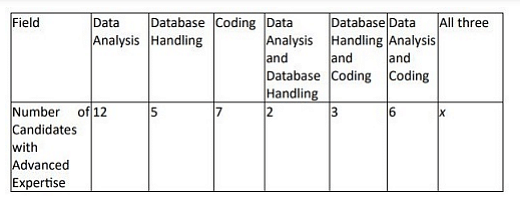
The number of applicants with advanced expertise in all three fields is given as x in the table, where x is a non-negative integer.
- XAT - 2024
- Data Interpretation