Question:hard
\(ABCD\) is a square with \(AB = 2\). \(P\) is the midpoint of \(AB\). The line through \(A\) that is perpendicular to \(DP\) meets the diagonal \(BD\) at \(Q\) and meets side \(BC\) at \(R\). Find the length of \(PR\).
\(ABCD\) is a square with \(AB = 2\). \(P\) is the midpoint of \(AB\). The line through \(A\) that is perpendicular to \(DP\) meets the diagonal \(BD\) at \(Q\) and meets side \(BC\) at \(R\). Find the length of \(PR\).
Show Hint
Try placing the square on coordinate axes with A at the origin; the perpendicularity condition then turns into a slope condition that is easy to solve.
Updated On: Jul 10, 2026
- \(\dfrac{1}{2}\)
- \(\dfrac{\sqrt{3}}{2}\)
- \(\sqrt{2}\)
- \(1\)
Show Solution
The Correct Option is C
Solution and Explanation
Instead of coordinates, this method uses similar triangles, leaning on the fact that AR is drawn perpendicular to DP, which creates matching angles between two right triangles in the figure.
- Set the known lengths: since ABCD is a square with side $AB = 2$, we also have $AD = 2$ and $BC = 2$. P is the midpoint of AB, so $AP = PB = 1$.
- Spot the two right triangles: triangle ADP has a right angle at A, since angle DAB of the square is $90^{\circ}$ and P lies on AB. Triangle ARB (formed by A, R on BC, and B) has a right angle at B, since angle ABC of the square is $90^{\circ}$.
- Show the triangles are similar: since AR is perpendicular to DP, chasing the angles around point A shows angle ADP in triangle ADP equals angle RAB in triangle ARB. Combined with both triangles already having a right angle, this makes triangle ADP similar to triangle ARB by the angle-angle rule.
- Write the similarity ratio: matching corresponding sides of the two similar triangles gives $\dfrac{AB}{AD} = \dfrac{BR}{AP}$. Since $AB = AD = 2$, both sides of the same square, the left side equals $1$, so $\dfrac{BR}{AP} = 1$, which gives $BR = AP = 1$.
- Apply the Pythagoras theorem in triangle PBR: angle PBR is $90^{\circ}$, the square's own corner angle at B, with legs $PB = 1$ and $BR = 1$. So $PR^2 = PB^2 + BR^2 = 1^2 + 1^2 = 2$, giving $PR = \sqrt{2}$.
Let's summarize:
- Because ABCD is a square, AB and AD are equal, which forces BR to equal AP once the two right triangles ADP and ARB are shown similar.
- With $PB = 1$ and $BR = 1$ both known, a single application of the Pythagoras theorem in the right triangle PBR gives $PR = \sqrt{2}$.
So $PR = \sqrt{2}$, confirming the same result a coordinate approach would give.
Was this answer helpful?
0
Top Questions on Geometry
- A rectangle \(ABCD\) has sides \(AB = 45 \, \text{cm}\) and \(BC = 26 \, \text{cm}\). Point \(E\) is the midpoint of side \(CD\). Find the radius of the incircle of the triangle \(\triangle AED\).
- CAT - 2024
- Quantitative Aptitude
- Geometry
- The coordinates of the foot of perpendicular from the point \( (2, 3) \) on the line \( y = 3x + 4 \) is given by:
- VITEEE - 2024
- Mathematics
- Geometry
- The points A(4, -2, 1), B(7, -4, 7), C(2, -5, 10), and D(-1, -3, 4) are the vertices of a:
- VITEEE - 2024
- Mathematics
- Geometry
- If A, B, C, D are the angles of a quadrilateral, then \[ \frac{\tan A + \tan B + \tan C + \tan D}{\cot A + \cot B + \cot C + \cot D} = \]
- VITEEE - 2024
- Mathematics
- Geometry
- Want to practice more? Try solving extra ecology questions todayView All Questions
Questions Asked in XAT exam
Applicants have been shortlisted for interviews for some data analyst positions. Some of the applicants have advanced expertise in one or more fields among the following: data analysis, database handling and coding. The numbers of applicants with different advanced expertise are given in the 2 × 8 table below.
The number of applicants with advanced expertise in all three fields is given as x in the table, where x is a non-negative integer.
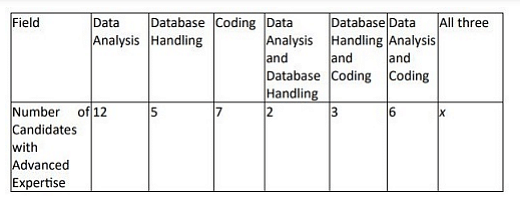
The number of applicants with advanced expertise in all three fields is given as x in the table, where x is a non-negative integer.
- XAT - 2024
- Data Interpretation