Question:medium
\(ABCD\) is a rectangle with \(AD = 10\). \(P\) is a point on \(BC\) such that \(\angle APD = 90^{\circ}\). If \(DP = 8\), find the length of \(BP\).
\(ABCD\) is a rectangle with \(AD = 10\). \(P\) is a point on \(BC\) such that \(\angle APD = 90^{\circ}\). If \(DP = 8\), find the length of \(BP\).
Show Hint
First use the right triangle APD to find AP, then set up two more Pythagoras equations for triangles ABP and DPC using AB = DC = x and BP = y, PC = 10 - y.
Updated On: Jul 10, 2026
- 6.4
- 5.2
- 4.8
- 3.6
Show Solution
The Correct Option is D
Solution and Explanation
There is a shortcut here that avoids setting up two separate Pythagoras equations: since $\angle APD = 90^{\circ}$, the two smaller right triangles ABP and DCP formed on either side of P turn out to be similar to each other. Once that is spotted, one clean ratio gives the answer directly.
- Find AP first: in right triangle APD, the hypotenuse is $AD = 10$ and one leg is $DP = 8$. By the Pythagoras theorem, $AP = \sqrt{AD^2 - DP^2} = \sqrt{100 - 64} = \sqrt{36} = 6$.
- Spot the similar triangles: angle $ABP$ and angle $DCP$ are both $90^{\circ}$, corners of the rectangle. Also, angle $APB$ plus angle $DPC$ must add up to $90^{\circ}$, because angle $APD$ itself takes up $90^{\circ}$ out of the straight line $BC$ at point P. Comparing complementary angles in the two right triangles shows angle $BAP$ equals angle $DPC$, and angle $APB$ equals angle $CDP$. So triangle $ABP$ is similar to triangle $PCD$ by the angle-angle rule.
- Write the similarity ratio: matching corresponding sides of triangle $ABP \sim$ triangle $PCD$ gives $\dfrac{AP}{PD} = \dfrac{BP}{CD} = \dfrac{AB}{PC}$.
- Use the first two ratios: since $CD = AB$, opposite sides of the rectangle, call this common length $x$. So $\dfrac{6}{8} = \dfrac{BP}{x}$, which gives $BP = \dfrac{6x}{8} = \dfrac{3x}{4}$.
- Bring in the leftover side lengths: $BP + PC = BC = AD = 10$, opposite sides of the rectangle are equal. From $\dfrac{AP}{PD} = \dfrac{AB}{PC}$: $\dfrac{6}{8} = \dfrac{x}{PC}$, so $PC = \dfrac{8x}{6} = \dfrac{4x}{3}$.
- Solve using $BP + PC = 10$: $\dfrac{3x}{4} + \dfrac{4x}{3} = 10$. Multiply throughout by $12$ to clear denominators: $9x + 16x = 120$, so $25x = 120$, giving $x = 4.8$.
- Find BP: $BP = \dfrac{3x}{4} = \dfrac{3(4.8)}{4} = \dfrac{14.4}{4} = 3.6$.
Let's summarize:
- Once AP is found using the Pythagoras theorem in triangle APD, spotting that triangle ABP is similar to triangle PCD avoids setting up two separate equations from scratch.
- Solving the resulting ratio alongside $BP + PC = 10$ gives $x = AB = 4.8$ and $BP = 3.6$, matching the direct algebraic approach.
So $BP = 3.6$.
Was this answer helpful?
0
Top Questions on Geometry
- A rectangle \(ABCD\) has sides \(AB = 45 \, \text{cm}\) and \(BC = 26 \, \text{cm}\). Point \(E\) is the midpoint of side \(CD\). Find the radius of the incircle of the triangle \(\triangle AED\).
- CAT - 2024
- Quantitative Aptitude
- Geometry
- The coordinates of the foot of perpendicular from the point \( (2, 3) \) on the line \( y = 3x + 4 \) is given by:
- VITEEE - 2024
- Mathematics
- Geometry
- The points A(4, -2, 1), B(7, -4, 7), C(2, -5, 10), and D(-1, -3, 4) are the vertices of a:
- VITEEE - 2024
- Mathematics
- Geometry
- If A, B, C, D are the angles of a quadrilateral, then \[ \frac{\tan A + \tan B + \tan C + \tan D}{\cot A + \cot B + \cot C + \cot D} = \]
- VITEEE - 2024
- Mathematics
- Geometry
- Want to practice more? Try solving extra ecology questions todayView All Questions
Questions Asked in XAT exam
Applicants have been shortlisted for interviews for some data analyst positions. Some of the applicants have advanced expertise in one or more fields among the following: data analysis, database handling and coding. The numbers of applicants with different advanced expertise are given in the 2 × 8 table below.
The number of applicants with advanced expertise in all three fields is given as x in the table, where x is a non-negative integer.
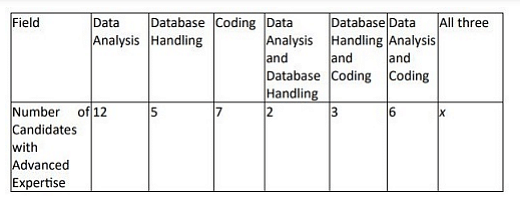
The number of applicants with advanced expertise in all three fields is given as x in the table, where x is a non-negative integer.
- XAT - 2024
- Data Interpretation