Question:hard
ABCD is a rectangle. The points P and Q lie on AD and AB respectively. If the triangles PAQ, QBC and PCD all have the same areas and BQ = 2 then AQ = ?
ABCD is a rectangle. The points P and Q lie on AD and AB respectively. If the triangles PAQ, QBC and PCD all have the same areas and BQ = 2 then AQ = ?
Show Hint
Set up right triangles at three corners of the rectangle, express their areas using AQ, BQ, AP and AD, then equate them to form and solve a quadratic in AQ.
Updated On: Jul 13, 2026
- \(1+\sqrt{5}\)
- \(1-\sqrt{5}\)
- \(\sqrt{7}\)
- \(2\sqrt{7}\)
Show Solution
The Correct Option is A
Solution and Explanation
Step 1: Name the unknowns directly on the rectangle.
Let the rectangle have sides AB and AD. Let $AQ = x$ (so Q splits AB), and since $BQ = 2$, the full side $AB = x+2$. Let $AD = h$ and let $AP = y$, so $PD = h-y$.
Step 2: Express each corner triangle's area using the rectangle's own sides.
Triangle QBC sits in the corner at B, with legs $QB=2$ and $BC=AD=h$:
\[ [QBC] = \frac12 \cdot 2 \cdot h = h \]
Triangle PAQ sits in the corner at A, with legs $AP=y$ and $AQ=x$:
\[ [PAQ] = \frac12 xy \]
Triangle PCD sits in the corner at D, with legs $DC=AB=x+2$ and $DP=h-y$:
\[ [PCD] = \frac12 (x+2)(h-y) \]
Step 3: Equate [PAQ] and [QBC] to link h and the product xy.
\[ \frac12 xy = h \ \Rightarrow\ xy = 2h \]
Step 4: Equate [PCD] and [QBC], then remove h using Step 3.
\[ \frac12 (x+2)(h-y) = h \ \Rightarrow\ (x+2)(h-y) = 2h \]
Replace $h$ with $\frac{xy}{2}$ throughout:
\[ (x+2)\left(\frac{xy}{2} - y\right) = 2\cdot\frac{xy}{2} \]
\[ (x+2)\cdot y\left(\frac{x}{2}-1\right) = xy \]
Cancel $y$ (a genuine side length, so $y \neq 0$):
\[ (x+2)\left(\frac{x-2}{2}\right) = x \]
\[ (x+2)(x-2) = 2x \]
\[ x^2 - 4 = 2x \]
\[ x^2 - 2x - 4 = 0 \]
Step 5: Solve and pick the valid root.
By the quadratic formula, $x = 1 \pm \sqrt5$. A length cannot be negative, and $1-\sqrt5 \approx -1.24$ is negative, so it is thrown out. That leaves a single valid answer, so AQ is in fact uniquely determined by the given data.
Final Answer:
\[ \boxed{AQ = 1 + \sqrt5} \]
Let the rectangle have sides AB and AD. Let $AQ = x$ (so Q splits AB), and since $BQ = 2$, the full side $AB = x+2$. Let $AD = h$ and let $AP = y$, so $PD = h-y$.
Step 2: Express each corner triangle's area using the rectangle's own sides.
Triangle QBC sits in the corner at B, with legs $QB=2$ and $BC=AD=h$:
\[ [QBC] = \frac12 \cdot 2 \cdot h = h \]
Triangle PAQ sits in the corner at A, with legs $AP=y$ and $AQ=x$:
\[ [PAQ] = \frac12 xy \]
Triangle PCD sits in the corner at D, with legs $DC=AB=x+2$ and $DP=h-y$:
\[ [PCD] = \frac12 (x+2)(h-y) \]
Step 3: Equate [PAQ] and [QBC] to link h and the product xy.
\[ \frac12 xy = h \ \Rightarrow\ xy = 2h \]
Step 4: Equate [PCD] and [QBC], then remove h using Step 3.
\[ \frac12 (x+2)(h-y) = h \ \Rightarrow\ (x+2)(h-y) = 2h \]
Replace $h$ with $\frac{xy}{2}$ throughout:
\[ (x+2)\left(\frac{xy}{2} - y\right) = 2\cdot\frac{xy}{2} \]
\[ (x+2)\cdot y\left(\frac{x}{2}-1\right) = xy \]
Cancel $y$ (a genuine side length, so $y \neq 0$):
\[ (x+2)\left(\frac{x-2}{2}\right) = x \]
\[ (x+2)(x-2) = 2x \]
\[ x^2 - 4 = 2x \]
\[ x^2 - 2x - 4 = 0 \]
Step 5: Solve and pick the valid root.
By the quadratic formula, $x = 1 \pm \sqrt5$. A length cannot be negative, and $1-\sqrt5 \approx -1.24$ is negative, so it is thrown out. That leaves a single valid answer, so AQ is in fact uniquely determined by the given data.
Final Answer:
\[ \boxed{AQ = 1 + \sqrt5} \]
Was this answer helpful?
0
Top Questions on Geometry
- A rectangle \(ABCD\) has sides \(AB = 45 \, \text{cm}\) and \(BC = 26 \, \text{cm}\). Point \(E\) is the midpoint of side \(CD\). Find the radius of the incircle of the triangle \(\triangle AED\).
- CAT - 2024
- Quantitative Aptitude
- Geometry
- The coordinates of the foot of perpendicular from the point \( (2, 3) \) on the line \( y = 3x + 4 \) is given by:
- VITEEE - 2024
- Mathematics
- Geometry
- The points A(4, -2, 1), B(7, -4, 7), C(2, -5, 10), and D(-1, -3, 4) are the vertices of a:
- VITEEE - 2024
- Mathematics
- Geometry
- If A, B, C, D are the angles of a quadrilateral, then \[ \frac{\tan A + \tan B + \tan C + \tan D}{\cot A + \cot B + \cot C + \cot D} = \]
- VITEEE - 2024
- Mathematics
- Geometry
- Want to practice more? Try solving extra ecology questions todayView All Questions
Questions Asked in XAT exam
Applicants have been shortlisted for interviews for some data analyst positions. Some of the applicants have advanced expertise in one or more fields among the following: data analysis, database handling and coding. The numbers of applicants with different advanced expertise are given in the 2 × 8 table below.
The number of applicants with advanced expertise in all three fields is given as x in the table, where x is a non-negative integer.
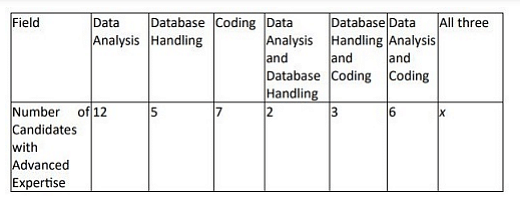
The number of applicants with advanced expertise in all three fields is given as x in the table, where x is a non-negative integer.
- XAT - 2024
- Data Interpretation