A trader buys goods from Delhi to sell in Bombay, where he gets a price realisation \(20\%\) higher than the Delhi price. In each journey, he spends Rs. 2000 on travelling and Rs. 2500 as a bribe to the parcel authority, and still makes a net profit of Rs. 20,000. Find the total value of goods purchased by the dealer in 7 journeys to Delhi.
Show Hint
- Rs. 1,22,500
- Rs. 2,45,000
- Rs. 8,57,500
- None
The Correct Option is C
Solution and Explanation
Here is another way to reach the same result, working with totals for all 7 journeys directly instead of first solving for one journey.
Let the total value of goods bought over all 7 journeys be Rs. \(T\). Since the same 20% markup applies to every journey, the total selling price in Bombay across all 7 trips is \(1.2T\).
Total expenses over 7 journeys: travel cost is \(7 \times 2000 = Rs. 14,000\), and the bribe cost is \(7 \times 2500 = Rs. 17,500\). Together, that is Rs. 31,500.
Total net profit over 7 journeys, since Rs. 20,000 is earned on each of the 7 trips, is \(7 \times 20,000 = Rs. 1,40,000\).
Now write the profit equation for the whole set of 7 journeys:
\[ (\text{Selling price}) - (\text{Cost price}) - (\text{Expenses}) = \text{Profit} \] \[ 1.2T - T - 31,500 = 1,40,000 \] \[ 0.2T = 1,71,500 \] \[ T = \frac{1,71,500}{0.2} = 8,57,500 \]Both routes agree: whether we scale up a single journey's cost by 7, or build the profit equation for all 7 journeys together, the total value of goods purchased works out to Rs. 8,57,500. Option (1) only gives the value for one journey, and option (2) is simply double that, so neither matches what the question actually asks for, the value over 7 journeys.
\[ \boxed{Rs.\ 8,57,500} \]Top Questions on Profit and Loss
- Geeta sells A \(→\) 20% (Profit) and B \(→\) 10% (Loss) at the same sp. If she increases SP such that A and B still sold at an equal price and profit of 10% made on B, then profit made on A will be?
- CAT - 2023
- Quantitative Aptitude
- Profit and Loss
- An item is sold with a profit of \(40\%\). If the cost price is reduced by \(40\%\) and Rs. \(5\) are also reduced from it, then the profit will be increased to \(50\%\). Find the final cost price.
- CAT - 2024
- Quantitative Aptitude
- Profit and Loss
- Minu purchases a pair of sunglasses at Rs.1000 and sells to Kanu at 20% profit. Then, Kanu sells it back to Minu at 20% loss. Finally, Minu sells the same pair of sunglasses to Tanu. If the total profit made by Minu from all her transactions is Rs.500, then the percentage of profit made by Minu when she sold the pair of sunglasses to Tanu is
- CAT - 2023
- Quantitative Aptitude
- Profit and Loss
- Jayant bought a certain number of white shirts at the rate of Rs 1000 per piece and a certain number of blue shirts at the rate of Rs 1125 per piece. For each shirt, he then set a fixed market price which was 25% higher than the average cost of all the shirts. He sold all the shirts at a discount of 10% and made a total profit of Rs 51000. If he bought both colors of shirts, then the maximum possible total number of shirts that he could have bought is
- CAT - 2023
- Quantitative Aptitude
- Profit and Loss
- Want to practice more? Try solving extra ecology questions todayView All Questions
Questions Asked in XAT exam
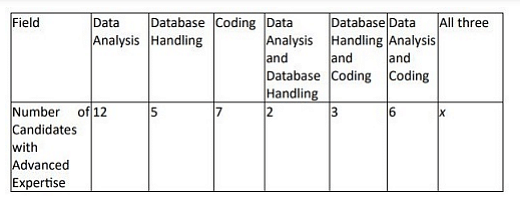
The number of applicants with advanced expertise in all three fields is given as x in the table, where x is a non-negative integer.
- XAT - 2024
- Data Interpretation