Question:medium
A spherical balloon is inflated and its radius is increasing at 4 cm/second. At what rate would the volume be increasing when its radius is 14 cm?
A spherical balloon is inflated and its radius is increasing at 4 cm/second. At what rate would the volume be increasing when its radius is 14 cm?
Show Hint
Differentiate the sphere volume formula \(V = \frac{4}{3}\pi r^3\) with respect to time to link \(\frac{dV}{dt}\) with \(\frac{dr}{dt}\), then substitute r = 14 cm and dr/dt = 4 cm/sec.
Updated On: Jul 13, 2026
- \(\pi(56)^2 \text{ cm}^3\text{/sec}\)
- \(9856 \text{ cm}^3\text{/sec}\)
- \(10{,}000 \text{ cm}^3\text{/sec}\)
- None of these
Show Solution
The Correct Option is B
Solution and Explanation
Step 1: Notice a shortcut.
For a sphere, the derivative of the volume with respect to the radius is exactly the surface area:
\[ \frac{dV}{dr} = \frac{d}{dr}\left(\frac{4}{3}\pi r^3\right) = 4\pi r^2 \]
This is just the curved surface area formula of the sphere at radius \(r\).
Step 2: Use the chain rule with this shortcut.
By the chain rule, $\frac{dV}{dt} = \frac{dV}{dr} \times \frac{dr}{dt}$. So the rate of change of volume equals the surface area at that instant times the rate at which the radius grows.
Step 3: Find the surface area at r = 14 cm.
\[ \text{Surface area} = 4\pi r^2 = 4\pi (14)^2 = 4\pi \times 196 = 784\pi \]
Step 4: Multiply by the rate of growth of the radius.
The radius grows at 4 cm/sec, so:
\[ \frac{dV}{dt} = 784\pi \times 4 = 3136\pi \]
Taking $\pi = \frac{22}{7}$:
\[ 3136 \times \frac{22}{7} = 448 \times 22 = 9856 \]
Step 5: Match with the options.
This numeric value, 9856 cm3/sec, is exactly option (2). The symbolic form in option (1) is the same quantity before the final numeric step, so it is not the number the question is after, and 10,000 cm3/sec in option (3) does not match our working at all.
\[ \boxed{9856 \text{ cm}^3\text{/sec}} \]
For a sphere, the derivative of the volume with respect to the radius is exactly the surface area:
\[ \frac{dV}{dr} = \frac{d}{dr}\left(\frac{4}{3}\pi r^3\right) = 4\pi r^2 \]
This is just the curved surface area formula of the sphere at radius \(r\).
Step 2: Use the chain rule with this shortcut.
By the chain rule, $\frac{dV}{dt} = \frac{dV}{dr} \times \frac{dr}{dt}$. So the rate of change of volume equals the surface area at that instant times the rate at which the radius grows.
Step 3: Find the surface area at r = 14 cm.
\[ \text{Surface area} = 4\pi r^2 = 4\pi (14)^2 = 4\pi \times 196 = 784\pi \]
Step 4: Multiply by the rate of growth of the radius.
The radius grows at 4 cm/sec, so:
\[ \frac{dV}{dt} = 784\pi \times 4 = 3136\pi \]
Taking $\pi = \frac{22}{7}$:
\[ 3136 \times \frac{22}{7} = 448 \times 22 = 9856 \]
Step 5: Match with the options.
This numeric value, 9856 cm3/sec, is exactly option (2). The symbolic form in option (1) is the same quantity before the final numeric step, so it is not the number the question is after, and 10,000 cm3/sec in option (3) does not match our working at all.
\[ \boxed{9856 \text{ cm}^3\text{/sec}} \]
Was this answer helpful?
0
Top Questions on Mensuration
- A triangle is drawn with its vertices on the circle C such that one of its sides is a diameter of C and the other two sides have their lengths in the ratio a:b. If the radius of the circle is r, then the area of the triangle is
- CAT - 2023
- Quantitative Aptitude
- Mensuration
- The area of the quadrilateral bounded by the \(Y\) -axis, the line \(x = 5\) , and the lines \(|x-y|-|x-5|=2\), is
- CAT - 2023
- Quantitative Aptitude
- Mensuration
- ABCD is a rectangle with sides AB = 56 cm and BC = 45 cm, and E is the midpoint of side CD. Then, the length, in cm, of radius of incircle of \(\triangle ADE\) is
- CAT - 2024
- Quantitative Aptitude
- Mensuration
- The surface area of a closed rectangular box, which is inscribed in a sphere, is 846 sq cm, and the sum of the lengths of all its edges is 144 cm. The volume, in cubic cm, of the sphere is ?
- CAT - 2024
- Quantitative Aptitude
- Mensuration
- Want to practice more? Try solving extra ecology questions todayView All Questions
Questions Asked in XAT exam
Applicants have been shortlisted for interviews for some data analyst positions. Some of the applicants have advanced expertise in one or more fields among the following: data analysis, database handling and coding. The numbers of applicants with different advanced expertise are given in the 2 × 8 table below.
The number of applicants with advanced expertise in all three fields is given as x in the table, where x is a non-negative integer.
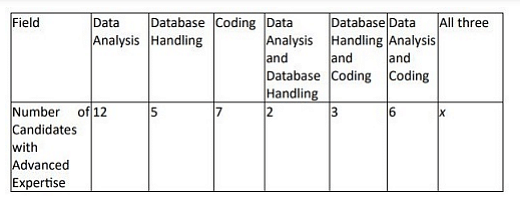
The number of applicants with advanced expertise in all three fields is given as x in the table, where x is a non-negative integer.
- XAT - 2024
- Data Interpretation