Question:medium
A solid trophy, consisting of two parts, has been designed in the following manner: the bottom part is a frustum of a cone with the bottom radius 30 cm, the top radius 20 cm, and height 40 cm, while the top part is a hemisphere with radius 20 cm. Moreover, the flat surface of the hemisphere is the same as the top surface of the frustum.
If the entire trophy is to be gold-plated at the cost of Rs. 40 per square cm, what would the cost for gold-plating be closest to?
A solid trophy, consisting of two parts, has been designed in the following manner: the bottom part is a frustum of a cone with the bottom radius 30 cm, the top radius 20 cm, and height 40 cm, while the top part is a hemisphere with radius 20 cm. Moreover, the flat surface of the hemisphere is the same as the top surface of the frustum.
If the entire trophy is to be gold-plated at the cost of Rs. 40 per square cm, what would the cost for gold-plating be closest to?
Show Hint
For composite shapes, calculate the surface area of each part separately and then sum them up for the total area.
Updated On: Jul 16, 2026
- Rs. 3,60,000
- Rs. 3,72,000
- Rs. 1,12,000
- Rs. 5,23,000
- Rs. 4,73,000
Show Solution
The Correct Option is B
Solution and Explanation
Step 1: Calculate the surface areas of the frustum and hemisphere.
Use the standard formulae to determine the surface area of the frustum and the hemisphere.
Step 2: Sum the surface areas and apply the cost per square cm.
Multiply the combined surface area by the given rate of Rs. 40 per square cm.
Final Answer: \[\boxed{\text{Rs. 3,72,000}}\]
Use the standard formulae to determine the surface area of the frustum and the hemisphere.
Step 2: Sum the surface areas and apply the cost per square cm.
Multiply the combined surface area by the given rate of Rs. 40 per square cm.
Final Answer: \[\boxed{\text{Rs. 3,72,000}}\]
Was this answer helpful?
0
Top Questions on Geometry
- A rectangle \(ABCD\) has sides \(AB = 45 \, \text{cm}\) and \(BC = 26 \, \text{cm}\). Point \(E\) is the midpoint of side \(CD\). Find the radius of the incircle of the triangle \(\triangle AED\).
- CAT - 2024
- Quantitative Aptitude
- Geometry
- The coordinates of the foot of perpendicular from the point \( (2, 3) \) on the line \( y = 3x + 4 \) is given by:
- VITEEE - 2024
- Mathematics
- Geometry
- The points A(4, -2, 1), B(7, -4, 7), C(2, -5, 10), and D(-1, -3, 4) are the vertices of a:
- VITEEE - 2024
- Mathematics
- Geometry
- If A, B, C, D are the angles of a quadrilateral, then \[ \frac{\tan A + \tan B + \tan C + \tan D}{\cot A + \cot B + \cot C + \cot D} = \]
- VITEEE - 2024
- Mathematics
- Geometry
- Want to practice more? Try solving extra ecology questions todayView All Questions
Questions Asked in XAT exam
Applicants have been shortlisted for interviews for some data analyst positions. Some of the applicants have advanced expertise in one or more fields among the following: data analysis, database handling and coding. The numbers of applicants with different advanced expertise are given in the 2 × 8 table below.
The number of applicants with advanced expertise in all three fields is given as x in the table, where x is a non-negative integer.
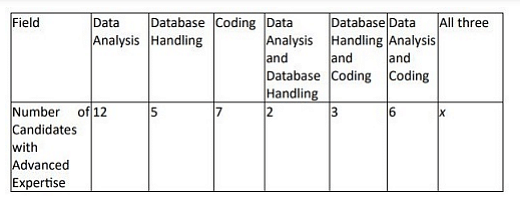
The number of applicants with advanced expertise in all three fields is given as x in the table, where x is a non-negative integer.
- XAT - 2024
- Data Interpretation